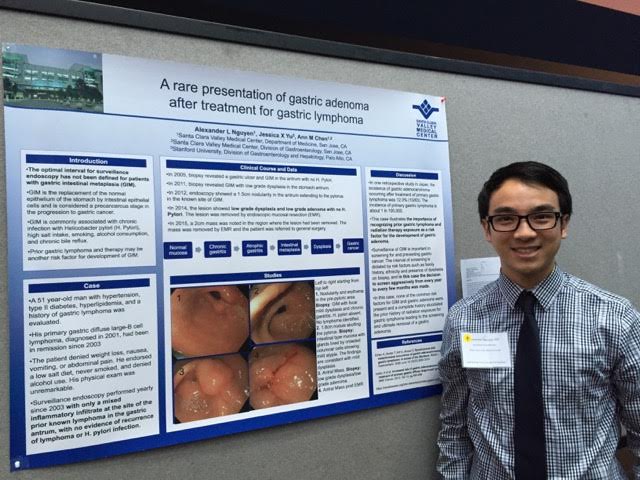
A shout out to our poster presenters and brave Jeopardy Team! It wouldn’t have been possible without all our housestaff who graciously covered our presenters – thank you very much! Saloni, Courtney, and Joe Li advanced to the finals in the poster competition. Three fascinating ID cases (cutaneous blastomycosis, rat bite fever, and pseudallescheria boydii) which is testament to all the cool ID we see here at Valley!

All posts by vmcimchiefs
Morning Report 10/14/15 Obscure Occult and Overt??
Teaching Pearls:
MKSAP Boards Question Review – Bipap has been shown to decrease mortality, decrease need for intubations, and decrease hospital stay in select patients with COPD exacerbations.
- Definitions
- Overt Bleeding – GI bleed that is clinically evident. Hematemesis, hematochezia, melena, etc
- Occult Bleeding – Slow bleed manifested by iron deficiency anemia and/or positive guiac tests
- Obscure Bleeding – Evident GI bleed without clear source of bleed despite standard work-up
- Common etiologies for obscure occult GI bleed
- Angioectasia
- Cameron lesions
- NSAID ulcer
- Malignancy
- Common etiologies for obscure overt GI bleed
- Dieulafoy lesion
- Meckel’s diverticulum
- Angioectasia
- Colonic diverticulum
- Tachycardia suggests blood loss of 15-30%. Patients develop hypotension once blood loss >30%.
- If unable to find source with EGD/colo, next step is to perform EGD and/or colonoscopy again as 30-50% can be identified
- Capsule – can detect lesions without active bleeding. Diagnostic in 50-75% of cases. Only offers diagnostic benefits
- Tagged RBC scan – good sensitivity but poor specificity. Does not offer therapeutic intervention. Ideal for bleeds 0.1-0.5cc/min.
- Angiography – best for overt bleeding (>1cc/min), allows for immediate therapy.
- Chronic Hepatitis B Treatment Goals:
- Treat HBeAg Positive patients if:
- ALT>2xULN
- HBV DNA >20,000IU/ml
- Treat HBeAg Negative patients if:
- ALT>2xULN
- HBV DNA >2,000IU/ml
- Treat HBeAg Positive patients if:
Morning Report 10/13/15: COPD and Acid/Base
Teaching Pearls:
- Only two interventions shown to reduce the progression of COPD: Smoking cessation and supplemental O2
- Stepwise Approach to Acid Base:
- Acidic or Alkalotic?
- Primary Disturbance? Respiratory or Metabolic
- Calculate the Anion Gap
- If Anion Gap present, calculate the Delta Gap
- If metabolic acidosis present, use Winter’s formula to calculate whether there is appropriate respiratory compensation
- For every 10 increase in pCO2, the bicarb should increase by 1 in acute respiratory acidosis and 3.5 in chronic respiratory acidosis
- BIPAP can be used to improve respiratory acidosis, increase pH, decrease risk of intubation, and to reduce the pCO2
- Contraindications of BIPAP include respiratory arrest, CV instability, altered mental status, aspiration risk/significant secretions, nasopharyngeal abnormalities, cranofacial trauma
- Right Bundle Branch Block: Causes include RVH, cor pulmonale, PE, ischemic HD, myocarditis. Look for Broad QRS > 120ms, RSR prime in V1-V3, wide slurred S in the lateral leads V5-V6
Morning Report 10/8/15 West Nile Virus
A special thanks to the ID service for joining us today!
Clinical Pearls:
- Kernig and Brudinski’s sign (thanks to Dan for demonstrating!)
- PRES: Posterior Reversible Encephalopathy Syndrome presents as headaches, confusion, seizures, and visual loss often in the setting of elevated blood pressure. Thought to be secondary to problems in cerebral autoregulation. Associated with immunosuppression, renal failure, eclampsia, hypertension, lupus.
- Obtain a CT scan prior to an LP to evaluate for mass lesions that can cause brain herniation in the following patients:
- Age >60
- Immunocompromised
- History of CNS disease
- Seizure within one week of presentation
- Empiric treatment for suspected bacterial meningitis includes Ceftriaxone (2gm IV q12 for CNS penetration), Vancomycin (resistant Strep pneumonia), and Ampicillin (immunocompromised and elderly patients for Listeria coverage, use Bactrim for penicillin allergies)
- Start IV Acyclovir to cover possible HSV meningitis/encephalitis. HSV-1 is associated with encephalitis while HSV-2 can cause recurrent aseptic meningitis (Mollaret’s meningitis).
- West Nile Virus
- Flavivirus which was first detected in the US in 1999, over 500 cases in California last year
- Asymptomatic in 80% of patients, symptomatic patients present with West Nile Fever (20%) or West Nile Neuroinvasive Disease (<1%)
- Can manifest with acute flaccid paralysis, extrapyramidal signs
- Detection of West Nile Virus IgM antibody in the CSF of symptomatic patients is diagnostic of West Nile Neuroinvasive Disease
- Serologic cross-reactivity with other flaviviruses can cause false-positives (for example recent Yellow Fever vaccination or dengue infection)
- Treatment of WNV is supportive
10/7/15 Simulation Session
Nice work everyone! Thank you to Dr. Friedenberg and Dr. Gohil for running the case.
Some pearls:
- Avoid Air Orders! Designate a “Code Leader” early on and stand at the head of the bed.
- For PEA, start CPR ASAP and go ahead and ask for 1mg of epinephrine
- During codes, make sure to ask for the Past Medical History, Medications, and Allergies.
- Start antibiotics early for neutropenic fever.
- Remember the sepsis core measures! If SBP < 90mmHg and/or MAP <65mmHg, recommend 30ml/kg of IVF bolus.
Intern Report 10/6 – New Onset Heart Failure
Teaching Pearls:
- MKSAP Board Review Question – Thrombotic Thrombocytopenic Purpura (TTP) pentad: thrombocytopenia, microangiopathic hemolytic anemia (presence of schistocytes), renal failure, fever, neurological deficits.
- Need only thrombocytopenia and MAHA (presence of schistocytes) for diagnosis.
- Hematologic emergency. Treatment with plasmapheresis.
- Left ventricular thrombus occurs in up to 10% of patients with post-MI and EF<30%.
- Due to combination effects of blood stasis and replacement of endothelium with fibrotic tissue.
- Diagnosis: Echocardiogram with Definity study
- Treatment involves anticoagulation for 3-6 months
- Etiologies of Heart Failure
- Ischemic
- Hypertensive heart disease
- Valvular disease
- Toxin/drug-induced
- Medication-induced
- Infiltrative disease
- Infectious etiologies
- Stress cardiomyopathy
- Idiopathic
- Presence of low voltage on EKG suggestive of tissue, air, or fluid surrounding the heart. Ex: obesity, pericardial effusion, etc.
- Isolated Q wave can be present in lead III in a normal heart.
- NT pro-BNP is primarily used as a helpful adjunct in distinguishing between heart failure and other etiologies of dyspnea. However if your patient clearly is coming in with symptoms of heart failure, it is not necessary to order it.
- FREEDOM Trial
- In patients with 3V disease, left main disease, and 2V disease with DM, CABG has demonstrated better clinical outcomes in CV mortality and MI compared to PCI.
- Increased risk of stroke seen with CABG vs PCI.
10/5/15 Morning Report DIC versus TTP
– Clinical presentation of platelet disorders vs factor disorder. Epistaxis and petechiae are more suggestive of platelet disorders. Factor deficiency is usually associated with larger bleeds such as hemoarthrosis.
– Palpable purpura….think Leukocytoclastic Vasculitis.
– Thrombocytopenia Framework: Decreased production, increased breakdown, sequestration, dilutional
– Treatment for APL is ATRA. Remember to consider ATRA differentiation syndrome which can present with pleural effusions, edema, shortness of breath, and fever. Treat ATRA differentiation syndrome with Prednisone.
– Causes of MAHA: DIC, TTP/HUS, malignant hypertension, mechanical valves, HELLP/Pre-eclampsia, Scleroderma renal crisis
– It is important to distinguish between TTP and DIC because the treatment is different. DIC – treat the underlying cause and supportive care. TTP – treat with Plasmapharesis.
| TTP | DIC | |
| Thrombocytopenia | x | x |
| Fibrin Degradation Products | x | |
| Elevated D-Dimer | x | |
| Low Fibrinogen | x | |
| Elevated LDH | x | x |
| Elevated PT and PTT | x | |
| MAHA/Schistocytes | x | x |
| ADAMTS13 | x | |
| Leukopenia | x |
Morning Report 9/30/15 – Multiple Sclerosis
Teaching Pearls:
- Cardiac Resynchronization Therapy (Biventricular pacemaker + AICD) can reduce mortality in patients on optimal heart failure medications with left ventricular ejection fraction of 35% or below, New York Heart Association functional class III or IV heart failure, and a QRS interval of 120 msec or greater.
- INO (Intranuclear ophthalmoplegia): Defect in the medial longitudinal fasciculus causing a problem with adduction of opposite eye and nystagmus on the ipsilateral eye.
- Lhermitte’s sign – shocking sensation down the neck to the body upon flexion of the neck.
- Dysdiadochokinesia- Inability for bilateral fast repetitive motion. Suggestive of cerebellar pathology.
- Scanning speech – “staccato speech”. Ataxic dysarthria. Words are broken up into several syllables, often separated by noticeable pauses
- Optic Neuritis – presents with pain with eye movements, blurry vision, mononuclear blindness, or pupillary defects. Afferent pupillary defects.
- Illness Script for MS: Young women with neurologic symptoms separated in time and space. Demyelinating plaques found in CNS white matter – ovoid-appearing demyelinating plaques that radiate from corpus callosum (Dawson’s fingers). Central (not peripheral) CNS disease.
- Uhthoff phenomenon: worsening of symptoms in heat, affects nerve conduction
- Treatment for acute MS flare: Solumedrol 1g x 3-5 days, prednisone therapy taper 10-14 days, begin immuno-modulating therapy with either Interferon- beta or Glatiramir.
Illness Scripts:
| Epidemiology | Timing | Neuro/Specific Factors | |
| Multiple Sclerosis | Female, 20-40 yearsF:M 3:1, most common non-traumatic neurologic disease | Subacute | Separated in time and spaceRelapsing-Remitting (85%)
1⁰ Progressive 2⁰ Progressive |
| Neuromyelitis Optica | F:M 10:1 | Days/Acute | Bilateral Optic Neuritis, Associated Transverse MyelitisNo plaques in the brain |
| Transverse Myelitis | Children, Young AdultsBimodal Distribution
Viral illness preceeding |
Acute | Bilateral weakness before a spinal segment, upper motor signs, bladder/bowel dysfunction |
| ADEM | Children/Young AdultsPreceeding illness 1-3 weeks prior | Acute | Distinguishing characteristics: encephalopathy, fevers, headache |
Morning Report 9/29/15 Heart Failure
Morning Report 9/28/15 – Hypertensive Urgency/Emergency
Teaching Pearls:
- Distinguish whether elevated blood pressure is secondary to other etiologies, including brain bleed, aortic dissection, drug use, etc
- Hypertensive emergency/urgency is a diagnosis of exclusion. Defined as very high blood pressure with active end organ damage. End-organ damage includes:
- Acute encephalopathy
- Pulmonary edema
- Aortic dissection
- Cushing’s Reflex: Hypertension, Bradycardia, and Respiratory variation.
- In LVH, you can commonly see T wave inversions along lateral leads due to repolarization abnormalities.
- Hypokalemia, Metabolic Alkalosis, Hypertension –> consider hyperaldosteronism, bilateral renal artery stenosis, or Cushing’s syndrome. Check Renin and Aldosterone levels:
- Elevated Renin/Elevated Aldosterone –> bilateral renal artery stenosis
- Low Renin, Elevated Aldosterone –> Conn’s syndrome
- Low Renin, Low Aldosterone –> Consider Cushing’s syndrome as corticosteroids can still bind to mineralocorticoid receptors.
- Treatment for Hypertensive emergency: Decrease of blood pressure 10-20% within the first hour. Then 5-15% for the next 23 hours. No more than 25% within the first 24 hours to prevent hypoperfusion.
- Two exceptions are acute CVA and aortic dissection.
- Acute CVA – no need to treat unless BP>185/110 with consideration of tPA, or BP>220/120
- Aortic Dissection – Important to treat aggressively to goal SBP 100-120. Use beta blockers.
- Medications For Treatment
- Nitroglycerin gtt, Nitroprusside (fast onset, short half life, risk factors for cyanide toxicity include AKI, increased infusion rate)
- Beta Blockers – Labetalol or esmolol
- Calcium Channel Blockers – Nicardipine