Category Archives: Morning Report

TRALI vs TACO

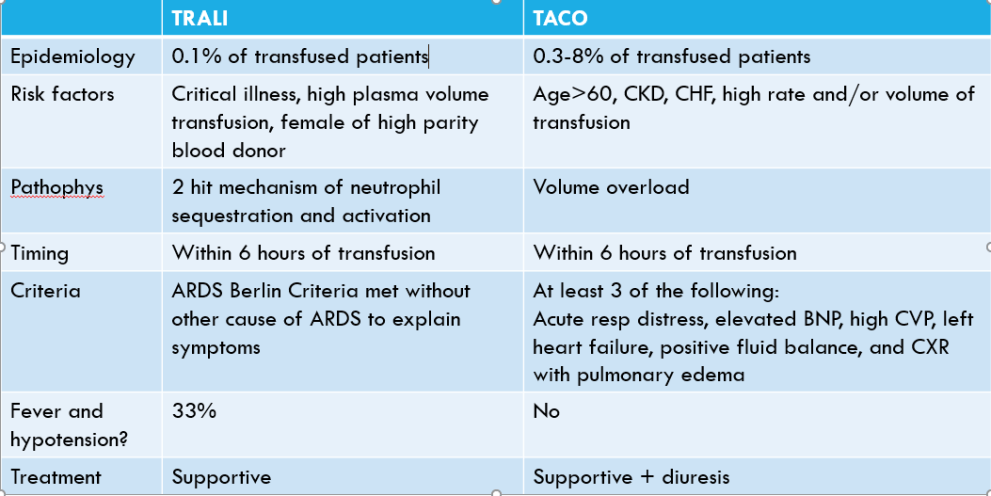
Yesterday, we discussed transfusion reactions and went through the difference between TRALI and TACO, which can both cause respiratory distress within 6 hours of a blood transfusion, but are very different entities. Here’s a handy table to help you remember the differences:

Capture

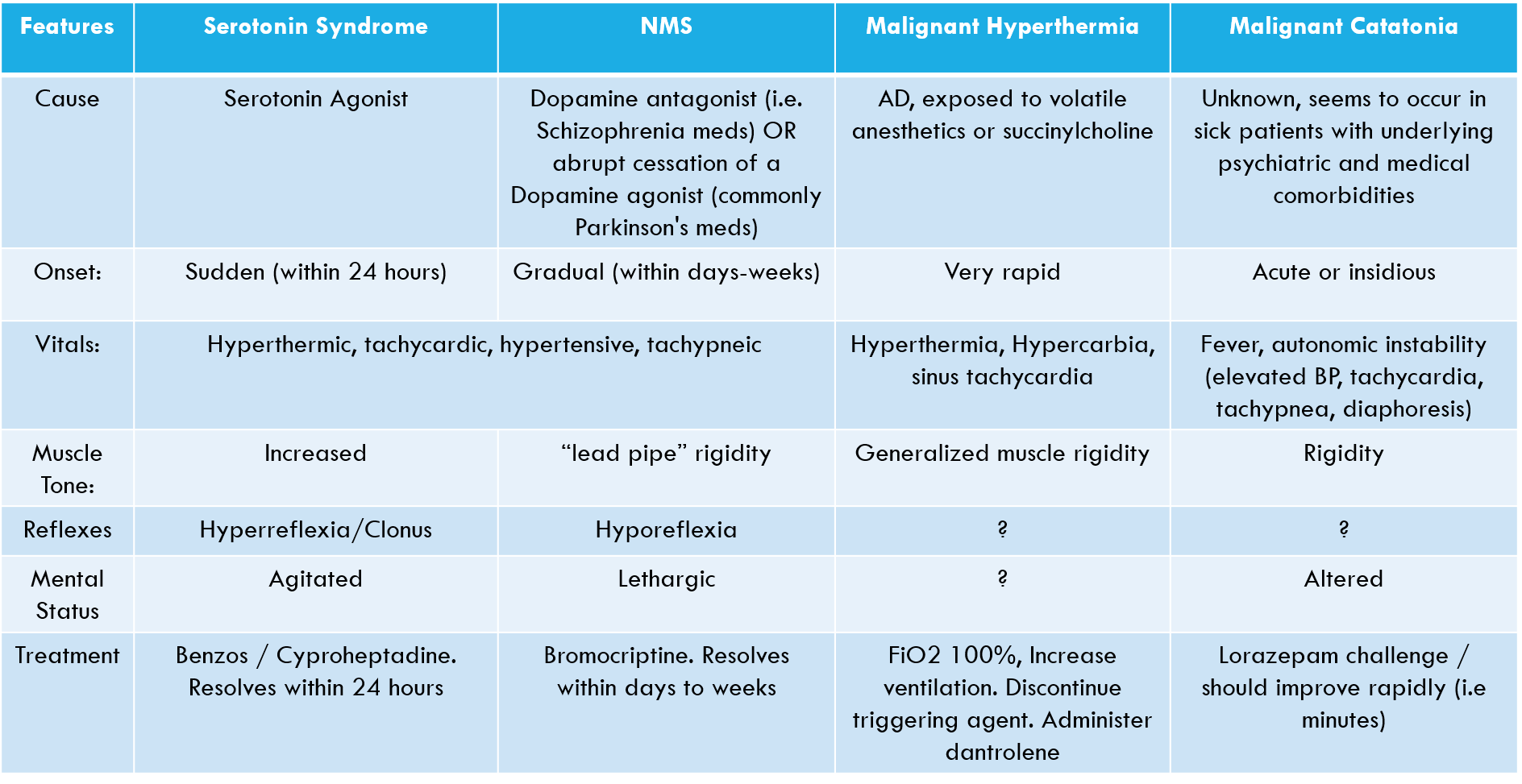
Hyperthermia – What You NEED to Know

Fever DDx (MISO!)

  • Malignancy/Infection/Systemic Vascular/Other

Hypertheremia DDx (NEED!)

  • Neurologic/Endocrine/Environmental/Drugs

In clinical practice, impossible to tell the difference between fever (raising of the body’s set point) and hypertheremia (failure of thermoregulation)

hyperthermia.png

*Sincere thanks to Dr. Julie Lee for correcting a critical error in the table!

COVID Updates – Part Deux

Today we discussed a variety of topics, and most excitingly, revealed that our inpatient anti-infective therapy guideline is now published on HHSConnect on the ASP page.

Same disclaimer applies: we have no direct clinical experience dealing with COVID+ patients and information has been taken from a variety of excellent resources as listed in the prior post. We make no claims for originality!

Pathophysiology and Stages of COVID

This is key folks. There seems to be a early viral replication phase, followed by a later dysregulated inflammatory response phase marked by ARDS and a cytokine storm. In the early phase, antiviral therapy may be much more helpful than delayed initiation. Once the late phase has arrived the mainstay of treatment will likely be immune-modulating agents (anti-IL6 agents and steroids..more on this later.

Modes of Transmission of COVID

  • Droplet (main)
  • Airborne
  • Contact

Yes, you read that correctly. There is evidence that aerosolization does occur and therefore in our hospital, we use a N95/face shield for all PUIs and confirmed patients – a move we strongly believe will improve the safety of our healthcare workers (HCWs)

https://www.nejm.org/doi/full/10.1056/NEJMc2004973

  • Air – 3 hours
  • Copper – 4 hours
  • Cardboard 24 hours
  • Stainless steel – 2-3 days
  • Plastic – 3 days [we should all be cleaning our work surfaces as frequently as possible]

Airway Management Prior to Intubation

  • Goal SpO2 92-96% when on supplemental O2
  • In our institution, O2 may be escalated to NRB at 6LPM, after which ICU should be consulted for ‘refractory’ hypoxia when the SpO2 <92%
  • Our hospital discourages HFNC/NIPPV due to aerosolization risk and encourages early intubation, a position consistent with many other organizations, including MGH
  • We discussed the data from SARS however that there is no definitive evidence that HFNC places HCWs at increased risk, and in fact, the act of intubation is linked with increased risk of HCWs.
  • The six risk factors that placed HCW at highest risk for contracting SARS were:
    • minimum distance between beds of 1 m
    • availability of washing or changing facilities for staff
    • whether resuscitation was ever performed in the ward
    • whether staff members worked while experiencing symptoms
    • whether any host patients required oxygen therapy [of any kind]
    • whether any host patients required bi-level positive airway pressure ventilation
  • SCCM position – “For adults with COVID-19 and acute hypoxemic respiratory failure despite conventional oxygen therapy, we suggest using HFNC over conventional oxygen therapy”
  • ANZICS position –“High flow nasal oxygen (HFNO) therapy (in ICU): HFNO is a recommended therapy for hypoxia associated with COVID-19 disease, as long as staff are wearing optimal airborne PPE. The risk of airborne transmission to staff is low with well fitted newer HFNO systems when optimal PPE and other infection control precautions are being used. Negative pressure rooms are preferable for patients receiving HFNO therapy.”
  • In summary, while early intubation is the official policy of our institution, I would not be surprised if during a surge, HFNC may be used to prevent intubation and protect a scarce resource for those who need it the most
  • Once your O2 <92% on 6L O2 – for now, call your consultant for likely early intubation

Sources:

a. ‘Why Did Outbreaks of Severe Acute Respiratory Syndrome Occur in Some hospital Wards But Not in Others – Yu et al in Clinical Infectious Diseases 2007

b. Risk Factors for SARS Transmission from Patients Requiring Intubation: A Multicentre Investigation in Toronto, Canada – PLOS1 2010

Pharmacological Therapies

  • Hydroxychloroquine + Azithromycin – Marseille Study – Gautret et al
    • Tiny study of 20 patients in France found that on Day 6, Tx group individuals showed a much lower than average PCR positive compared to untreated controls
    • This effect was magnified by the addition of Azithromycin
    • Reasonable dosing is currently HCQ 400 BID x 1 day, followed by 200mg q12rs x 5 – 10 days. Azithromycin is 500mg x 1d followed by 250mg daily
    • There is a long list of contraindications, including QT prolongation to be aware of and G6PD deficiency for HCQ
    • https://www.mediterranee-infection.com/wp-content/uploads/2020/03/Hydroxychloroquine_final_DOI_IJAA.pdf
    • Who Should Get It?
      • Our ASP guideline states those with moderate-severe COVID SHOULD receive it while PUIs who are deteriorating quickly should also receive it
  • Remdesivir
    • antiviral drug developed as a treatment for Ebola and Warburg virus
    • Gilead suspended compassionate use and restricted it to clinical trial use only so we will withhold discussing this for now
  • Lopinavir+Ritonavir
  • Anti-IL6 Therapy – Tocilizumab
    • During a potential cytokine storm, this medication may be crucial, but studies are underway
  • Steroids – Consider Giving During Dysregulated Immune/ARDS Phase
    • Controversial, as early use thought to increase viral shedding – but my personal opinion is consistent with one of our ICU doctors,  that there is evidence for its use in critically ill patients [i.e in the later phase once ARDS develops
    • Other guidelines state to withhold unless other indication for steroid develops but this is not consistent with strong evidence from the following study that showed a significant survival benefit to acutely ill patients who did receive methylprednisolone
    • https://jamanetwork.com/journals/jamainternalmedicine/fullarticle/2763184
  • ACEi/ARBs – Continue!
    • There is concern that ACEi/ARB use association with increase in expression of ACE2, which is the binding site of the virus BUT it is unknown what exactly that finding means and the European Society of Cardiology issues an extremely strongly worded statement that in the absence of any evidence that it actually leads to acquisition/transmission of the virus, that patients should continue their RAAS inhibition
    • In fact, some have even postulated an anti-inflammatory benefit
    • Bottom lines – insufficient evidence and no one knows
  • NSAIDs – No conclusive evidence
    • A variety of mechanisms have been postulated, WHO states insufficient evidence to recommend discontinuation
  • Fluids – AVOID excessive administration

That’s all for now, much of what was said will likely change. Thank you all for your incredible dedication to each other and to our patients. You all are heroes and I am so proud of you.


COVID 19 Updates

Today, Dr. Hakim is presenting a case of COVID-19 infection. We wanted to take this opportunity to give a general overview of COVID-19 and the available data. Just a quick disclaimer: we have extremely limited clinical experience in the treatment of COVID-19 and the following information is collected from various resources and articles. We anticipate that the details of COVID-19 will continue changing rapidly and the information here may become out of date very quickly.

ILLNESS SCRIPT:

Epidemiology: Median age is 47, slight male predominance (41.9% are female)

Symptoms and Signs of COVID-19: There are 7-9 large studies documenting signs and symptoms of COVID-19 infection with most data coming from China. The largest study, recently published in NEJM: Clinical Characteristics of Coronavirus Disease 2019 in China- W. Guan, Z. Ni, Yu Hu, et al. 

The most common symptoms of COVID-19 are fever and cough. These symptoms may not be present on admission. 

Systemic symptoms: Fever, fatigue, myalgias, anorexia, dizziness, headache

Respiratory symptoms: Dry cough, dyspnea, expectoration, pharyngalgia

GI symptoms: Diarrhea, nausea, vomiting, and abdominal pain

Capture

***There is no reliable way to distinguish influenza, other viral respiratory infections, and COVID-19 by symptoms alone. 

Incubation Period: median of 4 days, range up to 14 days

Lab Findings: White blood cell counts can vary!! Leukocytosis and leukopenia are reported.

  • Lymphopenia (absolute lymphocyte count <0.8) is the most common finding, but is extremely nonspecific as it occurs in many viral infections
  • Elevated LDH (>245), ferritin (>300), AST/ALT, troponin, and D-dimer (>1000) have all been reported
  • Procalcitonin is not elevated in most patients with COVID19 according to the Guan et al study cited above

Imaging: 

  • CXR may show infiltrates, but it really depends on the degree of respiratory symptoms
  • Chest CT most commonly shows bilateral peripheral ground-glass opacities (GGOs), and “crazy paving” in some instances
    • “Crazy paving”= GGOs with superimposed septal thickening
  • Imaging is NOT specific, but can add to your clinical picture and rule out non-pneumonia etiologies of respiratory distress

Diagnosis here at SCVMC:

  • ALL persons under investigation (PUIs) for COVID should be on airborne and contact precautions
  • Order Flu/RSV reflex to SARS-CoV2
  • Always notify Dr. Stephanie Chan and Dr. Jen Eng when COVID testing is sent via SecureChat message
  • If your patient is high risk or will need aerosolizing procedures (nebulized medications, sputum induction, open suctioning of airways, BIPAP/CPAP, HFNC, intubation, bronchoscopy), they should be admitted to a negative pressure room

Sensitivity and Specificity of Testing:

  • Sicker patients are thought to have higher viral loads and are more likely to have positive test results
  • Sensitivity is thought to be around 75% for swab PCR testing and there is evidence that CT scan may show disease sooner than PCR positivity. BAL has higher sensitivity than swab testing.
  • Repeat testing can be performed if necessary

Coinfection:

  • In China, the coinfection rate with COVID-19 and other viruses was thought to be low (1-5%), but data from Stanford University, show that >20% of patients had a coinfection with another virus

Key Resources for further COVID-19 Information:

UpToDate COVID19 article

EMCrit- Internet Book of Critical Care

MedCram.com COVID videos

Acid-Base Simplified

Today we discussed an complicated case of acid base disturbances that our house staff breezed through. Simi presented a young man with acute epigastric pain and emesis after copious alcohol ingestion. It looked like a case of alcohol-induced pancreatitis or gastritis, but his metabolic panel threw everyone for a loop.

Capture

Go through the labs on your own and try to find an explain all the acid-base disturbances.

Here is our suggested method for acid-base learning:

  1. Is the patient acidemic or alkalemic ? A.k.a. is their pH above or below 7.4
  2. What is the primary disorder? Is the bicarb or the pCO2 driving the acidemia /alkalemia?
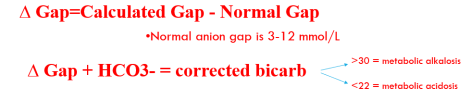
  3. What is the anion gap? Anion Gap = (Na+) – (Cl- + HCO3-). If there is an anion gap present, there is a concurrent anion gap metabolic acidosis. 
  4. Is there another metabolic disorder? In this case, do the delta gap and use it to correct the bicarb. If the corrected Capture

In this case, the patient is alkalemic and the primary disorder is a respiratory alkalosis because the pCO2 is low and the bicarb is normal. Physiologically, the pCO2 is not the main driver of the process, but we pick it as the primary disorder for the sake of our problem solving shchema. The anion gap is 30 in this patient so there is a concurrent anion gap metabolic acidosis. The delta gap is 18 so the corrected bicarb is 43, which is over 30 so there is a concurrent metabolic alkalosis. 

The patient’s disorders were likely multifactorial. Lactate was 10 and urinalysis showed trace ketones so AGMA was likely a result of alcohol-induced lactic acidosis with starvation/alcoholic ketoacidosis. The metabolic alkalosis was likely due to both contraction and excessive vomiting. The respiratory alkalosis was likely due to severe epigastric pain and anxiety from alcohol withdrawal.

Karl Friedrick Von Ludwig’s Angina

Today we discussed a case of deep neck space infection! Our patient was a middle-aged man with diabetes and poor oral hygiene who presented with right facial pain and swelling with stiff neck and trismus after seeing his dentist for a tooth infection.

We commonly see patients complaining of tooth aches or sore throats before diagnosing them with pharyngitis or dental caries, but how can we know when to suspect a deeper infection??

Signs and Symptoms that should make you think of deep neck space infection:

  • Trismus (inability to open the mouth fully)
  • Drooling
  • Muffled voice (“hot potato voice”)
  • Neck swelling or swelling of the floor of the mouth
  • Bulging of the pharyngeal wall, soft palate, or floor of the oropharynx
  • Neck pain or stiffness, torticollis
  • Crepitus
  • Respiratory distress: stridor, tripoding, cyanosis

When evaluating a patient with dental complaints, especially if any signs or symptoms of infection are present, it is VERY important to palpate the floor of the mouth for any tenderness or swelling. Over 70% of Ludwig’s angina cases are due to dental infections (most commonly the molars) and if we do not palpate the floor of the mouth, we may assume symptoms are due solely to dental problems. Ludwig’s angina is an infection of the submandibular space that is rapidly progressive and life threatening.  

On physical exam, you should feel a bilateral, tense edema of the floor of the mouth with possible neck swelling and tenderness usually without lymphadenopathy. Buzz words for this condition are “woody” or “brawny” cellulitis, similar to necrotizing fasciitis. Our patient exhibited 1cm trismus, poor dentition with many dental caries, fullness and tenderness to palpation in the floor of the mouth, as well as neck tenderness and swelling.

Initial evaluation should include rapid and thorough assessment of respiratory status, including asking about respiratory distress at night because these patients often occlude their airway when laying down. Some cases of Ludwig’s angina do not require intubation and can be managed with IV antibiotics and close monitoring in the ICU. However, any signs of respiratory distress should prompt immediate intubation as this can progress rapidly to airway occlusion. Fibreoptic nasotracheal intubation is preferred, often awake and upright, due to the risk of laryngospasm with oral intubation. Whenever intubating a patient with Ludwig’s angina, all preparations for a possible surgical airway should be made in advance due to the often difficult nature of these intubations. Anesthesia and ENT should be consulted emergently whenever Ludwig’s angina is suspected. These patients should always be admitted to the intensive care unit. Although controversial, many otolaryngologists recommend IV glucocorticoid use to decrease airway edema in the emergent period.

The condition is usually polymicrobial with a variety of oral flora, but when an agent is identified, Group A strep is most prevalent. Empiric coverage should consist of gram positive, gram negative, and anaerobic coverage. Unasyn is the drug of choice empirically, but if any MRSA risk factors are present, vancomycin should be added. These risk factors include IVDU, diabetes, ESRD on HD, residence in long-term care facility, hospitalization in the past year). If the patient is septic and at risk of rapid deterioration, MRSA coverage should be included regardless of risk factors. Pseudomonal coverage should be added for any immunocompromised patients. 

The diagnosis of Ludwig’s angina is clinical, but imaging (CT with contrast) may be performed to rule out abscess and determine the need for surgical drainage. This conditions usually does not include focal purulent collections, but is more typical of an aggressive nonpurulent cellulitis with diffuse infection so surgery is not always indicated.

When extubating these patients, throughout evaluation of airway patency must be performed, often including laryngoscopy prior to extubation and extubating over a guidewire.

Why did Ludwig name it “angina”???

Traditionally, we use angina to describe chest pain of cardiac origin. However, the word comes from the Latin angere and Gree ankhone, which mean choke and strangle. Before the discovery of penicillin, the mortality of Ludwig’s angina was over 50%, many due to asphyxiation.

Thyrotoxic Periodic Paralysis

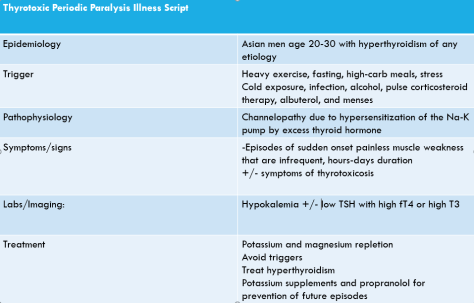
Yesterday we discussed a classic case of thyrotoxic periodic paralysis…. with a twist. Our patient was a young male of Asian descent with a history of Grave’s disease who fasted for routine lab tests, then ate a high carbohydrate meal, and developed acute lower extremity weakness. His presentation illustrates a classic case of the disease:

Capture

However, his case was slightly atypical because he recently underwent a radioiodine ablation to treat his Grave’s disease and his free T4 and T3 levels were actually normal. Cases of TPP have been reported after radioiodine ablation, thought to be due to a transient hyperthyroid state after ablation. An oral glucocorticoid taper prescribed to decrease chance of worsening Grave’s ophthalmopathy after ablation may have also contributed to his development of TPP.

Treatment consists of potassium replacement. A regimen of 30mEq PO KCl Q2h until improvement begins with a max dose of 90mEq in 24h. This regimen may seem cautious as many of these patients present with potassium levels of less than 2, but they are prone to potassium over-correction so cautious repletion is wise.

The Clots That Traveled Far and Distal

Today we discussed a case of an elderly gentleman who presented for AKI 5 weeks after a FEVAR with bilateral renal artery stent placement for a 6.5cm juxtarenal AAA.

We first reviewed the major risk factors for AAA:

  • elderly age, male
  • smokers
  • connective tissue disease

We then reviewed the USPSTF recommendation for AAA screening, which is one-time screening of all male patients 65-75 with any smoking history

We discussed indications for AAA repair

  • Ruptured -> emergent repair (endovascular management is a possibility)
    • Severe pain, hypotension and pulsatile abdominal mass in 50% of patients
    • Often misdiagnosed as renal colic, diverticulitis, GI hemorrhage, ischemic bowel
  • Symptomatic of any size or configuration who do not have a prohibitive surgical risk for repair should be urgent AAA repair
    • Abdominal pain, flank pain, limb ischemia, systemic manifestations such as fever or malaise
  • Asymptomatic infrarenal AAA <5.5cm = conservative
  • Asymptomatic AAA >5.5cm OR rapid expansion OR co-existing PAD OR female gender = elective repair
  • Asymptomatic AAA > 5.5cm with life expectancy <2 years, no repair

We then started reviewing the case, and quickly found out that this patient’s prior hospitalization was notable for livedo reticularis, blue toe syndrome and ischemic colitis. His discharge Cr was roughly stable and it was only 3 weeks later that he started having a significant rise in the Cr. His urine revealed no RBCs, a single eosinophil and no casts. A CT abdomen/pelvis without contrast revealed no stent migration or kinks and a renal duplex US revealed patent flow.

Nephrology reviewed all the data and were confident in their diagnosis: renal atheroemboli. Here’s what you need to know:

  • Vast majority will be iatrogenic, so look for a precipitating event such as angiography, lytic therapy or cardiovascular surgery
  • Look for subacute kidney injury (peaking 3-8 weeks after the event) and signs of extrarenal embolization (GI bleeding, focal neurologic deficits, blue toe syndrome, livedo reticularis
  • Eosinophilia, Eosinophiluria and Hypocomplementemia may all suggest atheroemboly
  • No proven effective medical therapy in patients with atheroembolic renal disease and management is supportive as well as considering how to prevent further embolization
  • Prognosis is generally poor, as many will have a stepwise decline in their renal function due to scarring as well as new embolic events and up to 1/3 may require renal replacement therapy


2nd Degree Heart Block Dissected

Today we went over the case of an elderly man with episodes of lightheadedness for one month who was found to have 2nd degree AV block on EKG in the ED (with old LBBB as well). Capture

EKG Criteria for AV blocks:

1st degree: PR prolongation (>200msec)

2nd degree Mobitz I: Wenckebach, progressively prolonging PR interval followed by a “dropped beat,” or nonconducted p wave

2nd degree Mobitz II: constantly prolonged PR followed by a “dropped beat,” or nonconducted p wave

3rd degree or complete: complete AV dissociation between p waves and QRS’s

As you move from 1st toward 3rd degree, the block is more clinically severe, more likely to need treatment, and more symptomatic. Anatomically as you move from first to third, the block becomes more distal in the conduction system.

2:1 Second Degree AV Block: Is it Mobitz 1 or Mobitz II?

In the above EKG, we see a 2:1 second degree AV block, which means that every other p wave is conducted. This does not allow us to see the progression of the PR interval. How are we to know if it is prolonging (Mobitz I) or constant (Mobitz II)? There are 4 ways to help answer this question:

  1. Look at the company it keeps. If you see periods of 3:2 in your patient’s telemetry, the 2:1 block you see on your EKG is likely the same type of block as the periods of 3:2.
  2. If the PR is >300msec or the QRS is narrow, your block is more likely to be Mobitz I (higher up the conduction system in origin).
  3. Give atropine! If the AV nodal conduction is enhanced (less frequent nonconducted p waves), your block is likely Mobitz I. If there is no response, your block is likely Mobitz II.
  4. Carotid sinus massage: This increases vagal tone, which will increase the blockade in Mobitz I, but improve conduction in Mobitz II by allowing more time for excitability to return to the bundle of His.