Category Archives: Morning Report

THE Dermatologic Emergency: SJS/TEN

On January 29th, our very own PGY-2 Hong Le, presented a case of the most well-known dermatologic emergency for our review: an elderly gentleman recently started on antibiotics for a urinary tract infection presents with a full body painful rash.

SJS and TEN are a spectrum of disease, TEN being more severe and SJS less severe. TEN covers >30% of total body surface area and SJS covers <10%. If between 10 and 30 percent of TBSA is covered by the rash, it is termed SJS/TEN overlap syndrome. A good way to estimate body surface area is to use the area of your hand as an estimate of 1%. 

Capturesure SJS/TEN is provoked by exposure to an inciting drug. Complete lists of drugs with reported association with this condition can be found online, but the most notable categories include allopurinol, antiepileptics, antibacterial sulfas, nevirapine (NNRTI), and NSAIDs ending in “-oxicam.” Patients with HIV have a particularly increased risk of developing SJS/TEN. The typical exposure period before reaction is 4 days to 4 weeks, but risk continued for 8 weeks after treatment with a new drug. 

The classic description and progression of SJS/TEN on physical exam are as follows. First, a flu-like prodrome may occur (malaise, myalgias, arthralgias, and fever) 1-3 days before the onset of rash. When the rash begins, it is extremely painful, ill-defined, coalescing macules with purpuric centers on the face and thorax that spread diffusely and symmetrically. These lesions are typically termed “dusky.” It usually spares the scalp, palms, and soles. Soon vesicles and bullae form and within days, the skin sloughs. Mucosal surfaces are involved in >90% of patients, which may cause symptoms such as photophobia, conjunctival itching/burning, odynophagia, dysuria, and painful defecation. Nikolsky sign is positive in these patients (the skin sloughs when tangential pressure is applied). Other diseases with a positive Nikolsky sign include pemphigus vulgaris and staphylococcal scalded skin syndrome. The “wet newspaper sign” is also classic for SJS/TEN, the shiny and lighter tone of exposed skin after a layer of affected epidermis sloughs off. The SCORTEN score can be used to determine prognosis and severity of the condition. 

Treating SJS/TEN is mainly supportive, including removing the offending agent, IV fluids, wound care, nutrition, and electrolyte repletion, but a multidisciplinary approach is necessary. Consults to dermatology, burn surgery, ophthalmology, OBGYN for a vaginal exam if the patient is female, and possible urology consult for males should occur immediately. High suspicion for infection and low threshold to start antibiotics are also beneficial.

There are multiple adjunctive treatments your dermatology consultants may recommend, but additional research is needed on most of them. Cyclosporine, anti-TNF drugs, steroids, IVIG, and plasmapheresis are a few of them.

Bilateral Lower Extremity Weakness

On January 28th, our wonderful PGY-1 Rainy Zhang presented a very interesting case of a young woman with a history of cancer presented with bilateral lower extremity weakness and numbness with hyperreflexia of the lower extremities concerning for spinal cord compression. Fortunately, the patient’s MRI spine did not show any pathology and her symptoms resolved within hours, indicating a likely somatic symptom disorder.

Here is a useful tidbit from our discussion:

Capture


HRS Type 1 and when to use a FENa

On January 15th, our amazing PGY2 Simi Sharma presented a case of a middle-aged man with alcoholic cirrhosis presented with decreased urine output, worsening leg swelling, and shortness of breath for one day. His labs revealed acute renal failure with a Cr of 5.8, up from a baseline of 1.2 only weeks before. Urinalysis did not show pyuria and only had 4 RBCs after Foley catheter placement, 11-20 granular casts were noted.

For this patient, getting urine electrolytes (Urine Cr, sodium, +/- urea) can be a valuable next step in finding the etiology of his acute renal failure. However, FENa calculations tend to be overused to determine the cause of AKI in hospitalized patients.

In order to use FENa (fractional excretion of sodium) to determine the cause of AKI, your patient should be oliguric without underlying CKD and NOT be on diuretics.

If your patient is not oliguric, FENa is not reliable to differentiate between prerenal AKI and ATN. In adults, oliguria is defined as a urine output of <0.5mL/kg/h or <300mL of urine per 24 hours.

If your patient has CKD, their sodium excretion may be enhanced or impaired to an unpredictable degree. Therefore, FENa may not be accurate.

If your patient is on diuretics, their sodium excretion will be increased regardless of the etiology of their kidney injury. FEUrea is a better way to distinguish between prerenal AKI and ATN in these patients. However, urine sodium should still be measured as an indication of hydration (if the urine sodium is low despite diuretics, they are likely very volume down).

The FENa should only be used to differentiate between prerenal AKI and ATN. It cannot exclude other causes of intrinsic kidney disease (glomerulonephritides etc) or postrenal kidney disease. Many causes of intrinsic AKI may have a FENa that looks prerenal. 

Hepatorenal Syndrome:

Hepatorenal syndrome is acute renal failure without other etiology in a patient with advanced cirrhosis and portal hypertension. It is essentially a diagnosis of exclusion. Their urinalysis should be bland, they should not be in shock or have an infection such as SBP, and they should not be on nephrotoxic drugs. Prerenal AKI should be excluded by volume expansion via albumin infusion 1g/kg body weight per day. If Cr rises despite this and other etiologies are excluded, HRS can be diagnosed.

HRS is classified in two different types. Type 1 HRS is rapidly progressive and defined by at least a twofold increase in serum Cr to a level of >2.5 during a period of less than 2 weeks. Type 2 HRS is any lesser degree of renal impairment.

Treatment of HRS type 1 includes ICU admission, octreotide infusion, and vasopressor support (usually norepinephrine in type 1 HRS) with continued albumin infusion of 25-50g/d until octreotide and pressors are discontinued. Treatment is continued for a total of 2 weeks. If there is some, but not total improvement in renal function, treatment duration may be extended, but if no improvement is noted, treatment is likely futile and prognosis is very poor. Hemodialysis can sometimes be used as a bridge to liver transplant or when there is a possibility of improvement in liver function, and therefore renal function, such as in potentially reversible causes of renal failure like Tylenol overdose.

However, if there is no possibility of listing a patient for liver transplant, HRS type 1 carries an 84% mortality at 6 months. For all patients with HRS type 1, palliative care and end of life discussions should be strongly considered. 

Tumor Lysis Syndrome

Today, Dr. Adrian Garcia presented an interesting case of tumor lysis syndrome in a patient with uncontrolled CML

Tumor lysis syndrome is a constellation of lab abnormalities caused my massive tumor cell lysis and is considered an oncologic emergency.  Classically, it presents soon after the initiation of cytotoxic therapy, but spontaneous TLS can also occur (usually in hematologic malignancies including leukemia and lymphoma).

It’s symptoms are nonspecific, but can include constitutional symptoms (anorexia, lethargy, nausea), symptoms of nephrolithiasis (hematuria, flank pain), and consequences of electrolyte abnormalities (heart failure, arrhythmias, seizures, muscle cramps, tetany, syncope, and sudden death). Lab findings include the following:

  • Byproducts of cell-lysis:
    • Hyperphosphatemia
    • Hyperkalemia
    • Hyperuricemia (nucleic acids are broken down into uric acid)
  • Secondary hypocalcemia caused by hyperphosphatemia
  • Acute kidney injury due to nephrolithiasis from uric acid and calcium phosphate stones

The treatment of tumor lysis syndrome includes:

  • High-volume normal saline with a loop diuretic to wash out renal crystals
  • Electrolyte correction:
    • Rasburicase for hyperuricemia
    • Phosphate binders for hyperphosphatemia
    • Hyperkalemia treatment: Kayexalate, insulin/D50, bicarb, albuterol, calcium gluconate if EKG changes
    • Do not treat hypocalcemia unless symptomatic due to increased risk of calcium phosphate precipitation in the renal tubules
  • Indications for hemodialysis:
    • severe oliguria or anuria
    • intractable fluid overload
    • persistent hyperkalemia
    • hyperphosphatemia-induced symptomatic hypocalcemia
    • calcium-phosphate product >= 70

Thanks so much for following along with our interesting cases.

The Octopus’ Trap

Today Dr. Anu Madhavan presented a very interesting case of a middle-aged woman with no cardiac risk factors and no cardiac history who presented with substernal chest pain after experiencing a fire at her workplace. Her troponin was elevated and EKG showed left anterior fascicular block and lateral T wave inversions. She was initially treated with aspirin, high-intensity statin, and heparin drip, but transthoracic echo soon revealed pronounced apical ballooning suggestive of Takotsubo’s cardiomyopathy.

Takotsubo presents very similarly to acute coronary syndrome with substernal chest pain, dyspnea, and rarely syncope in the setting of elevated troponin and ischemic EKG changes (about 44% have ST elevations, some have ST depressions or T wave inversions, and others have additional nonspecific EKG abnormalities). It is often preceded by a stressful (physical or emotional stress), but can present without a trigger as well. Echo typically shows apical ballooning and the wall motion abnormalities extend beyond the typical distribution of any one coronary artery. The name Takotsubo comes from the Japanese word for octopus trap, which is shaped like the LV with apical balloning.

It is diagnosed with the Mayo Clinic criteria, which include transient echo findings (hypokinesis, akinesis, or dyskinesis of the LV mid segments with or without apical involvement that extend beyond a single epicardial vascular distribution), absence of obstructive CAD on angiographic evidence of acute plaque rupture, new EKG abnormalities or modest elevation in cardiac troponin, and absence of pheochromocytoma or myocarditis.

Because our patient did not present with ST elevations and had typical apical ballooning, obstructive CAD was able to be ruled out with coronary CTA instead of cardiac catheterization. The apical ballooning seen on her echo would have required a large, mid or proximal LAD obstructive lesion. Coronary CTA can visualize proximal/mid left sided CAD well, but is very insensitive for distal vessels, RCA, or any pathology when the HR is extremely high.

The treatment of Takotsubo’s cardiomyopathy is not well-supported by randomized clinical trials, but there are suggestions that beta blockers and anticoagulation to prevent LV thrombus should be considered in this population.

Takotsubo’s Illness Script:

Epidemiology: Postmenopausal females most common, psychiatric or neurological disorders may be a risk factor

Pathophysiology: Multiple theories, but likely has something to do with catecholamine excess +/- microvascular spasm

Symptoms/signs: presents like ACS (substernal chest pain +/- dyspnea +/- syncope) with a trigger (emotional or physical stress). However, the trigger is not always present.

Labs: Elevated troponin +/- CK and BNP

EKG: ST elevations most common, ST depressions, other nonspecific findings (QT prolongation, TWI, Q waves)

Echo: Apical ballooning, regional all motion abnormality that extends beyond the territory perfused by a single epicardial coronary artery

Complications: tachyarrhythmias, heart failure, cardiogenic shock, stroke from apical thrombus

Treatment: supportive +/- beta blocker +/- anticoagulation (controversial)

Acute Alcoholic Pancreatitis and ARDS

Our esteemed doctors Madhavan and Garcia presented a fascinating two-part case from Monday and today. Our patient is a young man with a history of heavy alcohol use who presented with diffuse abdominal pain, nausea, and nonbloody nonbilious emesis. 

He was febrile and tachycardic on exam, but otherwise stable. His abdomen was diffusely tender to palpation and his bowel sounds were hypoactive. His lipase was 563 and a CT of his abdomen and pelvis show fat stranding around his pancreas with a pseudocyst near the pancreatic head.

What are the criteria to diagnose acute pancreatitis?

You must fulfill at least 2 out of the following 3 criteria:

  1. Characteristic pain (acute onset and severe epigastric pain +/- radiation to the back)
  2. Lipase 3x the upper limit of normal or higher
  3. Evidence of pancreatitis on imaging (contrast-enhanced CT abdomen is the modality of choice if the patient can tolerate the contrast load)

Our patient met 2-3 of these. Because his pain was not necessarily characteristic given its diffuse nature, a CT A/P was ordered. If the ER physician had considered him to have pain characteristic of acute pancreatitis, he would not need imaging to make the diagnosis. However, it is wise to get an abdominal ultrasound for patients with their first episode of pancreatitis to rule out gallstone pancreatitis even if there is a history of alcohol use.

Why did this patient get acute pancreatitis?

The most likely etiology in this case was alcohol use, which is the most common cause of acute pancreatitis in the United States. Other possible etiologies include:

Idiopathic

Gallstones

Ethanol

Trauma

Steroids

Mumps/malignancy

Autoimmune

Scorpion stings

Hypertriglyceridemia or hypercalcemia

ERCP

Drugs

What special findings can be seen in the physical exam of a patient with acute pancreatitis?

Physical exam findings of patients with acute pancreatitis should include epigastric tenderness to palpation and may include decreased lung sounds at the lung bases, abdominal distension, decreased bowel sounds. Grey-Turner and Cullen’s signs are ecchymosis at the flanks or umbilicus respectively. These are rare and if present, should prompt consideration of retroperitoneal bleeding from pancreatic erosion into adjactent vascular structures. Panniculitis is an uncommon finding associated with acute pancreatitis that presents as inflamed, erythematous, painful nodules on the lower extremities due to fat necrosis from circulating pancreatic enzymes.

Treatment of acute pancreatitis consists of:

  1. Aggressive fluid resuscitation
  2. Pain control (opting for IV opiates via PCA is justified)
  3. Nutrition: As soon as the patient can tolerate PO, they should be fed even in the setting of ileus. If the patient is unable to take PO, NJ tube should be inserted and nutrition begun within 3-4 days.

What does the pseudocyst on this patient’s CT scan tell you about the course of his disease?

He has most likely had an episode of pancreatitis in the past because pseudocysts to not develop acutely. They are seen 4 weeks after an episode of acute pancreatitis.

What are the complications of acute pancreatitis?

Local complications include fluid collection, walled off necrosis, acute necrotic collections, pseudocyst formation, and hemorrhage from invasion of adjacent vascular structures. These patients can also get ARDS, abdominal compartment syndrome, small bowel obstruction or ileus, pleural effusions, pancreatic ascites, splenic vein thrombosis, and chronic pancreatitis. Pseudoaneurysms can also be formed, which is when a vessel gets eroded and begins to drain blood into a pseudocyst, which becomes a pulsating hematoma.

In the ED, our patient received 3L NS and was placed on an LR infusion at 175 cc/h. Over the following hours, he became acutely hypoxic and required intubation and mechanical ventilation. CXR showed diffuse pulmonary infiltrates with an ABG of 7.42/39/111 on a PEEP of 5 and FiO2 of 100%. His echocardiogram was normal and he didn’t have elevated JVP or peripheral edema.

What are the criteria to diagnose ARDS?

We diagnose ARDS with the Berlin criteria, which have thee components and are as follows:

  1. Timing (within 1 week of known clinical insult or respiratory symptoms)
  2. Imaging with bilateral opacities not completely explained by effusions, lobar/lung collapse, nodules, or cardiogenic pulmonary edema. This requires objective assessment such as TTE to exclude cardiogenic edema.
  3. Hypoxia: We use the PaO2/FiO2 ratio (PF ratio) to evaluate hypoxia (200-300 mild, 100-200 moderate, <100 severe)

What is happening pathophysiologically in ARDS?

Inflammatory cytokines and cells are causing diffuse alveolar damage. This impairs gas exchange, causes alveolar collapse, and decreases surfactant functioning.

What should be your overall ventilation strategy for this patient?

Low tidal volume, which necessitates a high respiratory rate to maintain minute volume.

Higher PEEP to stabilize alveoli and increase recruitment.

Although a higher FiO2 is required to oxygenate these patients, minimizing FiO2 as much as possible to prevent oxidative damage is important.

How should you calculate the patient’s initial tidal volume?

First, you will need their predicted body weight, which can be calculated via formulas or MD calc or looked up based on their height. Keep in mind that there are different formulas and tables for men and women.

Men: 50 + 2.3[(height in inches)-60]

Women: 45.5 + 2.3 [(height in inches) -60]

Tidal volumes for ARDS patients should be low, start at 6mL/kg. 

How should you set their initial respiratory rate?

Your goal is to maintain the patient’s baseline minute ventilation despite having to use a decreased tidal volume to protect their damaged lungs.

Minute ventilation = tidal volume x respiratory rate

Your respiratory rate should never go above 35 and you should watch to make sure your patient is not breath stacking/auto-PEEP.

How do you set your PEEP and FiO2?

Start with a PEEP of 5 and an FiO2 of 100%. Over the next hour, you should wean FiO2 to as low as possible while adjusting PEEP using the ARDS Network guidelines, which includes a chart of appropriate PEEP levels per FiO2. Always start at the lowest PEEP included if there is a range. You want the lowest FiO2 possible to maintain an oxygen saturation by pulse oximeter of 88-95% OR PaO2 on ABG 55-80mmHg.

How do you make sure your pulmonary pressures are not too high?

Monitor plateau pressure Q4 hours and every time you make adjustments to ventilator settings. Plateau pressures should be maintained below 30 for ARDS patients. If your plateau pressure is too high, you have three main options:

  1. Decrease your tidal volume (this will require increasing your respiratory rate to maintain minute ventilation)
  2. Decrease your PEEP (this may decrease recruitment and cause hypoxia)
  3. If present, treat any ventilator dyssynchrony with neuromuscular blockade

What about the pCO2?

The main problem in ARDS is hypoxia, but when we are using a low tidal volume ventilator strategy, it is easy to make our patients hypecapneic. Some patients are so difficult to ventilate due to their low lung compliance that it is impossible to maintain normal oxygen and carbon dioxide without exceeding your plateau pressure limit of 30. For this reason, a strategy of permissive hypercapnea is employed in ARDS.

A pH 7.25-7.5 is tolerated in these patients without an increase in mortality.

 

A rare case of Adult Still’s Disease

Our wonderful medical student Tae presented a very interesting case today: a middle-aged male with no past medical history who presented with acute left knee pain and effusion, fevers, and leukocytosis. 

With any monoarticular, painful joint effusion without a history of trauma, arthrocentesis should be performed to rule out septic arthritis and look for crystalline arthropathies (gout and pseudogout). This patient’s synovial fluid showed 10 thousand WBCs with >75% neutrophils.

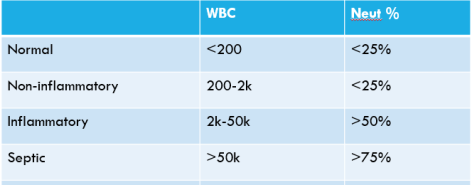
Interpretation of synovial fluid studies: When interpreting synovial fluid studies, many factors should be taken into consideration. The general cutoffs for WBC count in the fluid are guidelines, but there is significant overlap between categories.

Capture

When differentiating between noninfectious inflammatory arthritides and septic arthritis, the distinction is not clear cut. The more WBCs you see in the joint fluid, the more likely it is to be a septic joint (>50,000 WBC is typical), but immunocompromise can decrease the WBC count and early in the course of septic arthritis, counts may be lower. Noninfectious inflammatory arthritis can have WBC counts >50,000 as well so history and other clinical data must be taken into account.

In this patient’s case, the WBC count of only 10 thousand falls in the classical non-infectious, inflammatory arthritis range. Gram stain did not show any organisms, but cultures grew rare growth Strep viridans and Actinomyces after more than 3 days in the micro lab. Outside of hematogenous spread of polymicrobial bacteremia and direct penetrating trauma to the joint, polymicrobial septic arthritis is exceedingly rare. Although all of this cast doubt on the diagnosis of septic arthritis, the patient was treated with Vancomycin and Zosyn initially, then narrowed to Zosyn alone. However, fevers continued, WBC count rose from 21 to 31, and procalcitonin increased from 0.83 to over 5.  A second arthrocentesis was performed, which showed a WBC count of only 30 thousand and no organisms on gram stain with a negative culture. He was subsequently taken to the operating room for arthroscopic drainage and debridement, which did not yield any pus. The orthopedic surgery team deemed the knee to not be a septic joint and did not think bacterial joint infectious could be responsible for his worsening condition.

On review of systems, the patient also endorsed some mild left elbow pain and joint swelling over the past two weeks that had now resolved. A mild transaminitis was also observed on admission labs with extremely elevated CRP and ESR. During the admission, his right knee began to hurt and XR revealed another small effusion. He subsequently developed a diffuse, maculopapular rash, which was thought to be a drug rash. He was switched from Zosyn to Ceftriaxone and then again to Clindamycin, but the rash, fevers, and leukocytosis persisted. Tests for gonorrhea, chlamydia, HIV, syphilis, and viral hepatitis were all negative. Fungal and anaerobic cultures of synovial fluid were negative.  Blood cultures did not show any growth and echocardiogram did not show any abnormalities or vegetation. ANA and anti-CCP were negative, and rheumatoid factor was only very weakly positive (only mildly above the upper limit of normal).

Finally, his ferritin came back at >17,000 and the diagnosis of Still’s disease was made. Still’s is a rare rheumatologic condition akin to juvenile rheumatoid arthritis. It is an out of control immune reaction that typically presents with daily or twice daily fevers, an evanescent salmon-colored maculopapular rash, and polyarticular arthritis. It can also cause severe nonsuppurative pharyngitis, liver dysfunction, pleural effusions, pericarditis, lymphadenopathy, and splenomegaly. The Yamaguchi criteria can be used to diagnose it after infectious, malignant, and other rheumatologic causes are ruled out. It is treated with high dose steroids and sometimes IL-1 or IL-6 inhibitors.

After this patient begun high dose steroids, his fevers and rash resolved, transaminitis slowly improved, and his arthritis became less severe, confirming the diagnosis of Still’s disease.

The Dutch Physician with a Calm Disposition

Today we reviewed a case of Boerhaave Syndrome, named after Dr. Hans Boerhaave who was the first physician to have written about a patient with an esophageal rupture after severe retching.

  • Suspect it in any patient with severe chest discomfort followed by vomiting or retching, [though it can happen without a history of retching]. The presence of subcutaneous emphysema on examination (crepitus) in conjunction with the aforementioned two makes Mackler’s Triad, which is seen in only 14% of patients.
  • The diagnosis is made by contrast esophagram (avoid Barium and chose Gastrografin instead) or by CT scan
  • Treatment is to make the patient strictly NPO, IV antibiotics and surgical consultation
  • Contrast this with a Mallory Weiss tear in which there is a partial thickness, longitudinal laceration of the esophagus or stomach that may present with chest pain, vomiting and hematemesis

We also reviewed the anatomically based framework to abdominal pain, and considered our differential for epigastric pain as well as severe, diffuse abdominal pain.

For epigastric pain, we considered the following:

  • Acute MI
  • Acute pancreatitis
  • Chronic pancreatitis
  • PUD
  • GERD
  • Gastritis
  • Gastroparesis
  • Functional Dyspepsia

For severe diffuse pain

  • obstruction (i.e SBO or hepatobiliary obstruction)
  • perforation (esophageal, gastric, or intestinal)
  • ischemia (ie mesenteric)
  • inflammatory/infectious


A Lung Mass… But what kind??

Our visiting Stanford resident, Dr. Tiffany Guo, presented a very interesting case of an elderly female with a heavy smoking history who presented with a subacute dry cough and progressive dyspnea on exertion with new unilateral shoulder pain.

An initial differential for any heavy smoker with a dry cough and dyspnea should be broad, but include the following tobacco-related diagnoses: COPD, lung cancer, pulmonary HTN, postobstructive pneumonia, and smoking-related ILD including Langerhans cell histiocytosis, respiratory-bronchiolitis associated ILD, desquamative interstitial pneumonia, and sometimes, IPF, acute eosinophilic pneumonia, and pulmonary alveolar proteinosis. The smoking-related ILDs are a heterogeneous group, but in general, they tend to be asymptomatic or present with dry cough and dyspnea, occasionally with systemic symptoms like weight loss and fever. Physical exam may show rales or clubbing and PFTs show a restrictive lung defect. The diagnosis becomes more clear with specific findings on HRCT scan. Although these disorders are rare, they are important considerations because some have treatments and patients may be eligible for lung transplantation.

With this patient’s new onset shoulder pain, we also discussed Pancoast syndrome as a possible diagnosis. Pancoast syndrome consists of shoulder pain (most common initial symptom), Horner syndrome (ipsilateral ptosis, miosis/pupilary constriction, and anhidrosis/loss of sweating on the face), and weakness of the muscles of then hand due to a superior pulmonary sulcus tumors. This was not the diagnosis in our particular patient, but is an important diagnostic thought.

Our patient’s chest X-ray revealed a right hilar mass in the lung. While waiting for biopsy and counseling your patient on your initial concerns for malignancy, it is helpful to have a basic knowledge of the main types of lung cancer and their treatments.

Capture