Refractory Delirium Tremens and Anion Gap Metabolic Acidosis

Today’s case was a young man with alcohol use disorder who presented with delirium tremens refractory to high dose benzodiazepines and severe anion gap metabolic acidosis.

In the differential diagnosis for hyperthermia, tachycardia, and hypertension in a patient with alcohol use disorder and psychiatric comorbidities, it is essential to consider serotonin syndrome and neuroleptic malignant syndrome in your differential.

  NMS Serotonin Syndrome DTs
Onset Gradual, days to weeks <24h 72-96h after last drink
Vital signs Hyperthermia, tachycardia, labile or high BP Hyperthermia, tachycardia, hypertension Hyperthermia, tachycardia, hypertension
Neuromuscular Muscle rigidity (lead pipe), hyporeflexia


Tremor, myoclonus, oculoclonus Tremor
Reflexes Hyporeflexia Hyperreflexia Hyperreflexia
Pupils Normal Mydriasis (dilated) Mydriasis (dilated)
Causative agent Dopamine antagonist Serotonin agonists Alcohol cessation
Treatment bromocriptine Benzos, cyproheptadine Benzos
Resolution Days to weeks <24h Variable

The differential diagnosis for anion gap metabolic acidosis in an alcoholic patient is also wide, including alcoholic ketoacidosis, type A lactic acidosis from concurrent shock due to severe alcoholic pancreatitis, hepatitis, or aspiration pneumonia among other infections, type B lactic acidosis from ethanol itself, or coingestion of other toxic alcohols such as methanol or ethylene glycol.

It is important to rule out toxic coingestion in all patients with alcohol use disorder, altered mental status, and severe anion gap metabolic acidosis. Do this by calculating your serum osmolar gap with a formula that includes ethanol.

Serum osm= 2Na + BUN/2.8 + glucose/18 + ethanol/4.7

If the osmolar gap >10, coingestion should be high on your differential.
SVC Syndrome with Complete Thrombotic Occlusion

This morning we presented a case of SVC syndrome with complete thrombotic occlusion.

SVC 101

  • What is it?
    • Obstruction of blood flow through the SVC
  • What are the three mechanisms by which this can happen?
    • Thrombosis
    • Invasion
    • Extrinsic Pressure
  • How does the body compensate?
    • Collateral veins develop to return blood to the heart

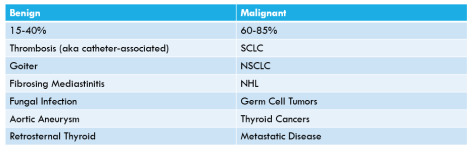
Causes of SVC Syndrome

CausesofSVCSyndrome.PNG

SVC Symptoms

  • Facial and neck swelling
  • Chest pain
  • Respiratory symptoms
  • Neurological manifestations such as head fullness, which may worsen by bending forward or lying own
  • Headaches, confusion, audiovisual disturbances
  • Cerebral edema can be fatal
  • Arm swelling
  • Onset of symptoms depends on whether collaterals had a chance to form

Physical Examination

  • May see distended chest wall veins
  • Pemberton’s sign may be positive
    • initially discovered in the context of a goiter, it can also be useful to identify other causes of SVC obstruction
    • have the patient raise their arms for two minutes and watch for increasing facial plethora (swelling and redness)

Treatment Options

  • Depends on urgency. If emergent, ABCs then straight to endovascular management with pharmacologic thrombolysis/balloon angioplasty/etc +/- stenting
  • If non-emergent, can obtain imaging and biopsy and plan treatment course with chemotherapy or radiation

Lastly, check out Radiopedia! It’s a great learning tool and really fun too.

https://radiopaedia.org/?lang=us

Hypercalcemia of Malignancy


Today we discussed an interesting case of acute encephalopathy due to hypercalcemia of malignancy due to bone metastases.

We first reviewed the importance of maintaining a broad differential for acute encephalopathy/delirium/acute confusional state/AMS.

We reviewed the following framework:

Neurologic / Toxic / Metabolic / Infectious / Other.

We then reviewed the differential for hypercalcemia. For those of you interested, please check out this awesome review video by Dr. Strong:

Our patient had hypercalcemia of malignancy and the following patients were made:

  • It is the most common cause of hypercalcemia in inpatients
  • The most commonly associated malignancies are breast, lung, multiple myeloma, and renal
  • There are three major mechanisms for hypercalcemia of malignancy
    • Secretion of PTHrP – 80% of malignancy related hyperCa
    • Osteolytic Metastases – ~20% of cases
    • Increased 1,25-OH-Vitamin D (calcitriol) 2/2 to increased 1-alpha-hydroxylase activity from activated macrophages in lymphomatous (and also granulomatous) tissue
  • We reviewed the PTH-based algorithm and determined that it was a PTH-independent process (PTH low or low-normal) and then used the PTHrP, calcidiol and calcitriol to guide to the correct diagnosis which was confirmed by MRI and bone scan

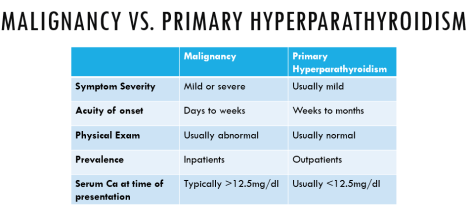
Finally, here is a way to distinguish between malignancy related hypercalcemia and primary hyperparathyroidism (most common cause in outpatients & higher co-occurrence in patients with malignancy)

primaryHyperPTH

For treatment options, please see the following blog post for more details!

Hypercalcemia of malignancy

Hyponatremia and B symptoms

Today’s case presented by Dr. Neharika Khurana was an elderly male with a history of tobacco use who presented with subacute/chronic cough, unintentional weight loss, night sweats, and hyponatremia.

Our general approach to hyponatremia:

Capture

*Diuretics create a high urine sodium regardless of volume status unless severe dehydration is present

*If renal disease or intracranial pathology (cerebral salt wasting syndrome) is present, urine sodium may be high when the volume status is actually low

Infection-Related GN

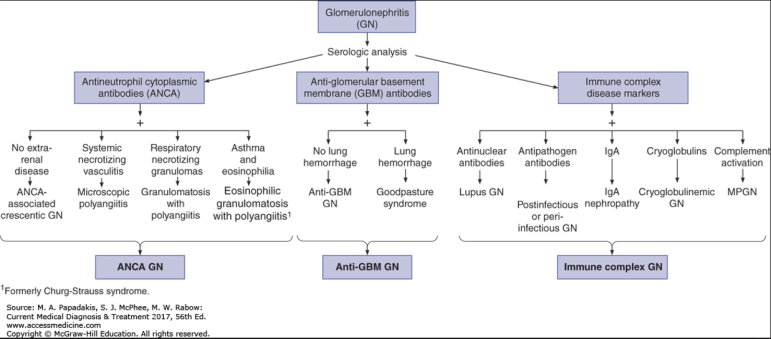
Today we discussed a case of a gentleman with a recent hospitalization for bacteremia who presented with hypertension, renal failure, nephrotic range proteinuria and dysmorphic RBCs consistent with a glomerulonephritis. We learned the following, pathological-based approach to classifying GNs.

GN

Courtesy: AccessMedicine

Infection-Related GN (IRGN)

  • Classically, IRGN begins 7-10 days after a RTI and 2-4 weeks after a skin infection but more commonly the GN coincides with the infection in adults
  • The presentation involves variable degrees of HTN, edema and AKI with a nephritic sediment (dysmorphic RBCs and RBC casts are highly specific though not sensitive for an acute GN)
  • variable degrees of proteinuria can occur
    • we reviewed that virtually any nephritic syndrome can present with nephrotic range-proteinuria (>3g/day)
  • treatment is supportive in most cases
  • Likelihood of full renal recovery is low, and and in some reports up to 50% of patients progress with ESRD
  • Bottom-line, infection-related kidney injury has a broad differential (sepsis-mediated, hypovolemia, medication-related ATN/AIN, ischemic ATN, AND infection-related GN). Even though IRGN is much, much less common than most of the other etiologies, keep it on the differential