Category Archives: Morning Report

Statin induced rhabdomyolysis

A very interesting case of an elderly female admitted for confusion, proximal weakness and fatigue with AST 1770/ALT 413 with associated CK that peaked at ~80k concerning rhabdomyolysis. Weakness is thought to be due to myopathy (autoimmune vs non-inflammatory).Her CK elevation is thought to be due to statin. She has shown significant improvement from stopping her statin and fluid resuscitation. However, it is important to note that statin induced  necrotizing autoimmune myositis should be on your differential. Some patients may require muscle biopsy to diagnose this which warrants treatment with anti-inflammatory (steroids). The highest risk statins for this presentation include atorvastatin, simvastatin and lovastatin as they are metabolized by cytochrome 450. 

Myopathy ddx

  1. Autoimmune
    • Primary
      • Dermatomyositis
      • Polymyositis
      • Inclusion body myositis
    • Secondary
      • Vasculitis
  2. Non-inflammatory
    • Meds: statin, steroids
    • Toxins: EtOH
    • Critical illness

Brucellosis

28 yo healthy male w/ recent travel to Africa with exposure to unpasteurized camel milk diagnosed with sacroiliitis 2/2 Brucellosis. 

Fever in a returning traveler

  • <10 days
    • Bacteria: typhoid fever, leptospirosis, rickettsia
    • Virus: dengue, zika, chikungunya, west nile, yellow fever, HIV
    • Parasite: malaria
  • >10 days
    • Bacteria: typhoid fever,TB, Q fever, brucella, tulleremia
    • Virus: HIV
    • Fungi: histoplasmosis
    • Parasite: malaria, schistosomiasis, trypanosomiasis 

Brucellosis presents with undulant fevers, night sweats, HA, malaise with complications with osteoarticular involvement> GU>Neuro involvement. You must warn lab workers so they take proper precautions if you suspect brucella. Brucella total ab titier>1:160 in serum is diagnostic. Treatment for uncomplicated infection is doxycycline + rifampin; if complicated infection -add aminoglycoside. 

Stercoral ulcer & laxatives

We discussed a case of an elderly woman with hx of CAD c/b MI, hx of recent PEA arrest due to high-grade AV block s/p PPM, HFrEF, and afib, who presented with acute diffuse abdominal pain, not passing gas, and large volume bright red blood per rectum, found to have severe constipation causing fecal impaction & rectal perforation.

LGIB ddx

  • Structural:  diverticulosis, hemorrhoids, post-polypectomy bleeding, polyps, malignancy, anal fissure, colonic / rectal ulcers
  • Vascular:  ischemic colitis, angiodysplasias, colonic / rectal varices, congenital or systemic diseases causing vascular anomalies (HHT, CREST), tumors (hemangiomas, Kaposi sarcoma)
  • Inflammatory:  IBD, infectious, radiation

Management of constipation & laxatives

  • PO hydration, exercise, fiber
  • Bulking:  psyllium, wheat dextrin, cellulose
  • Osmotic:  miralax, lactulose, magnesium citrate
  • Stimulant:  senna, bisacodyl
  • Stool softeners / enemas:  colace, tap water, soap suds, Fleet (glycerin, mineral oil, sodium phosphate)
  • Opioid antagonists:  methylnaltrexone, naloxegol

Lyme disease and Lyme carditis

We discussed a case of a previously healthy young man who presented with recent travel history to the NE United States, subacute-chronic myalgias & headaches, acute left Bell’s palsy, and acute palpitations, found to have sinus and AV nodal disease due to Lyme disease

Lyme carditis

  • Presented <1-28 weeks after infection onset
  • AV conduction block of varying severity is usually more common than sinus node & distal conduction system disease
  • ↑ risk of complete AV block if PR > 300 ms
  • Treatment:
    • If PR > 300 ms:  IV penicillin or IV ceftriaxone x28 days
    • If PR < 300 ms:  PO antibiotics (e.g. doxycycline x14-28 days)

Rapidly Progressive Glomerulonephritis (RPGN)

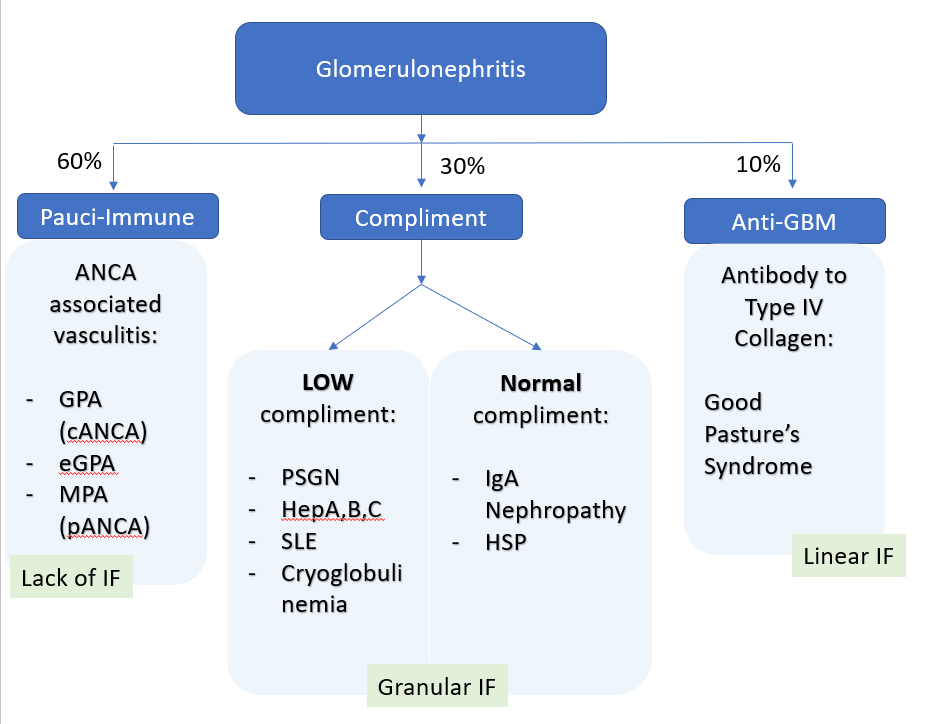
We presented a very interested case of a healthy young female presenting with hemoptysis, hematuria, anemia and profound AKI concerning for RPGN + DAH (diffuse alveolar hemorrhage). Our patient had a stat kidney biopsy with serum studies that resulted in p-ANCA +, ANA +. Kidney biopsy resulted in light microscopy showing “Pauci Immune GN” or “Anti GBM GN” however conflicting IF results of “full house” immunostaining consistent with lupus nephritis. The patient was diagnosed with RPGN 2/2 likely p-ANCA vasculitis (MPA) WITH overlapping features of lupus nephritis. Patient improved w/ pulse dose steroids and Rituximab. 

Advanced kidney disease on presentation should make you think of:
First think of pre-renal and post-renal etiologies but if intra-renal etiology of AKI is top of your differential, first start by considering the following: 

  1. Pigment – Myoglobin (Rhabdo); Hemoglobin (aka Thrombotic Microangiopathy)
  2. Paraprotein – Multiple Myeloma (SPEP)
  3. Crystals – Tumor Lysis Syndrome (Uric Acid) 

How to interpret UA
The UA is CRUCIAL in differentiating whether your AKI is glomerular, tubular, interstitial or vascular in etiology.  When looking at UA, clues that this is a glomerular cause includes hematuria and proteinuria. Remember that the dipstick UA (3+) mainly measures albumin. Checking protein:creatinine urine helps you know if there are proteins besides albumin at play! 

Glomerular causes of intrarenal AKI
The frank hematuria and amount of RBC clues us into a nephritis (rather than nephrotic) etiology as follows. 

Ulcerative colitis

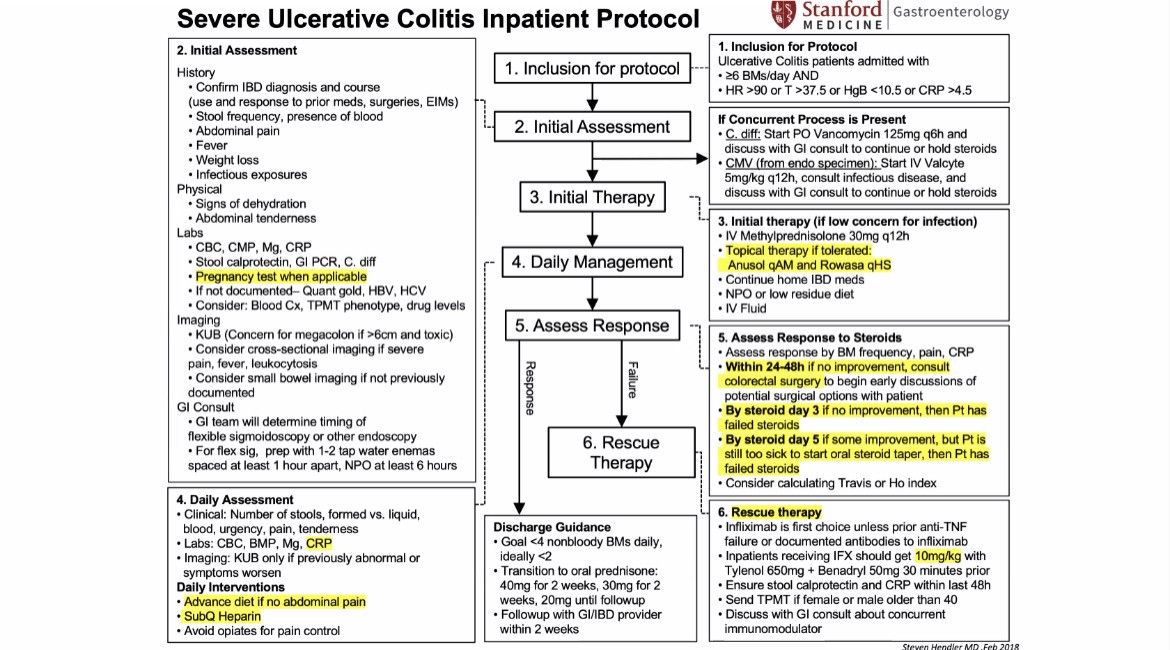
We discussed a case of a middle aged woman who presented with acute on chronic abdominal pain, bloody diarrhea, tenesmus, found to have a new diagnosis of ulcerative colitis.

Clinical manifestations

  • Abdominal pain, weight loss, diarrhea, urgency, incontinence, tenesmus
  • Ask about characteristics of stool (frequency and presence of blood)
  • Ask about GI infectious exposures

Important initial workup

  • R/o infection (C diff, enteric pathogen panel, CMV)
  • Stool calprotectin
  • Inflammatory markers (e.g. CRP)
  • Can consider imaging to r/o toxic megacolon / serious complications if pretest probability is high

Important daily interventions

  • Pts with active IBD or exacerbations are at high risk of DVTs. Start DVT prophylaxis (LMWH, unfractionated heparin, fondaparinux)
  • Mechanical DVT prophylaxis if there is severe GI bleeding (e.g. hypotension / shock)

Treatment (main categories)

  • 5-ASA (e.g. mesalamine)
  • Glucocorticoids
  • Immunomodulators (e.g. azathioprine)
  • Biologics (e.g. infliximab)
  • Surgery

Acute hepatitis due to EBV

We discussed a case of a healthy young man who presented with fevers, malaise, n/v, found to have posterior cervical lymphadenopathy and acute hepatitis due to infectious mononucleosis.

Clinical manifestations

  • Fevers, pharyngitis, tonsillar exudates, malaise, lymphadenopathy (posterior cervical / posterior auricular), atypical lymphocytosis
  • Splenomegaly
  • Hepatitis

Diagnosis

  • Heterophile / Monospot test (low sensitivity and specificity). Can have false negative during early infection
  • EBV specific antibodies to viral capsid Ag (earlier increase in serum levels) or nuclear Ag (later increase in serum levels)

Complications

  • Acute complications
    • Rash (classically associated with administrations of ampicillin)
    • Peritonsillar abscess (watch out for airway obstruction!)
  • Lymphoproliferative disorders (e.g. HLH, lymphomatoid granulomatosis)
  • Malignancies (e.g. lymphomas, nasopharyngeal carcinoma)

Spontaneous Spinal Cord Infarct

Elderly female with hyperlipidemia and HTN presenting with acute onset tingling back pain between her scapula with subsequent acute onset bl UE weakness and decreased sensation  with diminished reflexes throughout.

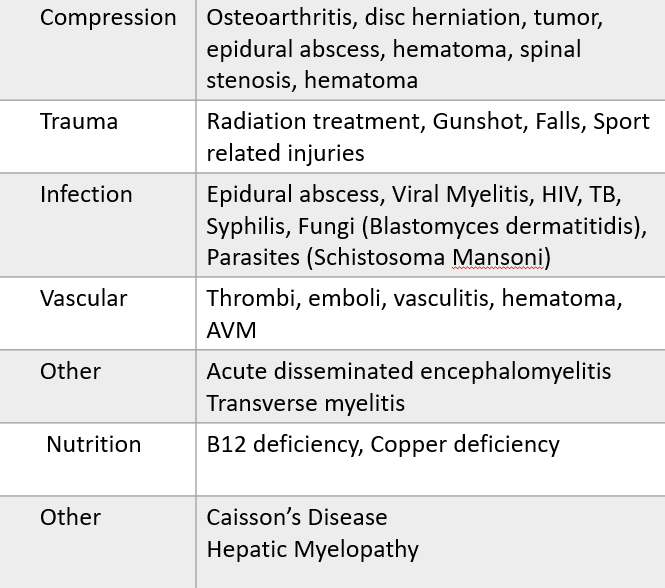
Differential for myelopathy

*Always remember to rule out aortic dissection 

Our patient’s first MRI was normal but subsequent MRI demonstrated an acute spinal cord infarct in the territory of the anterior spinal artery. Anterior region of the spinal cord involves spinothalamic and corticospinal tracts therefore affecting both light touch/pain and motor function. Our patient likely suffered vascular myelopathy with incomplete ASA ischemia. Prognosis is poor for acute spontaneous spinal cord infarct, most need rehab. One main teaching point is to remember that presentations of spinal shock initially present with hyporeflexia or areflexia rather than hyperreflexia. 

TB Peritonitis

We discussed a case of a young man with unintentional weight loss and ascites. Our patient had a SAAG 0.9 in his ascitic fluid with ADA 48 with high protein and LDH. The patient required laparoscopy with peritoneal biopsies which yielded a diagnosis of peritoneal TB. Patient was started on RIPE.

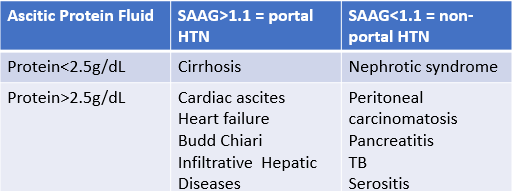
Differential for SAAG <1.1 in ascitic fluid
SAAG<1.1 indicates that the ascites is not related to high portal pressure

Protein Poor (decreased oncotic pressure causing leak)

  1. Nephrotic syndrome
  2. Malnutrition
  3. Protein losing enteropathy (IBD)

Protein Rich (Increased capillary permeability or lymph node obstruction)

  1. Peritoneal carcinomatosis
  2. Pancreatitis
  3. TB
  4. Chylous ascites (Lymphoma causing lymphatic infiltration/obstruction)

Presentation of peritoneal TB

  • Ascites (93%) > abdominal pain > fevers

Diagnosis of peritoneal TB

  • SAAG <1.1 g/dL with high protein, high lymphocytes
  • ADA of >36 IU/L (High sensitivity ~100%, High specificity 97% wo cirrhosis; 30% with cirrhosis)
  • Acid-fast bacilli smear is positive in <3% cases (needs 5000 bacilli/mL to be positive)
  • Culture is higher yield but takes weeks to return (needs only 100 bacilli/mL to be positive), Sensitivity ~20%
  • MTB PCR is highly sensitive and specific, confirmatory diagnosis
  • Laparoscopic + Peritoneal biopsy with caseating granuloma confirmatory (multiple samples)