All posts by vmcimchiefs

7/6/16: SBP versus Secondary Peritonitis

Diagnosis of SBP:

  1. PMNs >250 cells/mm3
  2. Positive bacterial cultures
  3. Absence of secondary causes (i.e. bowel perforation)

Secondary Peritonitis:

  1. PMNs >250 cells/mm3
  2. Positive bacterial cultures (typically poly microbial)
  3. Surgically treatable intra-abdominal source of infection

Remember it is important to distinguish SBP from secondary peritonitis for two main reasons:

  • Mortality of secondary bacterial peritonitis is approximately 100% without surgical intervention
  • Mortality of SBP approaches approximately 80% if patient undergoes an unnecessary exploratory laparotomy

Common pathogens in SBP:

  • E. coli (43%)
  • Strep species (28%)
  • Klebsiella pneumonia (11%)

SAAG – serum ascites albumin gradient (subtract the ascitic albumin from the serum level)

  • If >1.1 g/dL patient has portal hypertension (97% ACCURATE)

Reasons for Albumin Repletion:

  1. Prevention of post-paracentesis circulatory dysfunction (PPCD)
    • >4L give 6-8 g/L for each L removed
  2. Prevention of renal impairment in cirrhotic patients with SBP
    • Give 1.5 g/kg DAY 1
    • Give 1.0 g/kg DAY 3
  3. Diagnosis/treatment of HRS
    • Give 1.0 g/kg on DAYS 1 AND 2 (maximum of 100 g each)
    • If renal function improves, suggestive of pre-renal hypovolemia; if renal function worsens, suggestive of HRS.
6/30/16: Pulmonary Embolism

  • Remember the risk factors for AQUIRED THROMBOPHILIA:
    • Surgery (OR 21.7)
    • Trauma (OR 12.7)
    • Hospital/SNF (OR 8.0)
    • Cancer undergoing chemotherapy (OR 6.6)
    • Others: estrogen therapy, pregnancy, obesity, smoking
  • Approximately 6% of patients with unprovoked VTEs have an undiagnosed cancer at the time of the VTE; approximately 10% will be diagnosed with cancer in the following year.
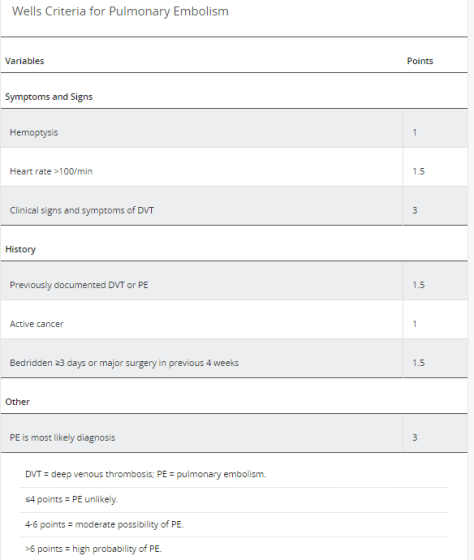
  • Use the Well’s PE Criteria for those patients whom you suspect a PE; if the score is <6 consider a D-Dimer to guide management

Wells PE

EKG findings in PE:

  • Sinus tachycardia: approximately 44% of patients
  • S1Q3T3 (acute cor pulmonale): not sensitive/specific; found in 20% of patients with PE
  • RV strain patter (TWI R precordial leads V1-V4): representative of elevated PA pressures; found in approximately 34% of patients

Indications for Thrombolytics in PE:

CLEAR INDICATIONS:

  1. Persistent hypotension / shock due to an acute PE

POSSIBLE INDICATION:

  1. Severe / Worsening RV Dysfunction
  2. Cardiopulmonary arrest due to a PE
  3. Extensive clot burden
  4. Free floating RA / ventricular thrombus
  5. Patient foramen ovale

Contraindications to thrombolytics:

  1.  Intracranial neoplasm
  2. Intracranial / spinal surgery or trauma
  3. History of hemorrhagic stroke
  4. Active bleeding
  5. Any stroke within 3 months

Classification of PE and distinction:

Massive: cardiopulmonary shock or hypotension

Submassive: RV dysfunction / elevated cardiac biomarkers

Low Risk: normal echocardiogram / negative cardiac biomarkers


6/20/16: Multiple Sclerosis

  • Recognize the risk factors for MS:
    • Age: typically younger (20-40 years old)
    • Female > Male (3:1)
    • Family History of MS
    • Infections (EBV)
    • Race – white, northern European decent
    • Smoking
    • Autoimmune disease
    • Northern hemispheres (potentially related to lack of sunlight / vitamin D deficiency)
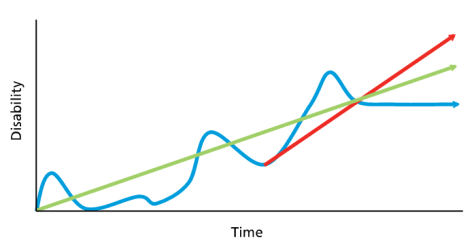
  • Remember the THREE TYPES OF MS:
    • Primary progressive (Green)
    • Relapsing/Remitting (Blue)
    • Secondary progressive (Red)

MS

Lhermitte Sign: a shock-like sensation radiating down the spine or limbs induced by neck movements.

Uhthoff Phenomenon: worsening MS symptoms with increased body temperature.

  • Diagnosis requires the evidence of CNS demylenation in BOTH SPACE AND TIME.
  • Remember the common eye findings with MS:
    • Optic neuritis: occurs in 50% of MS patients and is the presenting symptom in 20-30%
    • MLF syndrome: inability to adduct the affected eye; opposite eye can experience nystagmus
    • Marcus Gunn Pupil (afferent pupillary defect): inability of the affected eye to constrict when light is shown
  • Oligoclonal bands IgG on LP
  • Treatment regimen:
    • Routine: physical activity, vitamin D/calcium, routine vaccinations, smoking cessation
    • Acute: high dose steroids (typically 1 g/day for 3-5 days)

6/15/16: Acid/Base Problems

For Acid Base Disorders:

  • Check for internal consistency
  • Use pH to determine the primary disorder
  • Calculate the AG
  • Determine the presence of additional disorders
  • Calculate the expected pCO2 for any metabolic acidosis to evaluate for additional respiratory acidosis.

Winter’s Formula: expected pCO2 = 1.5 (HCO3) + 8 +/-2

  • Remember vagal maneuvers for SVT: carotid massage, valsalva, diving reflect
  • Remember the trial of DKA:
    • Hyperglycemia
    • Anion Gap Metabolic Acidosis
    • Ketonemia
  • DKA management:
    • Fluids: usually 3-6L deficient
    • Insulin: 0.1 U/kg bolus followed by a rate of 0.1 U/kg/hr; adjust as needed
    • Electrolytes: watch for K and phosphate – typically appear normal initially, but are actually “total body” deplete – likely to drop quickly with insulin administration

6/1/16: Adrenal Insufficiency

  • Remember the layers of the adrenal anatomy and the corresponding hormones produced:

Glomerulosa: Mineralcorticoids (i.e. aldosterone)

Fasciculata: Glucocorticoids (i.e. cortisol)

Reticuloaris: Adrenal Androgens (i.e. testosterone

Chromuffin Cells: Epinephrine

  • Remember the ANTERIOR products of the pituitatry gland: (FLATPEG)

FSH

LH

ATCH

TSH

PROLACTIN

ENODORPHINS

GH

  • Remember the two hormones of the POSTERIOR pituitary:

Oxytocin

ADH

06/30 Neutropenic fever Morning Report

TAKE HOME POINTS 

Diagnosis

>38.3 fever or >38 sustained for one hour
-ANC<500 or ANC expected to decrease <500 within 48 hours

Empiric therapy (give as soon as possible for neutropenic fever, <30-60 minutes)

1)Cefepime 2 gm IV q8h
2)Meropenem 1 gm q8h (or other carbapenem but NOT Ertapenem as misses pseudomonal coverage)
3)Zosyn 4.5 g IV q6-8h
4)Ceftazidime 2 gm IV q8h (less often used due to resistance patterns)

*If concern for anerobic infection, can add Flagyl to Cefepime or if suspecting C.diff
*No proven benefit to one empiric therapy over another

When to add Vancomycin to empiric therapy

1)Severe sepsis/HD unstable
2)Pneumonia
3)MRSA colonization
4)Suspected CVC related infection
5)Previously on Quinolone prophylaxis
6)Skin/soft tissue infections
7)+ BC for GPC

*Can consider discontinuing Vancomycin if negative cultures x 48 hours

How long to treat for with empiric therapy?

-(generally) continue antibiotics until ANC>500 and afebrile if no culture data
-If culture data, treat x 14 days

06/27/16 Morning Report-Factor 8 inhibitor

TAKE HOME POINTS 

How do approach elevated PT/INR, or PTT of unknown etiology

-Do Mixing study to see if it corrects (deficiency) or doesn’t correct (inhibitor)
-PT=Play Tennis OUTSIDE=Extrinsic pathway
-PTT=Play Table Tennis INSIDE=Intrinsic pathway
-Most common inhibitor is Factor 8 inhibitor causing elevated PTT

Causes of elevated PTT

-Involves Factor 8, 9, or 11
-Iatrogenic causes include heparin, LWMH
-Lupus anticoagulant (usually presents with thrombosis)

Risk factors for developing a Factor inhibitor

-Pregnancy, post-partum, RA,  malignancy, SLE, some drug reactions (Phenytoin/Penicillin)

Treatment

-Control bleeding (done via activated prothrombin complex concentrate like FEIBA or recombinant human factor VIIA)
-Eliminate inhibitor via immunosuppression (steroids +-rituximab +-Cytoxan)

5/19/16 Aeromonas SBP – morning report

Teaching Pearls

  • Aeromonas is a Gram Negative Rod and is the third leading cause of SBP in Korea
  • It causes a warm season diarrheal disease
  • Remember the three indications for SBP prophylaxis:
    • History of SBP, lifelong prophylaxis
    • Cirrhosis with GI Bleed, 7 days of prophylaxis
    • Ascitic protein < 1, prophylax while inpatient
  • Don’t forget to give Albumin 1.5grams/kg on Day 1 and 1.0gram/kg on Day 3 for patients with SBP
  • Remember to think about secondary bacterial peritonitis (from intestinal perforation, PUD) in the differential for SBP
  • Check out this review on AeromonasSBP!

Morning Report 12/30/15

  • Cryptococcosis is treated with Flucytosine, Ambisome for 2 weeks of Induction, and the Fluconazole for maintenance
  • Include Bacillary angiomatosis on the differential for Kaposi’s Sarcoma
  • Fungal infections can be due to Yeasts, Molds, or Dimorphic Fungi
    • Yeast: Think Single Celled Organisms, Candida and Cryptococcus
    • Mold: Think Filamentous with Hyphae. Aspergillus,  Mucor
    • Dimorphic Fungi: Can be both yeast or molds depending on the Temperature. Includes Histo, blasto, cocci
  • We didn’t get to this today, but here is a framework for organizing anti-fungal medications!