Category Archives: Morning Report

Central Adrenal Insufficiency

We presented a fascinating case of a middle aged woman who presented with fatigue, weakness, and a significant weight loss in the past year who was found to have hypotension refractory to a usual fluid challenge. Her AM cortisol was low and her post-stim cortisol remained <18, confirming the diagnosis of adrenal insufficiency. Her ACTH was inappropriately on the low end of normal, consistent with a central AI (secondary or tertiary). Here are the highlights:

Clinical Manifestations in Primary AI only:

  • Generalized hyperpigmentation of the skin and mucus membranes (exclusively in chronic primary adrenal insufficiency)
  • Hyponatremia/hyperkalemia and hypoglycemia generally occurs in primary AI only

Diagnosing Adrenal Insufficiency

  • An AM cortisol < 3 is sufficient, but a ACTH stimulation test is preferred
  • Check the ACTH level prior to the test!
  • After giving the standard-high dose of 250mcg of synthetic ACTH, a cortisol is checked 1 hour later and if <18, confirms the diagnosis of adrenal insufficiency
  • If the patient has AI, then look at the ACTH (which will take some time to result anyway)
  • If normal (inappropriately so) or low, this is ACTH dependent AI, also known as central AI (in secondary the problem is the pituitary and in tertiary, the problem is in the hypothalamus)
  • If high, then this is ACTH-independent AI, also known as primary AI (AKA the problem is with the adrenal gland)

Causes of Primary AI and Secondary AI

  • The causes for both are lengthy, but remember the most common etiology for each!
  • The most common cause of primary AI in the developed world is autoimmune adrenalitis
  • The most common cause of central AI is discontinuation of glucocorticoids

Cryptococcal Meningitis and a New Diagnosis of AIDS

Today, we presented an interesting case of a young man with no past medical history who presented with two weeks of progressive headache and fever, now with nausea, vomiting, and an episode of transient blurred vision. CSF revealed an elevated white blood cell count with lymphocytic predominance, low glucose, and elevated protein. Serum and CSF CrAg subsequently came back positive and fungal blood cultures showed Cryptococcus Neoformans.

Illness script for Crypto Meningitis:
Epi: AIDS patients with CD4<100
Symptoms: Indolent onset 1-2 weeks for fever, malaise, and headache. Can develop meningeal signs, altered level of consciousness, and focal neuro deficits. Disseminated disease can include pulmonary symptoms and skin findings resembling molluscum contagiosum.
Diagnosis: Serum and CSF CrAg with 93-100% sensitivity and 93-98% specificity. Crypto can be isolated on India Ink stain of CSF 60-80% patients.
Treatment: Induction with 2 weeks of IV amphotericin B and PO flucytosine, consolidation for 8 weeks with high dose fluconazole, and maintenance for one year with low-dose fluconazole. Serial LPs for ICP control. Start ART 2-10 weeks after starting antifungal treatment (delayed due to risk of IRIS).

CaptureCapture

The Ophthalmologist’s Pulse Examination That Identified a Vasculitis!

Today we discussed an impressive diagnostic mystery of a young woman with chronic neck pain and paresthesias who was later found to have a diminished ipsilateral pulse and a SBP of > 60 points in the affected arm compared to the contralateral arm!

The case highlighted a few, highly important points – first – that the pulse examination is paramount in the patient with paresthesias of an extremity.

A broad differential for diminished/absent radial pulse includes atherosclerosis (i.e PAD), embolism, vasculitis (i.e GCA and TA, less commonly Beurger Disease), anatomic (dissection, thoracic outlet obstruction, thrombosed aneurysm) and iatrogenic (i.e post ABG, vasopressors). When you notice unequal pulses in a patient with symptoms relating to that extremity, you must treat this as an emergency!

We then reviewed the distinguishing characteristics of GCA and TA

GCAvsTA.GIF

The key takeaway to remember is that TA is a chronic disease, filled with relapses and therefore these patients must be diligent about their immunosuppression, which in some cases may be lifelong at very low doses.

For those of you who are still here, a historical treat is your reward. At the 12th Annual Meeting of the Japan Ophthalmology Society held in 1908 in Fukuoka, the young Dr. Mikito Takayasu presented a curious case of vascular malformations of the eye. Two of his colleagues, Drs. Katsutomo Onishi and Tsurukichi Kagoshima also presented similar findings, but noted absence of pulses as well. The findings are impressive, but even more impressive is a subspecialist examining the entire body in a patient they were concerned about, a truly admirable – but increasingly uncommon – practice!

Sexually Transmitted Pharyngitis

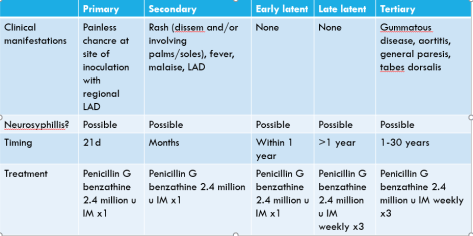
Today’s case, brought to us by Dr. Tuan Nguyen, was a middle-aged woman who presented with sore throat and globus sensation, which persisted for >6 weeks before she received a tonsilar biopsy that showed Treponema pallidum, consistent with secondary syphilis.

We went over a strategy of evaluation of the adult patient with acute pharyngitis. First, we ruled out any emergency by evaluating for airway compromise (respiratory distress, tripoding, “sniffing,” stridor), signs of epiglottitis or deep neck space infection (muffled/hot potato voice, drooling, bulging of the structures of the pharynx or palate, torticollis, neck pain/stiffness/swelling, trismus), or sepsis. We then evaluated for the likelihood of Group A strep infection with the Centor criteria. If left untreated, group A strep pharyngitis can lead to rheumatic fever, rheumatic heart disease, glomerulonephritis, and abscess. Then, we took a detailed sexual history to risk stratify the patient for acute HIV, gonococcal pharyngitis, and syphillis.

Capture

Capture


anti-HUH-Vasculitis?

Today we presented a very interesting case of anti-MPO vasculitis with renal biopsy confirming a pauci-immune necrotizing, crescenteric glomerulonephritis.

We first reviewed the common features of small-vessel ANCA associated vasculitides [AAV] -granulomatosis with polyangiitis; microscopic polyangiitis; eosinophilic granulomatosis with polyangiitis:

Common Systemic Signs and Symptoms– fevers, weight loss, arthralgias, malaise

  • Common Organ-Specific Manifestations
    • Kidney
      • Hematuria, proteinuria, AKI caused by GN
    • Skin
      • Purpura caused by leukocytoclasic angiitis in dermal venues and atertioles
    • Abdominal Pain and Fecal Occult Blood
      • From mucosal and bowel wall infarcts
    • Mononeuritis Multiplex from arteritis in peripheral nerves
    • Necrotizing sinusitis from upper respiratory tract mucosal angiitis
    • Pulmonary hemorrhage from alveolar capillaritis
  • Unique Organ-Specific Manifestations
    • GPA has necrotizing granulomatous inflammation seen most commonly in the respiratory tract
    • eGPA has blood eosinophilia and a history of asthma

Classification Systems

We reviewed that renal biopsy is not generally able to distinguish between the various AAVs, but rather will only be ‘pauci-immune’. The diagnosis, like all of rheumatology, truly is a beautiful integration of clinical, serological, and histological.

The 2012 International Chapel Hill Consensus Conference on the Nomenclature of Vasculitides clarified nomenclature for us and several important aspects of care has emerged from it.

Serologies in AAV

We know that vascular inflammation is cased by activated neutrophils and monocytes because of ANCAs. These ANCAs bind to a variety of antigens, most notably proteinase 3 (PR3-ANCA) and myeloperoxidase (MPO-ANCA). PR3 is tightly linked to C-ANCA and MPO to P-ANCA. In relation to our traditional clinicopathological (CPC) diagnoses of MPA, GPA and eGPA, we note the following:

Pr3mpo.png

Key takeaways are that not all “MPA, GPA and EGPA” is ANCA+, and when it is, the pattern of antigen-antibody complex is not specific! In other words, in a patient with PR3-ANCA, 75% of the time their CPC diagnosis is GPA but 40% of the time it is MPA. Putting aside the CPC diagnosis for a moment, we see that there are consistent, specific associations between PR3-ANCA/MPO-ANCA and certain clinical manifestations. For example, there is worse renal survival in MPO-ANCA patients and PR3-ANCA has consistently been shown to have a higher relapse rate and mortality rate compared to MPO-ANCA. For now, both systems of identification are useful (a serotype and CPC diagnosis) and in the future, I wonder if treatment will differ between the two. For now, regardless of the serotype of CPC diagnosis of MPA or GPA, the treatment is the same!

Treatment of MPA/GPA (eGPA tx is slightly different)

Induction

  • High dose steroids and either cyclophosphamide OR Rituximab (decision is complex and based on side effect profile i.e Rituximab in patients with concerns fertility or alopecia or if previously been on cyclophosphamide)
  • Indications for plasmapheresis include
    • Evidence of pulmonary hemorrhage (some say all, some say those who did not respond quickly to steroids)
    • Rapidly deteriorating kidney function or severe kidney dysfunction
    • Patients who have a concomitantly positive anti-GBM

Maintenance

  • Approx 80% of patients enter remission with induction therapy, but relapses are common (especially with PR3-ANCA serotype and lung or URT disease
  • Either azathioprine, mycophenolate or rituximab
  • Optimal duration not well-established, some say 12 months after remission is attained, followed by a gradual reduction

Source: National Kidney Foundation’s Primer on Kidney Diseases 7th ed, Gilbert & Weiner, 2018

UpToDate- https://www.uptodate.com/contents/granulomatosis-with-polyangiitis-and-microscopic-polyangiitis-initial-immunosuppressive-therapy?

DRESS Syndrome (or DIHS)

Today Dr. Kali Xu presented a riveting case of a middle-aged man with a history of gout on allopurinol who presented with a worsening, diffuse maculopapular rash with odynophagia, dysuria, and pain on defecation with eosinophilia, elevated ALT, and AKI.

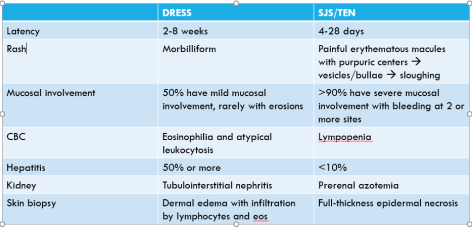
Given the mucus membrane involvement, multiorgan dysfunction, diffuse rash, and recent allopurinol initiation, the group astutely narrowed the differential diagnosis to DRESS vs SJS/TEN, which was the same differential of the dermatology team came up with.

The following is a useful table we created when deciding between these two similar diagnoses.

Capture

Other useful clinical pearls from today’s noon report:

  • The most common triggers for DRESS: anti-epileptics and allopurinol
  • When dealing with anti-epileptic induced DRESS, many experts use valproic acid for seizure disorder treatment because it is least likely to cause DRESS
  • There is a trend toward calling DRESS syndrome DIHS (drug-induced hypersensitivity syndrome)
  • DRESS can involve any organ including liver, kidney, lungs, heart, GI, pancreas, thyroid, brain, muscles, nerves, and eyes
  • Treatment for DRESS consists of a long steroid taper, which usually required prophylaxis for osteoporosis and steroid-induced peptic ulcers with calcium-vitamin D supplementation and PPI
  • Thyroid function should be monitored 2-3 months after acute presentation because autoimmune thyroiditis can be a late presenting sequelae of DRESS

A case of psychosis with lymphocytic pleocytosis in CSF… Anti-NMDA Receptor Encephalitis!

Today we discussed a very interesting case of a young female who presented with 3 months of progressive behavioral disturbances, hallucinations, headache, insomnia, and a seizure. In young females with progressive symptoms and seizures, anti-NMDA receptor encephalitis is an important diagnostic consideration, although it is quite rare.

Illness Script for NMDA encephalitis:

  • occurs in young females with ovarian teratomas, but can be associated with other tumors as well and is sometimes seen in men and children
  • proposed association with a history of HSV encephalitis (in one study 20-30% of HSV encephalitis patients who didn’t have anti-NMDAR antibodies during their episode of encephalitis developed them later)
  • Clinical presentation: headache, fever, viral-like prodrome followed by multistage progressive symptoms:
    • psychiatric manifestations: anxiety, agitation, bizarre behavior, hallucinations, delusions, disorganized thinking
    • insomnia
    • memory deficits
    • language dysfunction: diminished language output, mutism, echolalia
    • seizures
    • decreased level of consciousness, stupor with catatonic features
    • dyskinesias: orofacial, choreoathetoid movements, dystonia, rigidity, opisthotonic postures
    • autonomic instability: hyperthermia, fluctuations of BP, tachycardia, bradycardia, cardiac pauses, hypoventilation
  • LP: can be initially negative or have lymphocytic pleocytosis or oligoclonal bands
  • EEG: Can have infrequent epileptiform activity, but frequently slow, disordganized activity that doesn’t correlate with patient’s abnormal movements
    • Unique pattern associated with prolonged illness: extreme delta brush
  • MRI: Usually normal, but can have transient FLAIR abnormalities
  • Diagnosis: CSF anti-GluN1 antibodies + clinical symptoms, abnormal EEG + oligoclonal bands, and reasonable exclusion of other disorders
  • Treatment:
    • Tumor resection when possible
    • Methylprednisolone 1g IV daily x5d
    • IVIG 400mg/kg IV daily x5d OR plasma exchange
    • If sypmtoms very severe, consider Rituximab

Acute Cholangitis without a Gallbladder

Today, Dr. Nakache presented a case of a 63yoF with a history of cirrhosis and cholecystectomy who presented with RUQ pain and sepsis with EColi bacteremia, found to have acute cholangitis.

Causes of Acute Cholangitis: Stones, strictures, malignancy, stent occlusion, s/p ERCP, postoperative (Whipple, gastric bypass, etc), or extrinsic compression (Lemme’s syndrome, acute pancreatitis, Mirizzi syndrome), parasites (liver flukes or ascaris)

Symptoms/signs: 

Charcot’s triad: Fever, jaundice, abdominal pain (only 50-75% have this triad)

Reynold’s pentad for severe cholangitis: Charcot’s triad + hypotension and AMS

Complications: septic shock, hepatic abscess, multiple organ dysfunction

Labs: Leukocytosis/evidence of infection, Cholestatic LFTs, although can also get transaminitis if hepatocyte necrosis (high 2000s, consider liver abscess)

Diagnosis:

Must meet all criteria:

  1. Evidence of systemic inflammation: Fever, shaking chills, leukocytosis, elevated CRP
  2. Evidence of cholestasis (Tbili >= 2, elevated LFTs 1.5x ULN)
  3. Imaging with biliary dilation OR evidence of cause (stones, stricture, etc.

Choice of Imaging:

Start with abd US. If negative but still very high clinical suspicion, get abd CT. If negative, but still very high clinical suspicion, get MRCP. These tests get more expensive, more time consuming, and more sensitive as you go down the list.

Caveat #1: If the patient’s is s/p cholecystectomy, abdominal ultrasound may be too nonspecific due to normal postoperative biliary dilation. Visualization of the distal CBD is also particularly poor on ultrasound.

Treatment:

  1. Supportive care (fluids, electrolyte repletion, analgesia)
  2. Antibiotics
  3. Biliary drainage via ERCP, which is successful 90-95% of cases
  4. Address the cause (consider cholecystectomy if 2/2 stones, consider stenting if due to malignancy)

Antibiotic treatment:

If infection is community acquired without risk factors for antibiotic resistance, use one of the following regimens:

– Zosyn

– Cephalosporin + Flagyl

– Cipro or Levofloxacin + Flagyl

If the patient shows signs of end-organ damage, is in septic shock, OR there are risk factors for antibiotic resistance (recent travel to Asia, Africa, or Middle East, known colonization with antibiotic resistant organisms, or healthcare-acquired infection), use one of the following regimens:

– Zosyn

– Carbapenem: Meropenem or Imipenem + cilastatin or Doripenem

– Cefepime or ceftazidime + Flagyl

Duration of Therapy:

Continue antibiotics until 4-5 days after source control.

Timing of ERCP:

70-80% of cholangitis patients respond to initial therapy and ERCP can be done nonemergently within 24-48 hours.

If they shows signs of end organ damage, are in septic shock, or do not respond to 24 hours of antimicrobial therapy and supportive care, they should get ERCP emergently within 24 hours.

It’s Not Lupus…Except When It Is!

After a week-long hiatus we are back folks!

Yesterday we presented a case of a patient with untreated SLE who presented with the following:

  1. Diffuse joint pain and swelling, that were non-erosive on x-ray
  2. DAT+, IgG+ anemia
  3. ANA 1:640!
  4. +anti-dsDNA/+anticardiolipin screen
  5. UPCR of >13g/day with an AKI
  6. Pleuritic chest pain, likely representing serositis

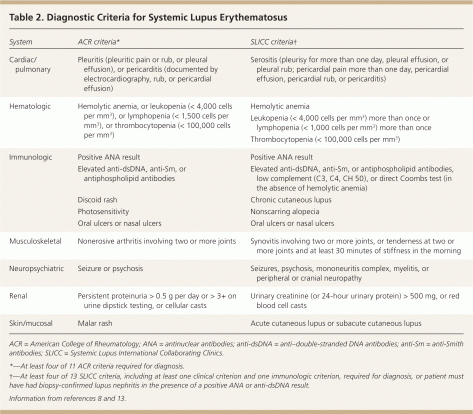
Taken together, she meet at least 6/11 criteria for lupus by ACR (only 4/11) are needed), which we briefly reviewed:

ACRlupus

We then reviewed the ISN/RPS histological classification of lupus nephritis and while it is full of technical language, we simplified it greatly as the following:

  • Class 1&2 – mesangial disease
    • conservative treatment with ACE-i
  • Class 3&4 – proliferative disease
    • treat with steroids + (mycophenolate OR cyclophosphamide)
  • Class 5 – membranous lupus nephritis (AKA membranous nepropathy-like with significant proteinuria
    • treat similarly to proliferative disease, though some experts also consider involving use of a calcineurin inhibtor, extrapolating its benefit from idiopathic membranous nephropathy
    • important to recognize that these classes are not stages, and you can have combined class 3 and class 5 disease OR you can have isolated class 5 disease for example that converts later to combined class 4 and 5 disease – illustrating the importance of a repeat biopsy in situations of acute decline in eGFR or increase in proteinuria
  • Class 6 – advanced sclerosing lupus nephritis
    • >90% of glomeruli on LM are globally sclerosed with no residual activity
    • conservative therapy until RRT needed

For a further review of lupus nephritis, please see the previous, excellent post:

Lupus Nephritis

A Teetering Submassive PE

Today we discussed a case of an unfortunate young man who presented with chest tightness and syncope who later was found to have a massive PE.

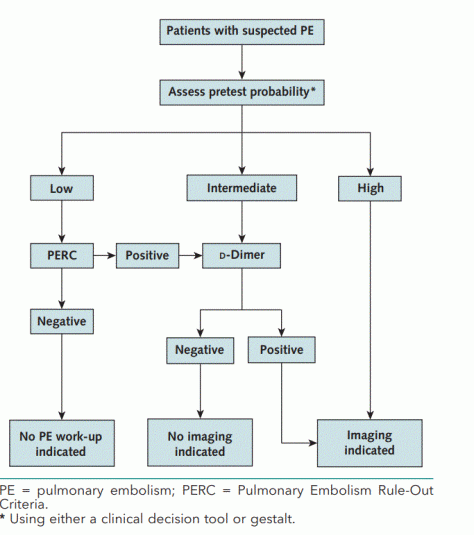
We first discussed that the PE risk stratification is, by no means standardized and that every single society guideline differs slightly. Furthermore, an algorithmic approach is never 100% sensitive and an overall gestalt is valuable.

A. Risk Stratification per ACP from their clinical guidelines, published in 2015 in Annals

PEriskstratificationACP

B. Once a PE is diagnosed, we emphasized the need to classify patients based on the following framework:

  • Massive PE
    • Hypotension is defined as a systolic blood pressure <90 mmHg or a drop in systolic blood pressure of ≥40 mmHg from baseline for a period >15 minutes or hypotension that requires vasopressors or inotropic support and is not explained by other causes
  • Submassive PE
    • Electrocardiographic Signs of Right Heart Strain
    • Echocardiographic Signs of Right Heart Strain
    • Biomarkers of Heart Strain
  • Nonmassive PE

Remember, the anatomic location of the embolus does not relate to the above classification (i.e in a saddle embolus, a retrospective analysis found that only ~22% of such patients had hemodynamic instability)

B. Treatment of PEs

  • Nonmassive PEs will be anticoagulated
  • Regarding massive PEs, treatment patterns vary depending on the institution – but generally speaking –thrombolytics are first line. Depending on the patient and expertise, mechanical thrombectomy and catheter-directed lysis are also possibilities
  • The controversial area is the submassive PE
  • There is no standardized approach to submassive PEs, and even more complicated is that there is no consensus on what exactly is submassive. As Dr. Gohil said, there is submassive and there is submassive. Our goal as internists is to identify patients on teethering death. See this phenomenal PulmCrit post regarding this concept: https://emcrit.org/pulmcrit/submassive-pe-peitho/

C. Treatment of Submassive PEs

  • For years the prevailing dogma is that in submassive PE, thrombolysis fixes the numbers but does nothing to improve clinically meaningful outcomes. The relatively low NNH due to ICH and other clinically significant extracranial bleeding was further evidence for skeptics that we really should not be doing this
  • The heterogeneity of studies has muddled meta-analysis and yet still, the 2014 (somewhat controversial) Chaterjee paper found a mortality benefit to a preemptive thrombolysis approach in submassive patients, muted of course by the increased incidence of bleeding. It is important to note that that has never been an individual RCT that has shown a mortality benefit in lysing submassive patients
  • In the view of experts, what is likely is that in acute, high risk submassive PE patients, thrombolysis may acutely drive the PA pressure down enough to prevent hemodynamic collapse and when done at a reduced dose (50mg/2hrs of tPA) likely does not confer a clinically increased risk of major bleeding
  • The question of course is who are these patients who would benefit from lysis? This requires expertise and early consultation with your specialists. Some experts have advocated for the following patients to be closely examined for thrombolysis

Likely?

  • Elevated shock index (HR/BP)
  • Syncope or presyncope
  • High Endogenous Stress
    • Lactic acidosis
    • Severely “ill appearing” or decompensating

 Possibly?

  • Severe hypoxemia
  • Severe right ventricular dysfunction
  • Extensive clot burden

The reason we lyse these patients is improvement of PA pressures just enough that it prevents hemodynamic compromise and a PEA arrest. The 2017 update to the PEITHO study quite convincingly shows that the long-term morbidity with regards to prevention of RV dysfunction and CTEPH, is likely not different, when compared to patients who were just anticoagulated.

D. Summary of Treatment Considerations (No Consensus and Must be Individualized!)

  • Use a clinical decision rule to help guide your pre-test probability and management for suspected PE
  • Attempt to identify high-risk submassive patients
  • Obtain studies & interventions quickly with the early assistance of consultants (pulmonary, IR, cards)
  • Thrombolysis in submassive patients should be restricted to patients at the greatest risk of death. In other words, it is likely most efficacious in acute, high risk submassive PE, not patients with stable subacute to chronic symptoms
  • Reduced dose of thrombolytics are likely just as efficacious as the full dose, with clearly reduced risk of clinically significant and intracranial bleeding
  • All of the above is not supported by any guidelines and for test question purposes, unless the patient is hypotensive, thrombolysis is probably not the right answer!
  • Other Considerations
    • Avoid volume loading an already dilated RV and if hypotensive, focus on norepinephrine
    • Avoid intubation unless absolutely essential (attempt HFNC first if possible)
    • iNO may have a role