Category Archives: Morning Report

6/30/16: Pulmonary Embolism

  • Remember the risk factors for AQUIRED THROMBOPHILIA:
    • Surgery (OR 21.7)
    • Trauma (OR 12.7)
    • Hospital/SNF (OR 8.0)
    • Cancer undergoing chemotherapy (OR 6.6)
    • Others: estrogen therapy, pregnancy, obesity, smoking
  • Approximately 6% of patients with unprovoked VTEs have an undiagnosed cancer at the time of the VTE; approximately 10% will be diagnosed with cancer in the following year.
  • Use the Well’s PE Criteria for those patients whom you suspect a PE; if the score is <6 consider a D-Dimer to guide management
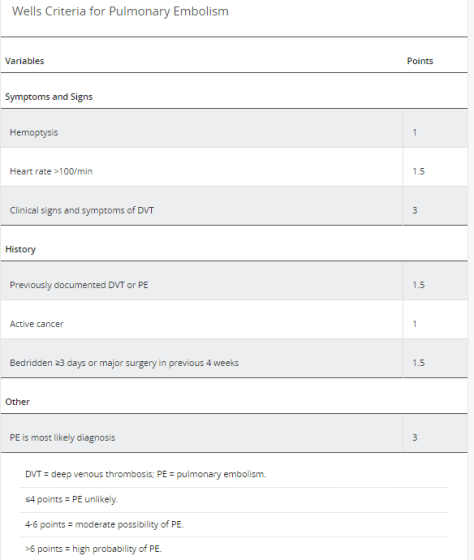
Wells PE

EKG findings in PE:

  • Sinus tachycardia: approximately 44% of patients
  • S1Q3T3 (acute cor pulmonale): not sensitive/specific; found in 20% of patients with PE
  • RV strain patter (TWI R precordial leads V1-V4): representative of elevated PA pressures; found in approximately 34% of patients

Indications for Thrombolytics in PE:

CLEAR INDICATIONS:

  1. Persistent hypotension / shock due to an acute PE

POSSIBLE INDICATION:

  1. Severe / Worsening RV Dysfunction
  2. Cardiopulmonary arrest due to a PE
  3. Extensive clot burden
  4. Free floating RA / ventricular thrombus
  5. Patient foramen ovale

Contraindications to thrombolytics:

  1.  Intracranial neoplasm
  2. Intracranial / spinal surgery or trauma
  3. History of hemorrhagic stroke
  4. Active bleeding
  5. Any stroke within 3 months

Classification of PE and distinction:

Massive: cardiopulmonary shock or hypotension

Submassive: RV dysfunction / elevated cardiac biomarkers

Low Risk: normal echocardiogram / negative cardiac biomarkers


6/20/16: Multiple Sclerosis

  • Recognize the risk factors for MS:
    • Age: typically younger (20-40 years old)
    • Female > Male (3:1)
    • Family History of MS
    • Infections (EBV)
    • Race – white, northern European decent
    • Smoking
    • Autoimmune disease
    • Northern hemispheres (potentially related to lack of sunlight / vitamin D deficiency)
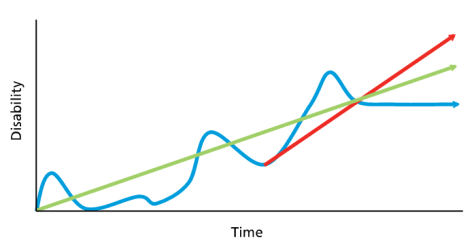
  • Remember the THREE TYPES OF MS:
    • Primary progressive (Green)
    • Relapsing/Remitting (Blue)
    • Secondary progressive (Red)

MS

Lhermitte Sign: a shock-like sensation radiating down the spine or limbs induced by neck movements.

Uhthoff Phenomenon: worsening MS symptoms with increased body temperature.

  • Diagnosis requires the evidence of CNS demylenation in BOTH SPACE AND TIME.
  • Remember the common eye findings with MS:
    • Optic neuritis: occurs in 50% of MS patients and is the presenting symptom in 20-30%
    • MLF syndrome: inability to adduct the affected eye; opposite eye can experience nystagmus
    • Marcus Gunn Pupil (afferent pupillary defect): inability of the affected eye to constrict when light is shown
  • Oligoclonal bands IgG on LP
  • Treatment regimen:
    • Routine: physical activity, vitamin D/calcium, routine vaccinations, smoking cessation
    • Acute: high dose steroids (typically 1 g/day for 3-5 days)

6/15/16: Acid/Base Problems

For Acid Base Disorders:

  • Check for internal consistency
  • Use pH to determine the primary disorder
  • Calculate the AG
  • Determine the presence of additional disorders
  • Calculate the expected pCO2 for any metabolic acidosis to evaluate for additional respiratory acidosis.

Winter’s Formula: expected pCO2 = 1.5 (HCO3) + 8 +/-2

  • Remember vagal maneuvers for SVT: carotid massage, valsalva, diving reflect
  • Remember the trial of DKA:
    • Hyperglycemia
    • Anion Gap Metabolic Acidosis
    • Ketonemia
  • DKA management:
    • Fluids: usually 3-6L deficient
    • Insulin: 0.1 U/kg bolus followed by a rate of 0.1 U/kg/hr; adjust as needed
    • Electrolytes: watch for K and phosphate – typically appear normal initially, but are actually “total body” deplete – likely to drop quickly with insulin administration

6/1/16: Adrenal Insufficiency

  • Remember the layers of the adrenal anatomy and the corresponding hormones produced:

Glomerulosa: Mineralcorticoids (i.e. aldosterone)

Fasciculata: Glucocorticoids (i.e. cortisol)

Reticuloaris: Adrenal Androgens (i.e. testosterone

Chromuffin Cells: Epinephrine

  • Remember the ANTERIOR products of the pituitatry gland: (FLATPEG)

FSH

LH

ATCH

TSH

PROLACTIN

ENODORPHINS

GH

  • Remember the two hormones of the POSTERIOR pituitary:

Oxytocin

ADH

06/30 Neutropenic fever Morning Report

TAKE HOME POINTS 

Diagnosis

>38.3 fever or >38 sustained for one hour
-ANC<500 or ANC expected to decrease <500 within 48 hours

Empiric therapy (give as soon as possible for neutropenic fever, <30-60 minutes)

1)Cefepime 2 gm IV q8h
2)Meropenem 1 gm q8h (or other carbapenem but NOT Ertapenem as misses pseudomonal coverage)
3)Zosyn 4.5 g IV q6-8h
4)Ceftazidime 2 gm IV q8h (less often used due to resistance patterns)

*If concern for anerobic infection, can add Flagyl to Cefepime or if suspecting C.diff
*No proven benefit to one empiric therapy over another

When to add Vancomycin to empiric therapy

1)Severe sepsis/HD unstable
2)Pneumonia
3)MRSA colonization
4)Suspected CVC related infection
5)Previously on Quinolone prophylaxis
6)Skin/soft tissue infections
7)+ BC for GPC

*Can consider discontinuing Vancomycin if negative cultures x 48 hours

How long to treat for with empiric therapy?

-(generally) continue antibiotics until ANC>500 and afebrile if no culture data
-If culture data, treat x 14 days

06/27/16 Morning Report-Factor 8 inhibitor

TAKE HOME POINTS 

How do approach elevated PT/INR, or PTT of unknown etiology

-Do Mixing study to see if it corrects (deficiency) or doesn’t correct (inhibitor)
-PT=Play Tennis OUTSIDE=Extrinsic pathway
-PTT=Play Table Tennis INSIDE=Intrinsic pathway
-Most common inhibitor is Factor 8 inhibitor causing elevated PTT

Causes of elevated PTT

-Involves Factor 8, 9, or 11
-Iatrogenic causes include heparin, LWMH
-Lupus anticoagulant (usually presents with thrombosis)

Risk factors for developing a Factor inhibitor

-Pregnancy, post-partum, RA,  malignancy, SLE, some drug reactions (Phenytoin/Penicillin)

Treatment

-Control bleeding (done via activated prothrombin complex concentrate like FEIBA or recombinant human factor VIIA)
-Eliminate inhibitor via immunosuppression (steroids +-rituximab +-Cytoxan)

5/19/16 Aeromonas SBP – morning report

Teaching Pearls

  • Aeromonas is a Gram Negative Rod and is the third leading cause of SBP in Korea
  • It causes a warm season diarrheal disease
  • Remember the three indications for SBP prophylaxis:
    • History of SBP, lifelong prophylaxis
    • Cirrhosis with GI Bleed, 7 days of prophylaxis
    • Ascitic protein < 1, prophylax while inpatient
  • Don’t forget to give Albumin 1.5grams/kg on Day 1 and 1.0gram/kg on Day 3 for patients with SBP
  • Remember to think about secondary bacterial peritonitis (from intestinal perforation, PUD) in the differential for SBP
  • Check out this review on AeromonasSBP!

Morning Report 12/30/15

  • Cryptococcosis is treated with Flucytosine, Ambisome for 2 weeks of Induction, and the Fluconazole for maintenance
  • Include Bacillary angiomatosis on the differential for Kaposi’s Sarcoma
  • Fungal infections can be due to Yeasts, Molds, or Dimorphic Fungi
    • Yeast: Think Single Celled Organisms, Candida and Cryptococcus
    • Mold: Think Filamentous with Hyphae. Aspergillus,  Mucor
    • Dimorphic Fungi: Can be both yeast or molds depending on the Temperature. Includes Histo, blasto, cocci
  • We didn’t get to this today, but here is a framework for organizing anti-fungal medications!

5/18/16 AM Report – Calciphylaxis

  • Think about calciphylaxis in your ESRD patients with non-healing ulcers in areas of adiposity (abdomen, buttocks, thighs, legs)
  • Biopsy shows arterial calcifications without vasculitis
  • Often associated with elevated PTH levels and elevated calcium-phosphorous product, hypoalbuminemia
  • Check out this UCSF resident hand-out on calciphylaxis!
  • We had a great review of features of chronic venous stasis including lipodermatosclerosis (inverted champagne bottle), atrophie blanche, telangiectasias, ulcerations on the medial ankles.
  • See the table below for comparison/contrast of arterial versus venous ulcers
Venous Arterial
Pathophysiology Reflux and Venous stasis, faulty valves Atherosclerosis, embolic
Skin Findings Lipodermatosclerosis (inverted champagne bottle)

Atrophie Blanche

Telangiectasias

Hyperpigmentation

Warm

Hairless

Pale, Shiny, Taut

Cold

Ulcers Shallow, superficial, irregular borders Punched out, deep, full thickness wounds
Pain Less painful usually, improves with leg elevation Severe pain, improves with lowering legs
Ulcer Location Medial and lateral malleolar Above bony prominences, pressure points, base of heel