Tag Archives: Rheumatology

Diffused Alveolar Hemorrhage (DAH) AND Hemophagocytic Lymphohistiocytosis (HLH) 10/22/2018

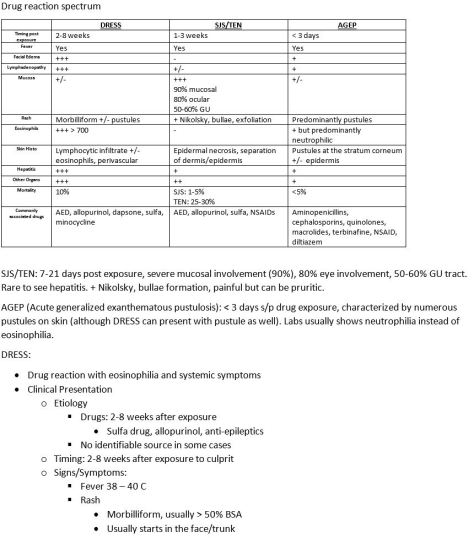
Thank you Charles for presenting this really interesting case. A 18 year old woman with a history of asymptomatic thrombocytopenia who presents with several days of non-specific fever, chills, malaise, mild shortness of breath and she was found to have acute anemia, thrombocytopenia, elevated transaminitis, and patchy bilateral pulmonary infiltrates on CXR during initial presentation. She became acutely ill with submassive hemoptysis and went into respiratory failure in 24-48 hours. She was found to have DAH on BAL. Her autoimmune and infectious work up came back negative, but her ferritin  came back at 75776. Base on this and her constellation of symptoms, further work up revealed a 6/8 criteria for diagnosis of hemophagocytic lymphohistiocytosis!


DAH

Presentation

  • Dyspnea, cough fever, respiratory failure, acute anemia
  • Hemoptysis only in 2/3 of cases
  • Definition: Hemoptysis, diffuse alveolar infiltrates, acute anemia, and hypoxemic respiratory failure

Pathophysiology

  • Widespread damage to pulmonary small vessels, leading to blood within the alveoli eventually causing impaired gas exchange.
  • Causes: Autoimmune/connective tissue disease leading to pulmonary vasculitis (ANCA, anti-GBM), certain pulmonary infections, toxins, drug reactions, mitral stenosis in some cases
  • 3 distinct histologic subtypes that can give hints to underlying pathology
    • Most common: Pulmonary capillaritis: ANCA vasculitis, GPA, EPGA, pauci-immune, Goodpasture, HSP, SLE, RA, APLS, MCTD, Behcet, drug-induced, lung transplant rejection, etc.
      • Systemic vasculitis manifestation
    • Bland pulmonary hemorrhage: Coagulopathy, mitral stenosis, toxin/inhalation, SLE, drugs, Goodpasture
      • Anti-GBM, SLE, no inflammation or destruction of capillaries but RBC leakage
    • Diffuse alveolar damage: BM transplantation, radiation, ARDS, cytotoxic drugs, other causes

Diagnosis

  • CXR: Diffuse bilateral alveolar infiltrates, no pathognomonic findings
  • BAL: serial bloody aspirate with sequential sampling
  • DAH
  • CT: Non-specific GGO
  • Biopsy: Tissue biopsy of the lung is definitive in confirmation of DAH but underlying cause might not be revealed.

Management

  • Treat underlying cause
  • Respiratory support, most patients die from respiratory failure
  • High dose corticosteroids, i.e. methylprednisolone up to 500mg Q6H (up to 2g daily)
  • Other agents: Cyclophosphamide, azathioprine, MTX, mycophenolate, etanercept.
  • Plasmapheresis for Goodpasture or vasculitidies.
  • Key: Early identification and treatment

HLH

Epidemiology

  • Worldwide incidence is unknown, not enough data available, thought to be rare AND underrecognized but growing recognitive leads to higher incidence.
  • Familial types: more common to occur in pts < 18yo
  • Secondary HLH: any age

Pathophysiology

  • Uncontrolled hyperinflammatory response with dysregulated macrophage activity leading to excessive cytokine production
  • Primary: HLH due to an underlying genetic abnormality or without clear cause
    • Autosomal recessive familial HLH
    • Idiopathic
  • Secondary: Due to something else
    • Retrospective study at Mayo in 2014:
      • Infection (34%), most commonly EBV
      • Autoimmune (8%), Macrophage activation syndrome (MAS), most often associated with AOSD, systemic juvenile idiopathic arthritis, or SLE.
      • Malignancy (52%) NHL, HL, acute leukemia
      • Idiopathic/Immune deficiency/other (6%)

Presentation

  • Fever, splenomegaly, cytopenias are most common
  • + manifestation of the trigger
  • Complications: Infection, DIC, bleeding complications (reports of intracranial hemorrhage, GIB, DAH), end organ damage.

Diagnosis: Per the Histiocyte Society: 5/8 criteria for diagnosis. In case you cannot remember all 8, please refer here for the famous HLH Song by Dr. Eric Lau:

    1. Fever
    2. Splenomegaly
    3. Peripheral cytopenia (> 2 cell lines)
    4. Hypertriglyceridemia or Hypofibrinogenemia
    5. Elevated ferritin > 500 (> 10000 = 90% sensitive and 96% specific for HLH)
    6. Low NK cell activity
    7. Elevated soluble CD25 (soluble IL2-R)
    8. Hemophagocytosis in BM, spleen, or LN: Only seen in later course of the diseases and not required for the diagnosis, neither sensitive nor specific, can be seen in severe sepsis/critical illness)

Management

  • Like all things in medicine, treat the underlying cause
  • Current treatment is based on the HLH-94 study on pediatric population
    • Induction: 8 weeks dexamethasone and etoposide.
    • Maintenance: Cyclosporine, tacrolimus, dex pulses
    • If MAS: Steroids alone, usually responsive.
    • Hematopoietic stem cell transplant is refractory/relapsing.

For more information on HLH, please refer to this article by Dr. Schram and Dr. Berliner published in Blood (as in the journal) in 2015.

On rhabdo and myopathies – 10/9/18

Thanks to Cameron and Adam for presenting the case of a middle aged man with no significant PMH who presented with diffuse myalgias and chronic progressive proximal muscle weakness, found to have a CK >12k and EMG findings concerning for an inflammatory myopathy, awaiting muscle bx for diagnosis.


Clinical Pearls

  • Rhabdomyolysis literally means dissolution of skeletal muscle and has a broad differential outside of the typical traumatic or exertional processes associated with it see below).
  • The four main inflammatory myopathies are dermatomyositis, polymyositis, inclusion body myositis, and necrotizing autoimmune myositis.
  • Polymyositis is rare and a diagnosis of exclusion after the other three main inflammatory myopathies have been investigated.
  • Overall, the prognosis of inflammatory myopathies is good with appropriate treatment.  The exception is inclusion body myositis which is a progressive disorder without any effective therapy.
  • Pigment nephropathy can occur with rhabdo regardless of the underlying etiology especially in patients with CK >5000.  Aggressive IV hydration to lower CK levels is important to reduce the risk of kidney injury.

Rhabdomyolysis:

DDx:

  • Traumatic
    • Crush injuries, surgery, prolonged compression from immobility or coma
  • Non-traumatic
    • Exertional:
      • Normal muscle: strenuous exercise, heat stroke, seizures, hyperkinetic states
      • Abnormal muscle: metabolic myopathies, mitochondrial myopathies, malignant hyperthermia, NMS
    • Non-exertional
      • Alcoholism
      • Drugs and toxins: lipid-lowering drugs (fibrates, statins), alcohol, heroin, cocaine, meth, colchicine
      • Infections: influenza, coxsackie, EBV, HIV, legionella
      • Electrolyte abnormalities: hypokalemia, hypophosphatemia, hypocalcemia
      • Endocrinopathies: DKA, HHS, hypothyroidism, vitamin D deficiency
      • Inflammatory myopathies (rare)
      • Paraneoplastic
      • Miscellaneous

Inflammatory myopathies

Largest group of potentially treatable myopathies in children and adults.

  • Four subtypes: distinguishing which process is important because each subtype has a different prognosis and response to therapy
    • DM
      • Anti-Mi-2, anti-MDA-5, anti-TIF-1, anti-NXP-2
    • PM
      • Rare, often misdiagnosed
      • Dx of exclusion
    • Necrotizing autoimmune myositis
      • More common than PM
      • Occurs alone or after viral infections or in association with cancer, CTD, or post-statin
      • Anti-SRP or anti-HMGCR
      • Highest CK level
    • Inclusion body myositis
      • Most common in people >50
      • 7.9 cases/million in the US
      • Distal muscles impacted first
      • Facial muscles impacted
      • Muscle atrophy occurs earlier than in others
      • Extramuscular manifestations are uncommon
      • Dysphagia occurs in >50%
      • Muscle atrophy is common
      • Lowest CK level
  • Up to 30% of patients with DM or PM have a constellation of clinical findings termed “antisynthetase syndrome”
    • Acute disease onset
    • Constitutional symptoms (fever, weight loss)
    • Myositis
    • Raynaud’s
    • Mechanic’s hands
    • Non-erosive arthritis
    • ILD
    • Labs show antibodies to tRNA synthetase enzymes (anti-Jo-1)
  • Extramuscular manifestations
    • systemic symptoms
    • cardiac arrhythmias or ventricular dysfunction
    • pulmonary complications (ILD)

Capture

Table above adapted from this and this review article by NEJM.

GPA – 10/1/18

Yours truly presented a case of a middle-aged woman with a recent history of otitis, sore throat, conjunctivitis, photophobia, and arthralgias who presented with chronic and progressive decline in functional status and AMS, found to be uremic with work up revealing c-ANCA associated ESRD.


Clinical Pearls

  • Remember that oval fat bodies are specific for glomerular pathology (more commonly nephrotic syndrome but can be seen in nephritic disease as well).
  • ANCA-associated vasculitides include GPA, MPA, eGPA (and renal-limited vasculitis).
  • All have similar features on renal histology (focal necrotizing, crescentic, pauci-immune glomerulonephritis).
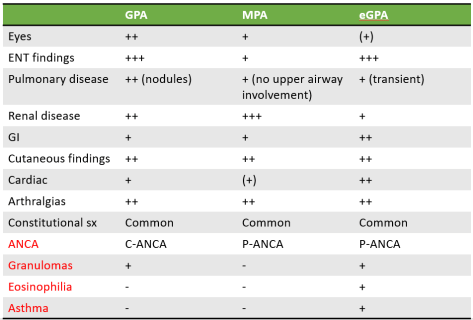
  • They can affect multiple organ systems (see breakdown below) which makes their clinical diagnosis challenging apart from the following differences:
    • c-ANCA is associated with GPA, p-ANCA is seen in MPA and eGPA
    • Granulomas are seen in GPA and eGPA
    • Eosinophilia and asthma are associated with eGPA

ANCA-associated vasculitides

Capture

Chart above adapted from this paper by Koldingsnes et al.

Granulomatosis with polyangiitis (GPA)

Diagnostic criteria (two or more has 88% sensitivity and 92% specificity):

  • Nasal or oral inflammation (painful/painless oral ulcers, or purulent or bloody nasal discharge)
  • Abnormal chest radiograph showing nodules, fixed infiltrates, or cavities
  • Abnormal urinary sediment (microscopic hematuria w/w/o red cell casts)
  • Granulomatous inflammation on bx of artery or perivascular area

Clinical presentation:

  • Most commonly in older adults, M=F
  • More common among white individuals (~89%)
  • S/s
    • Fatigue, fever, weight loss, arthralgias, rhinosinusitis, cough, dyspnea, urinary abnormalities, purpura, and neurologic dysfunction.
    • ENT
      • 90% of GPA cases, only 35% of MPA
      • Nasal crusting, sinusitis, otitis media, earache, polychondritis, ulcers, discharge
      • Conductive and/or sensorineural hearing loss
      • Saddle nose deformity
    • Tracheal and pulmonary disease
      • Airways or parenchyma
    • Renal
      • ~18% at presentation but subsequently develops in 77-85% of patients within the first 2 years of disease onset
      • High risk of progression to ESRD
      • Asymptomatic hematuria
      • Subnephrotic range proteinuria
      • Rapidly progressive GN
    • Cutaneous
      • ~50% of patients
      • Leukocytoclastic angiitis is most common which causes purpura of lower extremities
      • Other findings: urticarial, livedo reticularis, nodules, erythema nodosum, pyoderma gangrenosum, and Sweet syndrome
    • Ophthalmic/orbital
      • Conjunctivitis, corneal ulcers, episcleritis/scleritis, optic neuropathy, retinal vasculitis, and uveitis.
    • Other organs
      • CNS: neuropathy, CN abnormalities, mass lesions, hearing loss, granulomatous inflammation of the CNS
      • GI tract, heart, lower GU, parotids, thyroid, liver, or breast
      • High incidence of DVT (unclear mechanism)
    • Can progress slowly over months or explosively over days
    • Relapses can manifest differently than original presentation

Diagnosis requires biopsy!

Treatment:

  • Prompt initiation of therapy can be life and organ sparing
  • Induction therapy: Steroids +-Cyclophosphamide +-Rituximab
  • Maintenance therapy: multiple options-Azathioprine, MTX, Rituximab, Leflunomide

Still’s Disease – 9/10/18

Thanks to Becky Lee yet again for presenting an interesting case of a young woman presenting with acute onset of fever and polyarthritis, found to have a history of similar episodes in the past together with a rash concerning for Still’s disease!


Clinical Pearls

  • Still’s disease is a diagnosis of exclusion!  Yamaguchi criteria can help with ruling in the diagnosis.
  • Still’s remains a multi-systemic disorder of unknown etiology because it’s difficult to diagnose and rare (0.16 cases per 100,000).
  • RF and ANA are generally negative but can be positive in <10% of patients with Still’s in low titers.
  • ~66% of patients present with sore throat secondary to cricothyroid perichondritis or aseptic nonexudative pharyngitis.
  • The disease is often recurrent.  Predictors of poor outcome include erosive polyarthritis on presentation and shoulder/hip involvement.

Acute polyarthritis (>5 joints involved):

Remember that for rheumatologic disorders, timing, symmetry, and number of joints involved is crucial to coming up with a differential diagnosis.  So for our patient with acute polyarthritis, consider the following:

  • Infection
    • Viral: hepatitis, HIV, parvovirus B19
    • Spontaneous bacterial endocarditis
  • Rheumatologic:
    • Rheumatoid arthritis
    • Reactive arthritis
    • SLE
    • Dermatomyositis
  • Vasculitis
    • PAN
  • Drug reactions
  • Auto-inflammatory or disease of the innate immune system (as opposed to autoimmune or diseases of the adaptive immune system):
    • Periodic fever syndromes (TRAPS, PFAPA, hyper-IgD syndrome)
    • Still’s disease
  • Schnitzler’s syndrome – chronic urticaria associated with a monoclonal gammopathy (usually IgM kappa)
  • Sweet syndrome – painful skin lesions
  • Sarcoid
  • Kikuchi disease – cervical LAD and fever (necrotizing lymphadenitis)
  • HLH/Macrophage activation syndrome – leukopenia and thrombocytopenia, elevated triglycerides, low fibrinogen and haptoglobin

Still’s disease:

  • Some clarifications on nomenclature:
    • Systemic juvenile idiopathic arthritis (sJIA): first presentation <17 years old, previously referred to as Still’s disease
    • Adult onset Still’s disease (AOSD): first presentation  > 17 years old
  • Epidemiology of AOSD:
    • 0.16 cases per 100,000
    • No sex predominance (F=M)
    • Bimodal age distribution with peak between 15-25 and another 36-46 years of age.  New diagnosis in patients >60 have been reported.
  • Clinical features ⇒ Yamaguchi criteria (need 5 total with  > 2 major)
    • Major criteria:
      • Daily fevers to 39
      • Arthritis >2 weeks
      • Non-pruritic salmon-colored macular/maculopapular rash on trunk or extremities (though cases of pruritic rash have also been reported)
      • ↑ WBC >10k, >80% neutrophils
    • Minor
      • Sore throat
      • LAD and/or splenomegaly
      • ↑ AST, ALT, or LDH
      • Negative ANA/RF
  • Treatment
    • Mild: NSAIDs
    • Moderate: NSAIDs + DMARDs
    • Severe: NSAIDs + DMARDs (IL1 receptor antagonists like anakinra appear to be more helpful than TNF inhibitors especially in sJIA)
  • Prognosis:
    • Overall good prognosis
    • Disease can be limited to one episode or recurrent over time
    • Poor prognostic indicators:
      • Hip and shoulder involvement
      • Erosive polyarthritis at initial diagnosis
  • Complications
    • Macrophage activation syndrome (ie HLH) can occur in 15% of cases
    • DIC
    • TTP
    • Diffuse alveolar hemorrhage
    • Pulmonary HTN
    • Aseptic meningitis

References: 

Great recent review article on Still’s disease (AOSD Review) and this prior post on our blog!

Adrenal insufficiency, lupus flare, and mixed AIHA- 9/6/18

Thanks to Becky for presenting the case of a middle-aged woman with h/o SLE and Evans syndrome who presenting with subacute onset of fatigue after her prednisone dose was reduced, found to have iatrogenic adrenal insufficiency, lupus flare, and mixed autoimmune hemolytic anemia!


Clinical Pearls:

  • Evans syndrome describes AIHA + ITP, a rare condition associated with SLE and often precedes the diagnosis of SLE by a few years.
  • Hematologic manifestations of SLE are many and include the following
    • Anemia (chronic disease, iron deficiency, medication-induced, warm AIHA>>cold AIHA, pure red cell aplasia, MAHA, and pernicious anemia)
    • Leukopenia
    • Thrombocytopenia
    • Pancytopenia
    • Evans syndrome
  • Smear findings can be very helpful in diagnosing different types of hemolytic anemiasSchistocytes are a very specific for MAHA, valve disorders, AVMs, APLS whereas AIHA would result in spherocytes. 
    • The negative predictive value of spherocytes is low.  So a smear without spherocytes does not rule out AIHA!
  • Lastly, the most common cause of adrenal insufficiency (AI) is iatrogenic.
    • General rule of thumb for when risk of AI is high and you should taper steroids slowly is if someone is on prednisone > 20 mg for > 3 weeks.  Keep in mind that people with smaller BSA would be more susceptible to AI and at risk with even lower doses.

Hemolytic anemia work up

Check smear

  • Schistocytes
    • MAHA: TTP, HUS, HELLP, DIC, HTN
    • Valve disorder
    • AVMs
    • APLS
  • No schistocytes (+ spherocytes)
    • Intrinsic RBC defect
      • Enzyme deficiency (G6PD)
      • Hemoglobinopathy (sickle cell)
      • Membrane defect (hereditary spherocytosis)
    • Extrinsic RBC defect
      • Liver disease
      • Splenic sequestration
      • Infections (clostridium perfringens, babesia, malaria, bartonella)
      • Meds/toxins (dapsone, nitrites, lead, copper, snake venom)
      • AIHA (warm and cold)
    • Intravascular
      • Transfusion reaction
      • Infections
      • PNH

Lab findings in AIHA: 

  • ↑ retic
  • ↑ indirect bili
  • ↑ LDH
  • ↓ haptoglobin
  • + DAT (but keep in mind that DAT can be negative in 3% of patients with WAIHA)
  • + spherocytes

Summary of AIHAs:

Picture1


Felty’s Syndrome 8/13/2018

Narges presented a case of an elderly lady with chronic total body pain, found to have rheumatoid arthritis, pancytopenia, and splenomegaly… What could this be? Classic triad for Felty’s Syndrome!

We will start with a brief review of RA:

Rheumatoid Arthritis

  • Epidemiology
    • F : M = 3:1
    • Age of onset usually 50-75
    • Risk factors
      • Smoking
      • Nulliparity
      • Genetics (twins)
    • Extra-articular manifestation (40% cases will have some degree of involvement)
      • Bone: Osteoporosis, esp hip and L-spine
      • MSK: Myositis, muscle weakness
      • Vessels: Vasculitis
        • Neuropathy, pain (MSK vessel inflammation), skin ulceration
      • Skin: Rheumatoid nodule, skin ulcers esp LE, neutrophilic dermatoses
      • Eye: Episcleritis, scleritis, rare
      • Lung: Rheumatoid nodules, parenchymal disease, pleural disease, airway obstruction, pleural effusions (low glucose < 30)
      • Heart: Inc risk of CAD
      • Neuro: Inc risk for stroke
      • Kidney: Higher risk for development of rneal disease
      • Heme: Anemia, neutropenia, thrombocytopenia, inc risk of lymphoma
    • Diagnosis
      • Inflammatory arthritis 3 or more joints
      • RF or CCP
      • ESR/CRP elevation
      • > 6 weeks sx
    • Immunology
      • RF: Sensitivity 80%, Specificity 87%. 5-10% of healthy individuals might have positivity
      • CCP: Sensitivity 76%, Specificity 96%
    • Management (per American College of Rheumatology)
      • Treat ASAP, usually start with DMARD: Screen for latent TB, HBV and HCV prior!
      • HCQ (hydroxychloroquine): Baseline retinal screening and then annual after 5 years of use
      • SSZ (sulfasalazine)
      • MTX (methotrexate)
      • LEF (Leflunomide)
        • Mono
        • Double
        • Triple
        • Combo
      • Biologics
        • Tofacitinib (Janus kinase inhibitor)
        • Abatacept (T-lymphocyte inhibitor)
        • Tocilizumab (IL6 Ab)
        • Rituximab (CD20 MAB)
        • TNF: Etanercept, influximab
      • Steroids

RA Tx

Felty’s Syndrome

  • Epidemiology:
    • Occurs in ~ 1% of patients with RA
    • Not very well understood
    • Associated with HLA-DR4
  • Presentation: Triad of RA, pan-cytopenia, and splenomegaly
    • RA: Typically more severe, erosive, seropositive for RF +/- CP
      • More frequently with extra-articular manifestations
    • Neutropenia: Present in 100%, ANC < 2000 typically, usually with associated anemia + thrombocytopenia. Typically persistent
    • Splenomegaly: Present in most but does not correlate with disease severity
    • Inc risk for hematologic malignancy
  • Diagnosis
    • Clinical: Triad of RA, neutropenia, and splenomegaly
    • Immune: + DsDNA, anti-glucose 6 phosphate isomerase (92%), might have circulating immune complex formation (low complements)

If BM biopsy with lymphocyte infiltration = Large Granular Lymphocyte Syndrome (Pseudo-Felty’s), frequent infections, can progress to LGL Leukemia

Catastrophic Antiphospholipid Syndrome, +/- Heparin induced thrombocytopenia & thrombosis, +/- SLE 8/1/2018

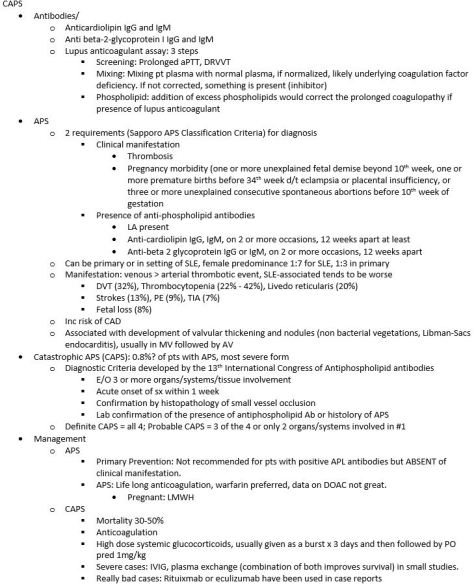
Wendy presented a fascinating (and confusing!) case of a patient with history of APS and DVT/PE on chronic warfarin presenting with painful, non-blanching, palpable purpuric rash on the left thigh and lower abdomen found to have thrombocytopenia,  and proteinuria. Skin biopsy revealed small vessel microthrombi. Work up positive SRA, positive ANA, positive DsDNA, low complements… Base on this presentation, the patient possibly has catastrophic antiphospholipid syndrome, with heparin induced thrombocytopenia, and newly diagnosed SLE!

CAPS1CAPS2CAPS3.JPG

Lupus nephritis – 7/26/18

Thanks to Naina for presenting an interesting case of a young woman presenting with fever, nausea/vomiting, and R flank pain found to have pyelonephritis and lupus nephritis!


Clinical Pearls

  • Renal involvement is noted in ~50% of patients with SLE and can present as nephrotic or nephritic syndromes.
  • The most common and severe form is diffuse proliferative lupus nephritis (class IV)
  • It is important to distinguish SLE flare from an infection. When infection is present, it must be treated first before starting immunosuppression.
    • SLE flare is associated with a normal WBC, low CRP (because CRP production by hepatocytes is down-regulated by type 1 IFN release in lupus flare), and absence of fever
  • Lab findings suggestive of flare include elevated anti-dsDNA (correlates with disease activity), low complement levels (predominantly C3 decline), worsening proteinuria, and elevated creatinine.

Capture

* Membranoproliferative GN can present with mixed nephrotic/nephritic picture.

SLE and renal disease:

  • Renal involvement is common and eventually occurs in ~50% of SLE patients
  • 10% progress to ESRD
  • High mortality compared to SLE w/o nephritis
  • More common and severe in African Americans, Hispanics, Asians and can be the only manifestation of lupus on presentation!
  • Classifications of GN:
    • Can evolve from one to another
    • Minimal mesangial lupus nephritis (class I)
      • Earliest and mildest form
      • Rarely diagnosed b/c pts have a normal U/A, no or minimal proteinuria, and normal Cr
    • Mesangial proliferative lupus nephritis (class II)
      • Microscopic hematuria and/or proteinuria
      • Light microscopy would show mesangial hypercellularity or mesangial matrix expansion
    • Focal lupus nephritis (class III)
      • Hematuria, proteinuria, some HTN, decreased GFR
      • Less than 50% glomeruli affected by light microscopy
      • Segmental glomerulonephritis
    • Diffuse lupus nephritis (class IV)
      • Most common and most severe
      • Hematuria, proteinuria, nephrotic syndrome, HTN, reduced GFR
      • Hypocomplementemia (esp C3) and elevated anti-dsDNA during active disease
      • >50% of glomeruli are affected
    • Lupus membranous nephropathy (class V)
      • nephrotic syndrome, Cr normal or slightly elevated
      • Diffuse thickening of the glomerular capillary wall and subepithelial deposits
      • Can present without any other clinical or serologic manifestations of SLE
    • Advanced sclerosing lupus nephritis (class VI)
      • Slow, progressive renal dysfunction with proteinuria and relatively bland urine sediment
      • Global sclerosis >90% of glomeruli
      • Active GN no longer observed
  • Treatment:
    • Best to initiate early but AFTER treatment of active infection:

      • Cyclophosphamide or Mycophenolate PLUS solumedrol 250-1 g/day x 3 days (former takes 10-14 days to have an effect so the latter is much faster) or prednisone 60 mg/day
      • Mycophenolate is the preferred choice to preserve fertility in women of reproductive age
    • Goals of therapy:
      • substantial reduction in urine protein excretion  to <0.33 g/day
      • improvement or stabilization of serum creatinine
      • improvement of urinary sediment

Dermatomyositis – Morning Report 4/24/18

Definitions

– Polymyositis = muscle weakness without cutaneous signs
– Dermatomyositis = muscle weakness and cutaneous signs
– Amyopathic DM = cutaneous signs without muscle weakness

Epidemiology

  • F:M = 2:1
  • Peak incidence is age 40-50 but any age affected

Clinical Manifestations

  • Muscle weakness in 90% of PM patients and 50-60% in DM – in DM, rashes usually come before or at the same time
  • Symmetric and proximal muscle weakness
  • If +distal muscle weakness, usually mild
  • Insidious onset usually for months before they go to doctors
  • Skin findings
    • Usually on the joints involved whereas lupus shows cutaneous things between the joints
    • Gottron’s papules and heliotrope rash
    • Facial erythema – includes nasolabial folds
    • Shawl and v-signs
    • Holster sign – lateral aspect of the thigh
    • Inflammation of the nail fold
  • Lung disease – 10% of cases of DM and PM
  • Malignancy – generally parallels that of the general population distribution
  • Esophageal disease – weakness of the muscles à dysphagia/regurgitation
  • Cardiac disease – conduction abnormalities and arrhythmias, increased risk of MI

Labs

  • Elevated muscle enzymes (CK, LDH, AST, ALT, aldolase)
  • ANA + in 80% of patients and myositis ab in 30-40% of patients (Jo, Mi2, SRP)
  • Elevated serum and urine myoglobin
  • ESR is normal or midly elevated

EMG

  • Normal in 10% of the patients