Category Archives: Morning Report

Hemoptysis 

Rainy Zhang, our wonderful PGY-3 presented a case of non-massive hemoptysis. Massive hemoptysis is defined as >150cc in 24 hours. If massive, remember to:

  1. Put the affected lung down
  2. Do your ABCs and call IR early
  3. Temporize with inhaled TXA
  4. Bronchoscopy can be done to localize the bleed  

If non massive hemoptysis, think about vasculitis work up – especially with multi-organ involvement. We will go over this case further next week. 

Myelin oligodendrocyte glycoprotein antibody disorders (MOGAD)

We discussed a case of a young female who had prodromal viral illness with subsequent acute onset right internuclear ophthalmoplegia, R optic neuritis, facial numbness, left UE/LE weakness and loss of sensation that quickly progressed to her right UE/LE involvement with urinary and bowel retention. Brain MRI showed hyperintensity on T2/FLAIR in the pons without restricted diffusion; Spine MRI w wo con showed diffuse cord signal abnormality with enhancement and cord expansion throughout the cervical/thoracic/lumbar spine. LP showed lymphocytic pleocytosis. Her “MOG” Antibodies returned >1:2560 with negative oligoclonal bands and negative paraneoplastic workup.

Ddx for acute myelopathy from immune-mediated neuroinflammatory causing demyelination

  • MOGAD
  • AQP4-NMOSD (Neuromyelitis optica spectrum disorder)
  • Multiple Sclerosis 

Sx of MOGAD

  • MOGAD often presents w/ optic neuritis. So consult ophtho! 

Treatment of MOGAD

  • She received high dose steroids and plasma exchange with full recovery of motor and sensory function 

Sweet Syndrome

We discussed a case of a young woman w/ refractory AML, who was admitted for relapse of AML and developed new acute edematous (“juicy”), violaceous plaques, found to have Sweet syndrome.

Types

  • Idiopathic (classic)
  • Malignancy-associated
  • Drug-associated

Clinical manifestations

  • Abrupt, painful, edematous (“juicy”), erythematous / violaceous
  • Papules / plaques / nodules

Diagnosis

  • Clinical assessment and diagnostic criteria (there are criteria for idiopathic and for drug-associated)
  • Biopsy

Treatment

  • Systemic glucocorticoids (1st line)

Polycythemia

We discussed a case of a young man w/ HTN, HLD, hx PE s/p anticoagulation, tobacco use disorder, and significant family cardiac history, who presented for acute on chronic chest pain, and was found to have multivessel CAD and polycythemia.

Framework for polycythemia

  • Relative (hemoconcentration)
  • Absolute
    • Primary / polycythemia vera (PV)
    • Secondary
      • Hypoxia, tumor-associated (EPO secretion), Misc (blood doping, exogenous EPO, androgen/steroids)

Clinical manifestations of PV

  • Aquagenic pruritus
  • Erythromelalgia
  • Facial plethora
  • Thrombosis (CVA, MI, DVT, PE)

Treatment of PV

  • Therapeutic phlebotomy: goal Hct < 45%
  • Low-dose ASA
  • Cytoreduction (hydroxyurea) for high risk PV

Heat Stroke

We discussed a case of an elderly woman who presented with fever (up to 39.4C), hypotension, acute encephalopathy, due to heat stroke.

Diagnosis

  • Core temp > 40C (104F) + CNS dysfunction + exposure to severe environmental heat

Types

  • Exertional vs Nonexertional

Complications

  • Pulm (aspiration, bronchospasm, noncardiogenic pulm edema, ARDS)
  • Cardiac (hypotension, arrhythmias)
  • MSK (rhabdomyolysis)
  • GI (hepatic injury)
  • Renal (AKI / renal failure)
  • Neuro (seizures, cerebral edema)
  • Heme (DIC)

Treatment

  • ABCs!
  • Rapid cooling via evaporative and convective methods (spray water + fan)
  • Fluid resuscitation
  • Pharmacologic therapies (eg acetaminophen, dantrolene) are NOT effective

Fulminant C diff infection

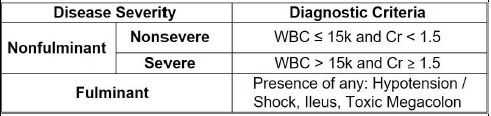
We discussed a case about an elderly woman w/ recent hospitalization for pneumonia, who presented w/ acute watery diarrhea, fevers, and encephalopathy, found to be in septic shock due to fulminant C diff colitis.

Disease severity

Treatment (2021 IDSA Updated Guidelines)

  • Updated IDSA guidelines recommend Fidaxomicin over Vancomycin in nonfulminant C diff infection. Can still treat with PO Vancomycin.
    • But fidaxomicin is $$$$, which can be a barrier
  • For recurrent C diff infections: If prior C diff infection was w/in the last 6 months, treat with adjunctive Bezlotoxumab

Acute cholangitis

We discussed a case about an elderly woman w/ history of cholecystectomy, who presented with acute fevers and RUQ pain, found to have sepsis from E coli bacteremia due to acute cholangitis. A 1.6 x 0.9 cm stone obstructing the distal CBD was visualized on MRCP.

Diagnosis

  • Tokyo 2018 guidelines (iPhoneMDCalc) can help with clinical diagnosis and assessing severity of disease

Treatment

  • Supportive care (fluids, analgesia)
  • Antibiotics: con’t for 4-5 days after source control
  • Urgent (w/in 24 hrs) biliary drainage criteria
    • Mild-moderate severity that fails to respond to 24 hrs of initial tx
    • Evidence of severe cholangitis

Lithium toxicity

We discussed a case about an elderly woman with hx of T2DM, hypothyroidism, and bipolar disorder (in remission on Lithium), who presented with chronic progressive encephalopathy, polydipsia, polyuria, ataxia, tremors / myoclonic jerks, and AKI. She was found to have Lithium toxicity.

Lithium

  • Lithium is almost entirely excreted by the kidneys, so even minor declines in function can trigger toxicity

Manifestations / Complications

  • GI: nausea, vomiting, diarrhea
  • Neuro (acute): encephalopathy, agitation, ataxia, neuromuscular excitability (tremors, myoclonic jerks), seizures, non-convulsive status epilepticus
  • Neuro (chronic): Syndrome of Irreversible Lithium Effectuated Neurotoxicity (SILENT), which is persistent encephalopathy despite normalized Lithium levels
  • Renal: Nephrogenic diabetes insipidus

Labs

  • Check Lithium levels frequently because it may NOT have peaked yet!

Treatment

  • Stop Lithium
  • Monitor ABCs
  • IVFs
  • GI decontamination (activated charcoal is NOT effective for Lithium toxicity)
  • Dialysis

Poison Control’s Number: 800-411-8080

Disseminated gonorrhea

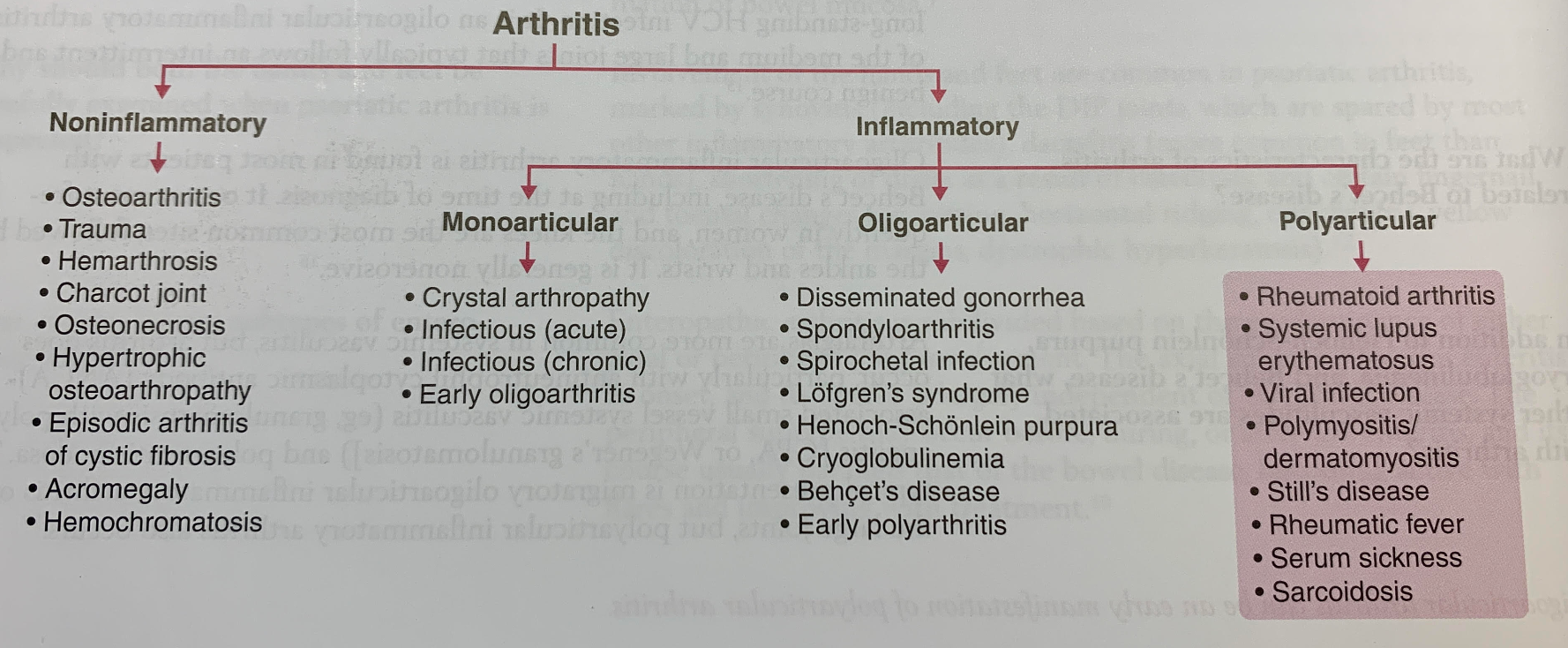
We discussed a case about a young woman with hx of STIs (syphilis and chlamydia s/p treatment), subacute hx of migratory polyarthralgias, who presented with fevers and acute arthritis / tenosynovitis of her left index finger + thumb. She was found to have gram negative diplococci bacteremia and diagnosed with disseminated gonorrhea.

Framework for arthritis

  • Categorize differentials based on non-inflammatory vs inflammatory, as well as mono- / oligo- / polyarticular.

CDC screening recommendations

  • Men: those at high risk (MSM)
  • Women: can be asymptomatic -> complications of STIs (eg PID, infertility)
    • < 25 yrs old    AND
    • ≥ 25 yrs old + STI risk factors

Preferred screening / diagnostic testing

  • Uncomplicated: NAAT (urine, genitals / throat / rectal swab)
  • Disseminated: Blood, joint, abscess, and/or CSF cultures

Gonorrhea treatment

  • CDC reports increasing azithromycin resistance
  • Ceftriaxone is first line

!Bonus learning! Chlamydia treatment

  • Also increasing azithromycin resistance
  • Doxycycline 100mg BID x7 days is first line

Rhabdomyolysis

We discussed a case about a young man with substance use disorder, who presented with acute encephalopathy and diffuse muscle aches. He was diagnosed with rhabdomyolysis with CK up to 12,000. His acute encephalopathy was due to acute methamphetamine intoxication.

Etiologies of rhabdomyolysis

  • Traumatic (injury, immobilization, burns)
  • Non-traumatic (Exertional such as exercise / shivering / seizures vs non-exertional such as medications / toxins / infections / electrolyte abnormalities)

Diagnosis of rhabdomyolysis

  • CK ≥ 5x upper limit normal
  • Red/brown urine, +/- myalgias, fevers, leukocytosis, hyperkalemia, hyperphosphatemia, hypocalcemia, AKI, elevated AST / ALT, myoglobinuria (UA w/ + Hgb but no RBC)

Treatment of rhabdomyolysis

  • Treat underlying cause
  • IV hydration
    • Goal: CK < 5000 and/or UOP 200-300 cc/hr
  • Can consider sodium bicarbonate in severe rhabdomyolysis if ALL the following are true:
    • NO hypocalcemia (precipitates calcium carbonate -> worsening hypocalcemia)
    • Arterial pH < 7.50
    • Serum bicarb < 30

Complications of rhabdomyolysis

  • Cardiac arrhythmia / arrest (related to hyperkalemia)
  • Acute renal failure
  • Compartment syndrome
  • DIC (rare)