All posts by vmcimchiefs

Pleural effusions – 7/25/17

Symptoms: Dyspnea, cough, and pleuritic chest pain

Exam: Decreased breath sounds, dullness to percussion, decreased tactile fremitus

Indications for thoracentesis: Any new unexplained effusion

Light’s criteria:

  • Pleural protein/Serum protein > 0.5
  • Pleural LDH/Serum LDH > 0.6
  • Pleural LDH > 2/3 ULN

Examples of transudates:

  • Heart failure
  • Nephrotic syndrome
  • Hepatic hydrothorax
  • Low albumin

Examples of exudates:

  • Parapneumonic effusions
  • Malignancy
  • TB
  • PE
  • Autoimmune disease (RA, SLE)

Uncomplicated effusion – pH > 7.2, glucose > 60, free flowing, < 1/2 hemithorax – treat the underlying cause, no need for chest tube

Complicated effusion – pH < 7.2, glucose < 60, can be > 1/2 hemithorax or loculated – treat the underlying cause and would benefit from chest tube

Empyema – complicated effusion with positive gram stain and culture – place a chest tube

Malignant effusions – if re-accumulating rapidly, can place a long-term chest tube or do a pleurodesis with talc
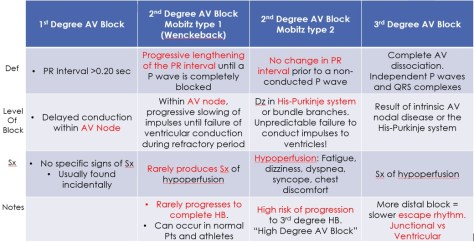
Heart Block 07/24/2017

Heart Block 1Heart Block 7

Heart Block 8

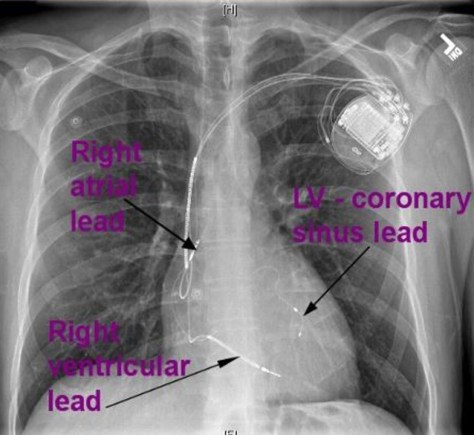
  • Two General Indications for permanent pacemaker (PPM) implantation 
    • 1) Symptomatic sinus bradycardia with rate <40bpm
    • 2) High grade or symptomatic AV block
  • Pacing is generally not indicated in asymptomatic sinus bradycardia

Heart Block 2

Heart Block 3

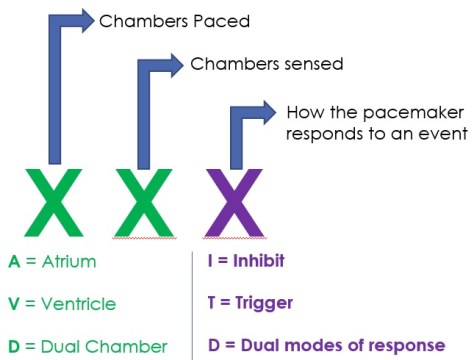
  • There are Four main rhythms that are seen with DDD
    • 1) Normal sinus rhythm
      • pacemaker is totally inhibited due to acceptable intrinsic sinus rate and AV conduction
    • 2) Atrial sensing and ventricular pacing
      • Sinus rate is above the set rate (inhibited atrial pacing) with prolonged AV conduction (triggered ventricular pacing)
    • 3) Atrial pacing, normally conducted to the ventricle with native QRS
      • Atrial pacing is triggered by sinus bradycardia in the setting of normal AV conduction (inhibited ventricular pacing)
    • 4) AV sequential pacing
      • Both atrial and ventricular pacing are triggered due to sinus brady and prolonged AV conduction

Heart Block 4Heart Block 5Heart Block 6

Tuberculosis 07/18/2017

  • Definitions
    • Primary Tuberculosis
      • 1-5% of cases
      • Infection directly after inoculation by airborne particles
      • Symptoms
        • Fever (70%)
        • Pleuritic chest pain (25%)
      • 90% of immunocompetent patient enter latent state
        • 10% develop TB pneumonia or progress to distant sites
          • Usually those with poor immune responses (HIV, CKD, DM2, immunosuppressants)
    • Latent TB (LTBI)
      • Non-contageous, quiescent state
      • Only manifestation is positive PPD or Quantiferon (IGRA – interferon gamma release assay)
    • Reactivation TB
      • 90% of adult cases in non-HIV patients
      • Classic symptoms
        • Cough, fatigue, fever, night sweats, weight loss
          • Sometimes hemoptysis –> usually in the setting of cavitary disease
  • Risk Factors
    • For exposure
      • Foreign born
      • Homeless
      • Incarceration
      • Health care workers
    • For reactivation
      • Immunocompromised
        • HIV, malignancy, steroids, DM2
      • Prior untreated or inadequately treated disease
      • Lifetime risk for reactivation
        • Immunocompetent -> 10% lifetime risk
        • Immunocompromised -> 10% per year
  • Physical finding –> non-specific and usually absent in mild-moderate disease
  • Labs
    • Sputum samples
      • AFB smear/culture
        • Obtained by coughing vs induced (inhalation of hypertonic saline from nebulizer)
        • 3 specimens at least 8 hours apart
        • Most rapid and inexpensive test
          • 45-80% sensitive
        • AFB positive smear can represent non-tuberculosis mycobacteria (NTM) as well
          • Must confirm with culture and nucleic acid amplification
      • Nucleic acid amplification (NAA) tests
        • Xpert MTB/RIF Test
          • Detects MTB DNA and rifampin resistance mutations
            • But cannot provide specific sequence information
          • Smear positive sample –> 95% sensitive, 98% specific
          • Smear negative sample –> 80% sensitive, 95% specific
          • Negative Xpert cannot exclude active TB!
          • Watch out for false positives from recent previously treated infection
      • Sequencing assays
        • Sequencing assays provide specific sequence mutations and predicts drug resistance with greater accuracy
          • Not approved by FDA; Remains investigational
    • Tuberculin Skin Test (TST) and quantiferon
      • Only used to diagnose latent TB infection, not active TB!
      • Positive result supports Dx; negative result cannot be used to rule out
  • Imaging
    • CXR
      • Primary TB
        • Hilar and peritracheal lymphadenopathy (65%)
        • Small homogeneous lobar vs perihilar infiltrates (30%)
        • Pleural effusion (30%)
      • Reactivation TB
        • Normal hosts
          • apical-posterior infiltrates (85%)
            • MTB prefers higher O2 tensions in the apical lung areas
            • poor lymphatic flow in apices results in poor organism clearance
          • cavitation
        • Immunocompromised (AIDS) Pts –> Atypical findings
          • Diffuse disease (military)
          • Mid/lower lung zones
          • Hilar and mediastinal LAD
        • CT
          • More sensitive than plain CXR for early or subtle parenchymal and nodal disease
  • Management
    • General approach
      • 6 months of treatment in 2 phases
        • Intensive phase –> 2 months
          • First line drugs –> “RIPE”
            • Rifampin, INH, pyrazinamide, ethambutol
        • Continuation phase –> 4 months
          • Rifampin
          • INH
    • Watch out for hepatotoxicity!
      • Rifampin, INH, and pyrazinamide are all associated with hepatotoxicity
    • All pts in INH should get vit B6
    • Avoid fluoroquinolones in suspected TB cases!
      • Avoid resistance from TB monotherapy

Endocarditis – 7/17/17

Risk Factors for developing Endocarditis

  • Dental procedure that penetrates the gums
  • Prior endocarditis
  • Prosthetic valves
  • IVDU
  • Immunosuppression

Common Organisms

  • Staph
  • Strep
  • Enterococcus
  • HACEK

Symptoms/Signs

  • Fever (most common)
  • Murmur
  • Splinter hemorrhages
  • Janeway lesions (non-tender erythematous macules on palms and soles)
  • Osler nodes (tender, subcutaneous nodules, on pads of fingers and toes)
  • Roth spots (exudative edematous hemorrhages in the retina)

Indications for surgical repair

  • New heart failure
  • Perivalvular abscess/extension
  • Conduction abnormalities
  • Persistent bacteremia
  • Prosthetic valves
  • Septic emboli
  • Large vegetation > 10-15 mm
  • Resistant organisms


Myasthenia Gravis 07/13/2017

  • Definition
    1. Two clinical forms of myasthenia
      1. Ocular
        • Limited to the eyelids and exraocular muscles
      2. Generalized
        • Affects the ocular muscles and variable combinations of bulbar, limb, and respiratory muscles
  • Pathogenesis
    1. Auto-antibodies directed against acetylcholine receptors (AChR)
      • Autoantibodies are present in 90% of patients
  • Epidemiology
    1. Can happen at any age, but there is a Bimodal distribution
      1. Early peak –> 20-30s
        • Female predominance
      2. Late peak –> 60-80s
        • Male predominance
  • Presenting symptoms
    1. Occular symptoms (Ptosis and/or diplopia) –> 50% of patients
    2. Bulbar Sx (dysarthria, dysphagia, fatigable chewing –> 15% of patients
    3. Muscle weakness that worsens throughout the day
    4. Respiratory muscles
      1. Most feared symptom –> Can lead to respiratory failure (“myasthenic crisis”)
  • Diagnosis
    1. Bedside tests
      1. Ice pack test
        • Bag of ice is placed on the eyelid for 2 minutes then removed. –> Improvement in ptosis is measured
        • 80% sensitivity
      2. Tensilon (Edrophonium) test
        • 2mg doses of edrophonium are given –> improvement in symptoms measured
    2. Lab tests
      1. Two Auto-antibodies:
        • Acetylcholine receptor antibody (AChR-Ab)
          • Present in 85% of patients with generalized disease
        • Muscle specific receptor tyrosine kinase (MuSK)
          • Present in up to 50% of patients who are AChR-Ab negative.
    3. Electrophysiological studies
      1. Repetitive nerve stimulation (RNS)
        • 75% sensitive
        • Most frequently used due to wide availability
      2. Single-fiber EMG
        • Used if RNS is negative because it is 95% sensitive
        • Less widely available
  • Associated conditions
    1. Thymic tumors
      1. 75% of patients with AChR-antibodies have thymic abnormalities (70% hyperplasia vs 10% thymoma)
      2. CT vs MRI to evaluate
    2. Autoimmune disorders
      1. Thyroid disease (5%)
      2. RA
      3. SLE
  • Treatment
    1. Acetylcholinesterase inhibitors
      • Pyridostigmine (mestinon)
        • Some patients only need this
        • Cholinergic side effects
    2. Immunomodulator drugs
      1. Chronic immunomodulators
        • Glucocorticoids
        • Azathioprine, mycophenolate, cyclosporine
      2. Rapid
        • Useful in myasthenic crisis or preoperatively before thymectomy à not useful long term
          • IVIG
          • Plasmapharesis
    3. Thymectomy

Alcoholic Hepatitis 07/11/2017

  • Risk Factors
    • Mean intake of 100g/day for 10-20 years
      • Standard drink of ETOH = 14g pure alcohol
        • 12oz beer
        • 5oz wine
        • 5 oz of 80 proof liquor (“Shot”)
    • Binge drinking
      • Men = 5 drinks in 1 sitting
      • Women = 4 drinks
  • Pathophysiology
    • Standard alcohol metabolism in cells
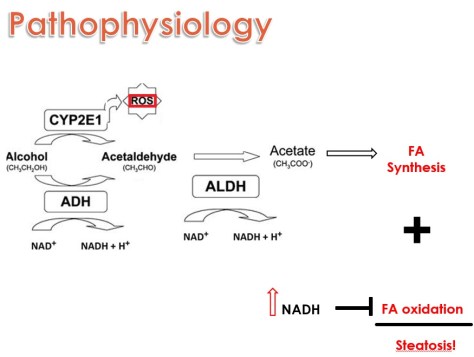
      • Alcohol dehydrogenase (ADH) plus cytochrome P-450 2E1 (CYP2E1) convert ethanol into acetaldehyde which is then converted to acetate
      • CYP2E1 releases reactive oxygen species leading to inflammation
      • NAD+ is used as oxidizing agent for ADH and is converted to NADH
        • Excess alcohol creates an imbalance of NAD/NADH
        • Excess NADH decreases oxidation of fatty acid oxidation
      • While acetate increases fatty acid synthesis
        • Both leading to steatosisAlcoholic hepatitis mechanism
  • Presentation
    • Pts often present between 40-50 years of age
    • Classic presenting features
      • Jaundice
      • Scleral icterus
      • Anorexia
      • Fever
      • Tender RUQ
      • Hepatomegaly
      • Abdominal distention due to ascites
      • Hepatic encephalopathy
      • Bruit can be appreciated over the liver due to increased hepatic blood flow

Labs

  • LFTs
    • Moderate elevations of AST and ALT
      • Usually less than 300, rarely higher than 500
      • AST:ALT ratio >2
        • ALT is less due to alcohol induced deficiency of Pyridoxal 5-phosphate, which is a coenzyme of ALT. Thus the ratio reflects the failure to appropriately increase the ALT, rather than an inappropriate increase in AST.
      • Elevated Tbili and Dbili
  • CBC
    • Leukocytosis (usually <20) with a neutrophil predominance
      • Extreme Leukemoid reaction (>50) is associated with a very poor prognosis.
    • Macrocytosis
      • Reflective of poor nutritional status
    • Thrombocytopenia
    • Coags
      • Elevated INR
  • Imaging (show pics!)
    • 1st choice: Abdominal ultrasound
      • It’s quick, easy, and relatively cheap
      • Will help rule out Budd-Chiari, abscess, obstruction, or neoplasm
      • Will show fatty changes in liver vs underlying cirrhosis
  • Maddrey Discriminant Function
    • DF >32 signifies severe alc hep and is associated with high short-term mortality
      • May benefit from glucocorticoid therapy
  • Treatment
    • 3 main things
      • Alcohol cessation
      • Nutritional support
      • Steroids
        • Contraindicated for:
          • GI Bleed
          • Infection
          • Renal failure
          • Pancreatitis
        • Check Lille Score on day 7 to evaluate response
          • >.45 is associated with 6-month survival of 25% –> ok to stop steroids
          • <.45 is associated with 85% survival
    • Pentoxyfilline –> little evidence!
      • The Steroids or Pentoxifylline for Alcoholic Hepatitis (STOPAH) trial was just published in the New England Journal in 2015.
        • They found a significant 28 day mortality benefit for prednisolone with an odds ratio of .61.
          • However, the mortality benefit was lost at 90 days and 1 year
        • On the other hand, pentoxifylline did not improve survival compared to placebo

AM Report 7/10/17 – Falciparum Malaria

  • Most dangerous form of malaria – highest number of deaths
  • Transmitted by the female Anopheles mosquito (females feed on blood, males feed on nectar)
  • Most commonly seen along in Southeast Asia, Latin America, and Africa
  • Two phases – liver and RBC phase
  • Symptoms:
    • Temperature paroxysms (alternating fevers and chills)
    • Headache
    • Diarrhea
    • Jaundice
  • Considered severe infection if evidence of end organ damage (Falciparum is sticky and can cause ischemia and infarcts as the RBCs get more viscous!)
    • Cerebral malaria – ischemia/infarcts in the brain
    • ARDS
    • Nephropathy
    • Hypotension
  • Physical exam findings:
    • Hepatomegaly (from the parasite replicating in the liver)
    • Splenomegaly (from the spleen taking up the damaged RBCs)
    • Pallor
    • Jaundice and scleral icterus
  • Diagnosis:
    • Thick and thin smears
      • Thick smears give a look at the RBCs in an overall sense to figure out if a parasite is present – are there parasites? If yes, look at thin smear.
      • Thin smears give a closer look at the TYPE of parasite – what type of parasite is it?
    • Rapid detection test – blood test which looks at enzymes on the various parasites to determine the type – only available at certain hospitals
  • Treatment:
    • Start immediately!
    • Determined based on the type of plasmodium, whether the malaria is severe or not, and whether the organisms are from an area with high resistance
    • Use 2-3 medications for treatment – consult ID immediately once you have a suspicion!
  • Prophylaxis
    • Given to anyone going to an endemic area – start a few weeks before travel, continue during travel, and continue for some time after returning depending on the medication
    • Wear long sleeves and pants
    • Use DEET