Tag Archives: Infectious Disease

GI Kaposi Sarcoma – 8/20/18

Thanks to Wendy for presenting a case of an elderly man with h/o remote renal transplant presenting with chronic progressive DOE, lower extremity edema, and upper and lower GI bleed, found to have AIDS-related GI kaposi sarcoma and associated protein-losing enteropathy!


Clinical Pearls:

  • Keep a broad differential for patients on immunosuppression
  • Incidence of KS is higher with CD4 counts <200 but it can be seen in CD4>500 as well.
  • Prognosis is generally good with treatment.  Poorer prognosis is associated with visceral involvement (as opposed to cutaneous), multiple opportunistic infections, and CD4<200
  • Mainstay of therapy is anti-retrovirals.  Chemotherapy can be used for ARV unresponsive disease, significant edema, extensive organ involvement, or IRIS.  Studies on chemo + ARV vs ARV alone showed no survival benefit with the former.
  • Thanks to Dr. Szumowski for the clinical pearl on use of sirolimus in renal transplant recipients with KS (article here).

Differential for odynophagia:

  • Infectious
    • HSV
    • CMV
    • Fungal
      • Candida ⇒ risk factors include dentures, immunosuppression (AIDS, chemo), radiation to head and neck, recent antibiotics
      • Others: crypto, histo, blasto, aspergillus
    • Mycobacteria
  • Medication-induced
  • Less common
    • Reflux esophagitis
    • Crohn’s

Kaposi Sarcoma:

  • Vascular tumor associated with HHV-8
  • Four different epidemiologic forms:
    1. AIDS-related: most common type in US
      • Higher incidence with CD4 <200 but can be seen with CD4 >500 as well.
    2. Endemic/African
    3. Organ transplant-associated (higher incidence after solid organ transplant)
    4. Classic (indolent cutaneous proliferative disease in older men of Mediterranean or Jewish descent)

KS in the GI tract:

  • Can occur in the absence of cutaneous disease
  • Symptoms range from asymptomatic to weight loss, abdominal pain, n/v, UGIB/LGIB, malabsorption, diarrhea
  • Inflammatory cytokine syndrome:
    • Systemic inflammation in AIDS-related KS
    • Symptoms:
      • Fever
      • Edema
      • Neuropathy
      • GI/respiratory symptoms
      • Hypoalbuminemia (can occur in the absence of the who syndrome)
        • Secondary to protein losing enteropathy (check stool clearance of alpha-1 antitrypsin)
      • Thrombocytopenia
      • Splenomegaly
Staging of KS: 
  • Extent of tumor (T): limited to skin with minimal oral cavity involvement is good.  Visceral involvement has poor prognosis.
  • Immune status (I): Degree of immunosuppression from HIV. CD4 <200 has worse prognosis
  • Severity of systemic illness (S): poor prognosis a/w h/o OI, thrush, B symptoms, etc.
  • Endoscopy and bronchoscopy are only done if initial stool test and CXR are abnormal
Treatment:
  • Goal: palliation, prevention of disease progression, and shrinkage of tumor to alleviate edema, organ compromise, and psychological distress
  • Systemic
    • Treatment with potent ART
      • IRIS can occur within 3-6 weeks of initiation
    • Chemo: for patients with advanced KS and rapid progression
      • Indications
        • >25 lesions
        • Unresponsive to local treatment or ART alone
        • Extensive edema
        • Symptomatic visceral involvement
        • IRIS
      • Agents:
        • Pegylated liposomal doxorubicin or daunorubicin
        • Paclitaxel, bleo, vinblastine, vincristine, etoposide
    • Chemo + ART or ART alone? While response rates are higher with the former, no survival benefit
  • Local symptomatic therapy
    • Intralesional chemo (vinblastine)
    • Radiation therapy
    • Topical alitretinoin


Infective endocarditis – 8/6/18

Thanks to Janhavi for presenting the case of a middle-aged man with no significant PMH presenting with acute onset of malaise, myalgias, and a “stubbed toe,” septic with petechiae on palms and soles, found to have mitral valve endocarditis.


Clinical Pearls:

  • Endocarditis is more common in men (2:1)
  • ~50% of cases of endocarditis occur in people with no known underlying valve disease
  • 80% of cases are caused by staph and strep species
  • TEE is the gold standard for diagnosis and recommended when clinical suspicion for endocarditis is high.  TTE is more helpful to rule out disease when clinical suspicion is low.
  • Indications for early surgery based on this NEJM article include:
    • Heart failure
    • Uncontrolled infection
    • Prevention of embolic events

Duke’s criteria:

Major criteria:

  • Blood culture positive:
    • Typical organism in two separate blood cultures
    • Persistently positive blood cultures
    • Single positive culture for Coxiella
  • E/o endocardial involvement
    • Echo positive for vegetation
    • New valve regurgitation

Minor criteria:

  • Predisposition to IE (i.e. IVDU, prosthetic valve, congenital cyanotic heart disease)
  • Fever >38
  • Vascular phenomena ⇒ arterial emboli, pulmonary infarcts, mycotic aneurysms, intracranial hemorrhage, conjunctival hemorrhage, Janeway lesions
  • Immunologic phenomena ⇒ GN, Osler’s nodes, Roth’s spots, RF
  • Microbiologic evidence: positive blood culture not meeting major criteria

Probability of endocarditis:

Definite IE:

  • 2 major, 1 major + 3 minor, 5 minor

Possible IE:

  • 1 major + 1 minor, or 3 minor

Rejected IE:

  • Firmly established alternative diagnosis
  • Resolution of symptoms < 4 days with antibiotics
  • Does not meet definite/possible criteria

Indications for surgery:

  • Valve dysfunction causing heart failure
  • Perivalvular extension with development of abscess, fistula, and/or heart block
  • Fungi or other highly resistant organisms that are difficult to treat with abx alone
  • Persistent bacteremia despite maximal treatment
  • Recurrent embolization with persistent vegetations
  • Large vegetations (>1 cm) with severe valvular regurg
  • S aureus prosthetic valve endocarditis

Indications for early surgery:

  • Heart failure
  • Uncontrolled infection
  • Prevention of embolic events

Complications:

  • Most common cause of death: heart failure
  • Heart block
  • Emboli
    • More likely with s. aureus or S. bovis, veg > 1 cm, or increased veg mobility on echo
    • Antiplatelet therapy initiation is not recommended because of increased risk of hemorrhagic conversion of septic emboli

Want more?

  • Check out this blog post and this great review article in the NEJM.

Syphilis – 7/23/18

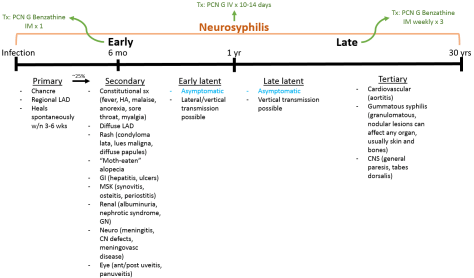
Carriann presented the case of a young woman with HIV (CD4 250 off ARVs) and prior syphilis s/p treatment five years ago who presented with constitutional symptoms and diffuse rash involving the palms and soles, found to have RPR 1:256 consistent with secondary syphilis!


Clinical Pearls 

  • Lues maligna or malignant syphilis is a rare manifestation of secondary syphilis in immunocompromised individuals and presents as an ulceronodular rash.
  • Syphilitic hepatitis is seen in ~10% of patients with secondary syphilis and presents as predominantly elevated alkaline phosphatase with normal or mildly elevated transaminases.
  • Neurosyphilis can occur at any point after infection with syphilis!
  • Treatment success is defined as a four-fold drop in nontreponemal titers (ie RPR).

Capture

Diagnosis:

Keep in mind the following principles:

  • Treponemal tests remain positive long-term
  • Non-treponemal tests can become negative after treatment.  They are useful for treatment monitoring because they can be quantitative
  • Both tests can be falsely negative early in disease course so repeat tests if clinical suspicion remains
  • Screening algorithm

Treatment monitoring:

  • Jarisch-Herxheimer reaction is a self-limited condition that can occur in ~10-35% of patients within 24 hours of treatment with antibiotics.
  • A four-fold decline in titers (2 dilutions) is considered treatment success.
  • Monitor titers q 6-12 months post treatment.  Increasing titer is concerning for treatment failure, neurosyphilis, or reinfection!

TB Pericarditis! 6/25/18

Today, we learned about a young man with no significant medical history who presented with fever of unknown origin, noted to have R sided lymphadenopathy and a pericardial friction rub.  Work up revealed a moderate sized pericardial effusion, a thickened pericardium, and a necrotic LN showing caseating granulomas on biopsy consistent with TB pericarditis!


Clinical Pearls:

  • Most common cause of pericarditis in the west is idiopathic.
  • Indications for pericardiocentesis
    • Tamponade
    • Suspicion for purulent/tuberculous/neoplastic pericarditis
    • Moderate to large pericardial effusions not responding to anti-inflammatory therapy
  • Purulent pericarditis occurs in 1% of infectious cases with staph aureus being the most common underlying pathogen.
  • TB pericarditis:
    • Leading cause of pericarditis in high HIV prevalent and resource limited settings around the world
    • Treatment requires anti-TB medications.  Steroids are not routinely recommended but may benefit high risk populations
    • Leading complication is constrictive pericarditis, early therapy does not decrease likelihood of development.

Pericarditis

Diagnosis: (Requires 2 out of the following 4)

  1. Typical chest pain
  2. Pericardial friction rub
  3. EKG with diffuse ST elevations
  4. TTE with an effusion

Etiology:

  • Idiopathic
    • Primary cause of pericarditis in the west
  • Infectious
    • Viral
      • Coxsackie, EBV, adeno, HIV
    • Bacterial
      • Staph aureus (most common cause), TB, strep pneumo, neisseria, legionella, nocardia
    • Other
      • Toxoplasma
      • Echiconoccus
  • Non-infectious:
    • Neoplastic
      • hematologic malignancies, lung CA, breast CA, melanoma, mesothelioma
    • Metabolic disorders
      • Uremia, hypothyroidism
    • Autoimmune diseases
      • SLE, RA, scleroderma, MCD, sjogren’s, vasculitides
    • Cardiac injury
      • Trauma, MI, post-PCI, post cardiothoracic surgery
    • Drugs
      • INH, doxorubicin

Indications for pericardiocentesis:

  • Tamponade
  • Suspicion for purulent/tuberculous/neoplastic process
  • Moderate to large effusions of unknown etiology that are not improving with conservative management

 TB pericarditis 

  • Diagnosis is often delayed or missed leading to constrictive pericarditis and increased mortality
  • Occurs in 1-2% of patients with pulmonary TB.
  • Symptoms:
    • Cough, dyspnea, CP, fever, night sweats, orthopnea, weight loss
  • Exam
    • Fever
    • Tachycardia
    • Elevated JVP
    • Hepatomegaly
    • Ascites
    • Peripheral edema
    • Friction rub
    • Distant heart sounds
    • Kussmaul’s sign (lack of inspiratory decline in JVP), prominent Y descent, pericardial knock
  • Evaluation
    • TTE
    • Sputum AFB and culture
    • PTB noted on CXR 32-72% of the time
    • Pericardiocentesis indicated for diagnosis but does not reduce likelihood of developing complications or death
      • Send fluid studies for cell count, protein concentration, LDH, AFB smear/culture, GS and bacterial culture, ADA, and cytology
      • Fluid has high protein content and lymphocytic/monocytic leukocytosis
  • Complications
    • Constrictive pericarditis (30-60% of patients) even with prompt therapy, more common in HIV uninfected individuals
    • Effusive constrictive pericarditis
    • Myopericarditis
    • Cardiac tamponade
  • Treatment:
    • Anti-TB therapy
    • Steroids?
      • Not routinely recommended and do not consistently prevent complications
      • Could consider in high risk groups with early signs of constriction
    • Pericardiectomy for those with persistent constriction