All posts by vmcimchiefs

Infective endocarditis – 8/6/18

Thanks to Janhavi for presenting the case of a middle-aged man with no significant PMH presenting with acute onset of malaise, myalgias, and a “stubbed toe,” septic with petechiae on palms and soles, found to have mitral valve endocarditis.


Clinical Pearls:

  • Endocarditis is more common in men (2:1)
  • ~50% of cases of endocarditis occur in people with no known underlying valve disease
  • 80% of cases are caused by staph and strep species
  • TEE is the gold standard for diagnosis and recommended when clinical suspicion for endocarditis is high.  TTE is more helpful to rule out disease when clinical suspicion is low.
  • Indications for early surgery based on this NEJM article include:
    • Heart failure
    • Uncontrolled infection
    • Prevention of embolic events

Duke’s criteria:

Major criteria:

  • Blood culture positive:
    • Typical organism in two separate blood cultures
    • Persistently positive blood cultures
    • Single positive culture for Coxiella
  • E/o endocardial involvement
    • Echo positive for vegetation
    • New valve regurgitation

Minor criteria:

  • Predisposition to IE (i.e. IVDU, prosthetic valve, congenital cyanotic heart disease)
  • Fever >38
  • Vascular phenomena ⇒ arterial emboli, pulmonary infarcts, mycotic aneurysms, intracranial hemorrhage, conjunctival hemorrhage, Janeway lesions
  • Immunologic phenomena ⇒ GN, Osler’s nodes, Roth’s spots, RF
  • Microbiologic evidence: positive blood culture not meeting major criteria

Probability of endocarditis:

Definite IE:

  • 2 major, 1 major + 3 minor, 5 minor

Possible IE:

  • 1 major + 1 minor, or 3 minor

Rejected IE:

  • Firmly established alternative diagnosis
  • Resolution of symptoms < 4 days with antibiotics
  • Does not meet definite/possible criteria

Indications for surgery:

  • Valve dysfunction causing heart failure
  • Perivalvular extension with development of abscess, fistula, and/or heart block
  • Fungi or other highly resistant organisms that are difficult to treat with abx alone
  • Persistent bacteremia despite maximal treatment
  • Recurrent embolization with persistent vegetations
  • Large vegetations (>1 cm) with severe valvular regurg
  • S aureus prosthetic valve endocarditis

Indications for early surgery:

  • Heart failure
  • Uncontrolled infection
  • Prevention of embolic events

Complications:

  • Most common cause of death: heart failure
  • Heart block
  • Emboli
    • More likely with s. aureus or S. bovis, veg > 1 cm, or increased veg mobility on echo
    • Antiplatelet therapy initiation is not recommended because of increased risk of hemorrhagic conversion of septic emboli

Want more?

  • Check out this blog post and this great review article in the NEJM.

Catastrophic Antiphospholipid Syndrome, +/- Heparin induced thrombocytopenia & thrombosis, +/- SLE 8/1/2018

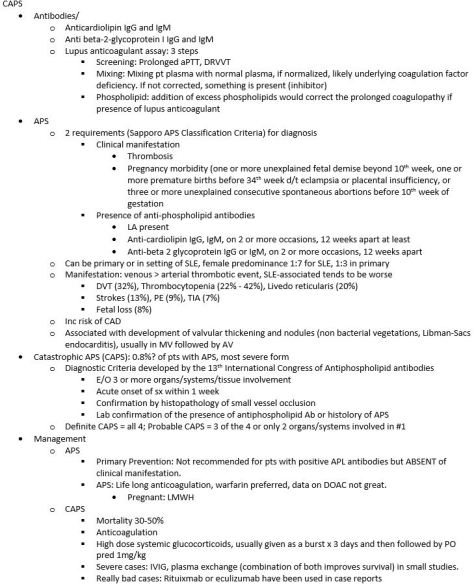
Wendy presented a fascinating (and confusing!) case of a patient with history of APS and DVT/PE on chronic warfarin presenting with painful, non-blanching, palpable purpuric rash on the left thigh and lower abdomen found to have thrombocytopenia,  and proteinuria. Skin biopsy revealed small vessel microthrombi. Work up positive SRA, positive ANA, positive DsDNA, low complements… Base on this presentation, the patient possibly has catastrophic antiphospholipid syndrome, with heparin induced thrombocytopenia, and newly diagnosed SLE!

CAPS1CAPS2CAPS3.JPG

Inflammatory Bowel Disease – 7/31/18

Thanks to Connie for presenting a case of a young man with chronic bloody diarrhea, abdominal pain, and fever, found to have a new diagnosis of severe Ulcerative Colitis.


Clinical Pearls

  • Acute diarrhea requires work up in anyone >65, immunocompromised, blood in stools, fever, severe abdominal pain, recent antibiotics, known or suspected IBD, risky jobs like food handler, or recent travel.
  • Fecal calprotectin can help distinguish inflammatory from non-inflammatory diarrhea and is a more sensitive and specific marker than fecal leukocytes.
  • 5-ASA based drugs are generally more effective in the colon so their primary role is in the treatment of Ulcerative Colitis or Crohn’s Colitis.

Capture

Disease severity in IBD:

  • Mild: <4 stools/day, no systemic toxicity
  • Moderate: 4-6 stools/day, no systemic toxicity
  • Severe: >6 stools per day, systemic toxicity
  • Fulminant: >10 BMs per day, continuous bleed, systemic toxicity

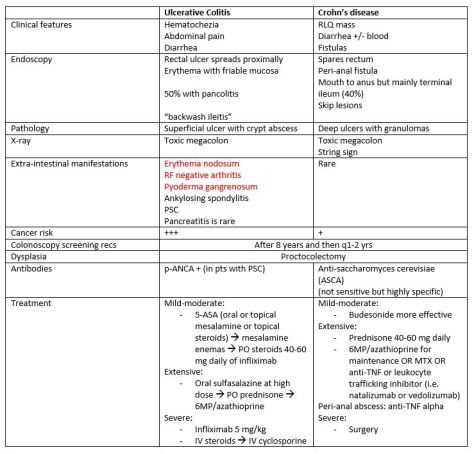
Key distinctions between UC and CD:

Capture 2

Items in red in the table above correlate with disease activity.

Before initiating immunosuppression:

  • Check PPD/quantiferon
  • Hepatitis serologies
  • Administer routine live vaccines
  • Check TPMT level (to assess phenotype for bone marrow suppression secondary to 6MP).  If TPMT level low, do not give 6MP!

Lupus nephritis – 7/26/18

Thanks to Naina for presenting an interesting case of a young woman presenting with fever, nausea/vomiting, and R flank pain found to have pyelonephritis and lupus nephritis!


Clinical Pearls

  • Renal involvement is noted in ~50% of patients with SLE and can present as nephrotic or nephritic syndromes.
  • The most common and severe form is diffuse proliferative lupus nephritis (class IV)
  • It is important to distinguish SLE flare from an infection. When infection is present, it must be treated first before starting immunosuppression.
    • SLE flare is associated with a normal WBC, low CRP (because CRP production by hepatocytes is down-regulated by type 1 IFN release in lupus flare), and absence of fever
  • Lab findings suggestive of flare include elevated anti-dsDNA (correlates with disease activity), low complement levels (predominantly C3 decline), worsening proteinuria, and elevated creatinine.

Capture

* Membranoproliferative GN can present with mixed nephrotic/nephritic picture.

SLE and renal disease:

  • Renal involvement is common and eventually occurs in ~50% of SLE patients
  • 10% progress to ESRD
  • High mortality compared to SLE w/o nephritis
  • More common and severe in African Americans, Hispanics, Asians and can be the only manifestation of lupus on presentation!
  • Classifications of GN:
    • Can evolve from one to another
    • Minimal mesangial lupus nephritis (class I)
      • Earliest and mildest form
      • Rarely diagnosed b/c pts have a normal U/A, no or minimal proteinuria, and normal Cr
    • Mesangial proliferative lupus nephritis (class II)
      • Microscopic hematuria and/or proteinuria
      • Light microscopy would show mesangial hypercellularity or mesangial matrix expansion
    • Focal lupus nephritis (class III)
      • Hematuria, proteinuria, some HTN, decreased GFR
      • Less than 50% glomeruli affected by light microscopy
      • Segmental glomerulonephritis
    • Diffuse lupus nephritis (class IV)
      • Most common and most severe
      • Hematuria, proteinuria, nephrotic syndrome, HTN, reduced GFR
      • Hypocomplementemia (esp C3) and elevated anti-dsDNA during active disease
      • >50% of glomeruli are affected
    • Lupus membranous nephropathy (class V)
      • nephrotic syndrome, Cr normal or slightly elevated
      • Diffuse thickening of the glomerular capillary wall and subepithelial deposits
      • Can present without any other clinical or serologic manifestations of SLE
    • Advanced sclerosing lupus nephritis (class VI)
      • Slow, progressive renal dysfunction with proteinuria and relatively bland urine sediment
      • Global sclerosis >90% of glomeruli
      • Active GN no longer observed
  • Treatment:
    • Best to initiate early but AFTER treatment of active infection:

      • Cyclophosphamide or Mycophenolate PLUS solumedrol 250-1 g/day x 3 days (former takes 10-14 days to have an effect so the latter is much faster) or prednisone 60 mg/day
      • Mycophenolate is the preferred choice to preserve fertility in women of reproductive age
    • Goals of therapy:
      • substantial reduction in urine protein excretion  to <0.33 g/day
      • improvement or stabilization of serum creatinine
      • improvement of urinary sediment

Syphilis – 7/23/18

Carriann presented the case of a young woman with HIV (CD4 250 off ARVs) and prior syphilis s/p treatment five years ago who presented with constitutional symptoms and diffuse rash involving the palms and soles, found to have RPR 1:256 consistent with secondary syphilis!


Clinical Pearls 

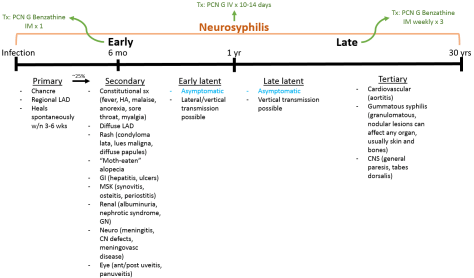
  • Lues maligna or malignant syphilis is a rare manifestation of secondary syphilis in immunocompromised individuals and presents as an ulceronodular rash.
  • Syphilitic hepatitis is seen in ~10% of patients with secondary syphilis and presents as predominantly elevated alkaline phosphatase with normal or mildly elevated transaminases.
  • Neurosyphilis can occur at any point after infection with syphilis!
  • Treatment success is defined as a four-fold drop in nontreponemal titers (ie RPR).

Capture

Diagnosis:

Keep in mind the following principles:

  • Treponemal tests remain positive long-term
  • Non-treponemal tests can become negative after treatment.  They are useful for treatment monitoring because they can be quantitative
  • Both tests can be falsely negative early in disease course so repeat tests if clinical suspicion remains
  • Screening algorithm

Treatment monitoring:

  • Jarisch-Herxheimer reaction is a self-limited condition that can occur in ~10-35% of patients within 24 hours of treatment with antibiotics.
  • A four-fold decline in titers (2 dilutions) is considered treatment success.
  • Monitor titers q 6-12 months post treatment.  Increasing titer is concerning for treatment failure, neurosyphilis, or reinfection!

New A fib, severe MR, and papillary muscle rupture… 7/17/18

Thank you Naina for presenting the case of an elderly man with 20 packyear smoking history presenting with acute onset of dyspnea and scant hemoptysis, found to have new onset A fib and L heart failure secondary to severe mitral regurgitation resulting from papillary muscle rupture!


Clinical Pearls

  • In patients with severe mitral regurgitation (MR) and a normal L atrium size, think about acute causes of MR.  TEE is often indicated to better visualize the valve structure and determine need for operative intervention.
  • MR can be caused by papillary muscle rupture, especially 3-7 days post MI.  Other etiologies of rupture include endocarditis and myxomatous valve degeneration.
  • Patients with rupture present with acute onset hypotension, pulmonary edema, and a hyperactive precordium. A systolic murmur is not always present!
  • Treatment:
    • Aggressive afterload reduction AND
    • Surgery (high mortality rate 20-25%)

Atrial Fribrillation

Categories:

  • Paroxysmal (terminates within 7 days)
  • Persistent (>7 days)
  • Long-standing persistent (>1 year)

Differential for new onset A fib: (PIRATES!)

  • Pulmonary (OSA, PE, COPD, PNA)
  • Ischemia/infarction/CAD*
  • Rheumatic heart disease/mitral regurgitation
  • Alcohol/anemia (high output failure
  • Thyrotoxicosis/toxins (stimulants)
  • Electrolytes/endocarditis
  • Sepsis/sick sinus syndrome
  • Other: HTN*, congenital heart disease, previous cardiac surgery, viral infections

* Most common causes in the US.

Treatment:

  • Rate control (preferred method based on AFFIRM and RACE trials)
    • Beta blockers
    • Calcium channel blockers ⇒ contraindicated in decompensated heart failure
    • Digoxin ⇒ avoid use in renal failure, hypokalemia, hypomagnesemia, or hypercalcemia
    • Amiodarone
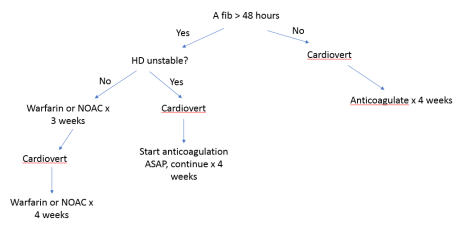
  • Rhythm control
    • Methods:
      • Chemical (~30% success rate)
        • Class III (amiodarone, sotalol, ibutilide)
      • Electrical (synchronized to QRS, ~80% success rate)
    • Preferred modality in
      • Hemodynamically unstable
      • Young patient (age <65) or good functional status
      • Early in natural history of disease
      • Failure of rate control agents
      • Heart failure

Capture

Complications post MI:

Picture1

Figure from article by Reed et al. Lancet. 2017.

Papillary muscle rupture:

  • Posteromedial muscle is 6-12x more likely because blood supply is through PDA only. Anterolateral muscle receives dual supply from LAD and LCx.
  • Clinical presentation
    • Acute onset hypotension, pulmonary edema
    • Hyperactive precordium
    • Mid, late, or holosystolic murmur with widespread radiation (though many have no murmur!)
    • Diagnosis requires TTE/TEE
    • Treatment:
      • Aggressive afterload reduction
      • Urgent/emergent surgical intervention (20-25% mortality)