Category Archives: Morning Report

Aplastic Anemia 9/12/2018

Today our Doctor-in -Training, Emma, presented a case of a middle age woman with no significant medical or family history coming in with a month of fatigue, menorrhagia, and gum bleeding. She was incidentally found to be pan-cytopenic. Bone marrow biopsy revealed hypocellularity with no abnormal morphologies, which is consistent with aplastic anemia!

Aplastic anemia

  • Epidemiology
    • Rare, 2 per million per year, higher incidence amongst Asians, can occur in all ages but most of the time in the first 1st-4th decades.
  • Pathophysiology
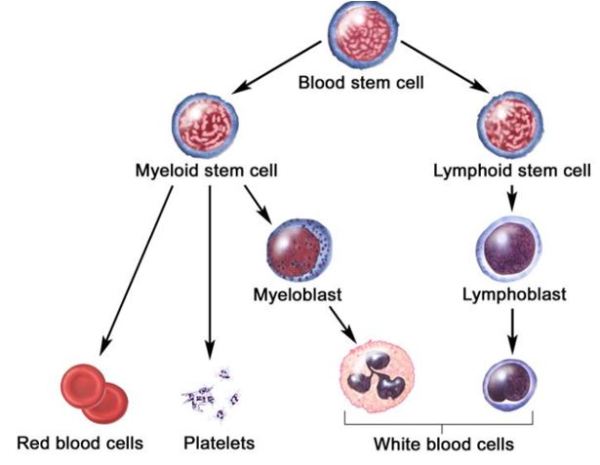
    • Big picture: Think of it this way. Aplastic anemia is similar to a factory not working due to not enough workers (stem cells). Compare and contrast this with MDS, which is basically a loss of quality control (mutation in the stem cells) leading to bad products that get worse over time (leading eventually to pancytopenia, leukemia).Capture
      • Causes
        • Primary (rare), most of the time acquired
        • Infectious: CMV, Parvo, EBV, HIV, hepatitis, TB
        • Toxins: Benzene, glue vapors, solvents, pesticides
        • Autoimmune: SLE, eosinophilic fasciitis, graft v host,
        • Other: Pregnancy, paroxysmal nocturnal hemoglobinuria, thymoma, irradiation
        • Medications: NSAIDS, Bactrim, Lasix, Gold, Allopurinol, penicillamine, phenothiazines, AEDS, anti-psychotics
      • Association
        • PNH: CD55 & CD59 abnormalities can be sen in up to 50% of patients with aplastic anemia!
      • Presentation
        • S/S of anemia
        • S/S of thrombocytopenia (menorrhagia, petechiae)
        • Recurrent infections
      • Diagnosis
        • Bone marrow biopsy most definitive, helps distinguish AA from other causes of pancytopenia
        • BM finding
          • Hypocellular, marrow space mostly fat cells and marrow stroma.
          • Remaining cells are morphologically normal
          • No fibrosis, no e/o malignancy
        • Severe AA criteria
          • BM cellularity < 25 + 2 of ANC < 500, plt < 20k, retic < 20k
        • Very Severe AA criteria
          • ANC < 200
        • Mgx: Severe AA require treatment
          • Under age 20: Early allogeneic HCT as soon as possible. If HCT not possible, immunosuppressives
          • 20 – 50: HCT also recommended if no contraindications, immunosuppressives (Anti-thymocyte globulin, cyclosporine for example) + eltrombopag (thrombopoietin agonist) otherwise.
          • > 50:
            • Transplantable: Early hematopoietic cell transplantation
            • Older, not candidates for HCT: Immunosuppressive, less intense preferred as age increases.
          • Treat other underlying/reversible causes in all cases.

Fun Fact: Blood transfusion can lead to falsely elevated iron studies within the first 24-36 hours.

Angioedema 9/11/2018

Today Arthur presented a case of a young woman with a personal and family history of facial swelling presenting with acute onset periorbital and scalp swelling, in setting of recent hair-dye exposure. No urticaria or pruritus on presentation but she did have acute pruritus after exposure to the hair-dye. She responded quickly to benadryl and steroids. The final diagnosis is allergic angioedema.

What is angioedema? It is a non-pitting swelling of the deep/subcutaneous tissues.

Angioedema

(Image adapted to JAMA)

Pathophysiology of angioedema

  • Mast cell mediated (most common)
    • Examples: Food allergies, insect stings
    • IgE -> Mast Cells -> inflammatory response
      • BeE, FoodiE = IgE
    • Findings:
      • Flushing
      • Urticaria
      • Generalized pruritus
      • +/- bronchospasm, throat tightness, hypotension
    • Onset: Minutes after exposure, develop over the next few hours
    • Recovery: 24-48 hours
    • Anaphylaxis = life threatening systemic reaction which is a severe manifestation of an allergic reaction. Angioedema is a finding.
    • Management: IM Epi is FIRST LINE, 0.3 – 0.5mg IM, repeat Q5-15min PRN. Everything else (steroids, benadryl, anti-histamines) are adjuvant only. Get that IM Epi stat.
  • Bradykinin mediated
    • Examples: Acquired angioedema (AAE, associated with underlying malignancy or autoimmune conditions), RAAS-blocker angio edema (RAE, African Americans are 3x likely vs Whites), hereditary angioedema (HAE, autosomal dominant mode of inheritance)
    • Findings:
      • Absent urticaria/pruritus, bronchospasm.
      • Minimal skin findings but can have swelling without urticaria.
    • Onset: More prolonged course, can develop over 24-36 hours
    • Recovery: 2-4 days
    • Management: depends
  • Histamine/Unclear: Seen in idiopathic angioedema (IAE)

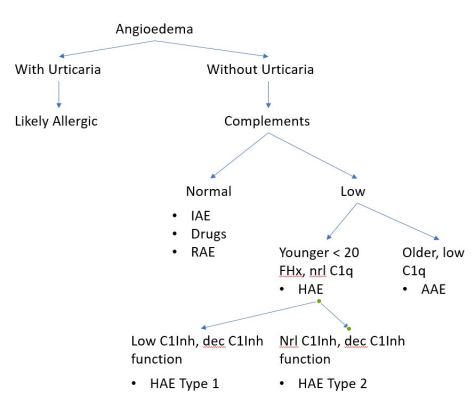
Angioedema algorithm

Capture

HAE Management

  • C1 Inh concentrate (takes a while to obtain)
  • Icatibant (synthetic bradykinin receptor antagonist)
  • Ecallantide (recombinant plasma kallikrein inhibitor)
  • FFP (fastest to get!)
  • Supportive care, airway monitoring

Still’s Disease – 9/10/18

Thanks to Becky Lee yet again for presenting an interesting case of a young woman presenting with acute onset of fever and polyarthritis, found to have a history of similar episodes in the past together with a rash concerning for Still’s disease!


Clinical Pearls

  • Still’s disease is a diagnosis of exclusion!  Yamaguchi criteria can help with ruling in the diagnosis.
  • Still’s remains a multi-systemic disorder of unknown etiology because it’s difficult to diagnose and rare (0.16 cases per 100,000).
  • RF and ANA are generally negative but can be positive in <10% of patients with Still’s in low titers.
  • ~66% of patients present with sore throat secondary to cricothyroid perichondritis or aseptic nonexudative pharyngitis.
  • The disease is often recurrent.  Predictors of poor outcome include erosive polyarthritis on presentation and shoulder/hip involvement.

Acute polyarthritis (>5 joints involved):

Remember that for rheumatologic disorders, timing, symmetry, and number of joints involved is crucial to coming up with a differential diagnosis.  So for our patient with acute polyarthritis, consider the following:

  • Infection
    • Viral: hepatitis, HIV, parvovirus B19
    • Spontaneous bacterial endocarditis
  • Rheumatologic:
    • Rheumatoid arthritis
    • Reactive arthritis
    • SLE
    • Dermatomyositis
  • Vasculitis
    • PAN
  • Drug reactions
  • Auto-inflammatory or disease of the innate immune system (as opposed to autoimmune or diseases of the adaptive immune system):
    • Periodic fever syndromes (TRAPS, PFAPA, hyper-IgD syndrome)
    • Still’s disease
  • Schnitzler’s syndrome – chronic urticaria associated with a monoclonal gammopathy (usually IgM kappa)
  • Sweet syndrome – painful skin lesions
  • Sarcoid
  • Kikuchi disease – cervical LAD and fever (necrotizing lymphadenitis)
  • HLH/Macrophage activation syndrome – leukopenia and thrombocytopenia, elevated triglycerides, low fibrinogen and haptoglobin

Still’s disease:

  • Some clarifications on nomenclature:
    • Systemic juvenile idiopathic arthritis (sJIA): first presentation <17 years old, previously referred to as Still’s disease
    • Adult onset Still’s disease (AOSD): first presentation  > 17 years old
  • Epidemiology of AOSD:
    • 0.16 cases per 100,000
    • No sex predominance (F=M)
    • Bimodal age distribution with peak between 15-25 and another 36-46 years of age.  New diagnosis in patients >60 have been reported.
  • Clinical features ⇒ Yamaguchi criteria (need 5 total with  > 2 major)
    • Major criteria:
      • Daily fevers to 39
      • Arthritis >2 weeks
      • Non-pruritic salmon-colored macular/maculopapular rash on trunk or extremities (though cases of pruritic rash have also been reported)
      • ↑ WBC >10k, >80% neutrophils
    • Minor
      • Sore throat
      • LAD and/or splenomegaly
      • ↑ AST, ALT, or LDH
      • Negative ANA/RF
  • Treatment
    • Mild: NSAIDs
    • Moderate: NSAIDs + DMARDs
    • Severe: NSAIDs + DMARDs (IL1 receptor antagonists like anakinra appear to be more helpful than TNF inhibitors especially in sJIA)
  • Prognosis:
    • Overall good prognosis
    • Disease can be limited to one episode or recurrent over time
    • Poor prognostic indicators:
      • Hip and shoulder involvement
      • Erosive polyarthritis at initial diagnosis
  • Complications
    • Macrophage activation syndrome (ie HLH) can occur in 15% of cases
    • DIC
    • TTP
    • Diffuse alveolar hemorrhage
    • Pulmonary HTN
    • Aseptic meningitis

References: 

Great recent review article on Still’s disease (AOSD Review) and this prior post on our blog!

Adrenal insufficiency, lupus flare, and mixed AIHA- 9/6/18

Thanks to Becky for presenting the case of a middle-aged woman with h/o SLE and Evans syndrome who presenting with subacute onset of fatigue after her prednisone dose was reduced, found to have iatrogenic adrenal insufficiency, lupus flare, and mixed autoimmune hemolytic anemia!


Clinical Pearls:

  • Evans syndrome describes AIHA + ITP, a rare condition associated with SLE and often precedes the diagnosis of SLE by a few years.
  • Hematologic manifestations of SLE are many and include the following
    • Anemia (chronic disease, iron deficiency, medication-induced, warm AIHA>>cold AIHA, pure red cell aplasia, MAHA, and pernicious anemia)
    • Leukopenia
    • Thrombocytopenia
    • Pancytopenia
    • Evans syndrome
  • Smear findings can be very helpful in diagnosing different types of hemolytic anemiasSchistocytes are a very specific for MAHA, valve disorders, AVMs, APLS whereas AIHA would result in spherocytes. 
    • The negative predictive value of spherocytes is low.  So a smear without spherocytes does not rule out AIHA!
  • Lastly, the most common cause of adrenal insufficiency (AI) is iatrogenic.
    • General rule of thumb for when risk of AI is high and you should taper steroids slowly is if someone is on prednisone > 20 mg for > 3 weeks.  Keep in mind that people with smaller BSA would be more susceptible to AI and at risk with even lower doses.

Hemolytic anemia work up

Check smear

  • Schistocytes
    • MAHA: TTP, HUS, HELLP, DIC, HTN
    • Valve disorder
    • AVMs
    • APLS
  • No schistocytes (+ spherocytes)
    • Intrinsic RBC defect
      • Enzyme deficiency (G6PD)
      • Hemoglobinopathy (sickle cell)
      • Membrane defect (hereditary spherocytosis)
    • Extrinsic RBC defect
      • Liver disease
      • Splenic sequestration
      • Infections (clostridium perfringens, babesia, malaria, bartonella)
      • Meds/toxins (dapsone, nitrites, lead, copper, snake venom)
      • AIHA (warm and cold)
    • Intravascular
      • Transfusion reaction
      • Infections
      • PNH

Lab findings in AIHA: 

  • ↑ retic
  • ↑ indirect bili
  • ↑ LDH
  • ↓ haptoglobin
  • + DAT (but keep in mind that DAT can be negative in 3% of patients with WAIHA)
  • + spherocytes

Summary of AIHAs:

Picture1


Stress-induced cardiomyopathy – 9/5/18

Thanks to Eric for presenting the case of an “late middle-age” woman with chest pressure, found to have ST depressions, troponin elevation, TTE with apical akinesis, and clean coronaries on cardiac cath concerning for Takotsubo cardiomyopathy.


Clinical Pearls

  • Think of heart failure as ischemic vs non-ischemic
  • Most common causes of heart disease are ischemia (CAD), HTN, idiopathic, valvular, infectious (viral), and drugs.
  • MINOCA or myocardial infarction with nonobstructive coronary arteries is MI in the absence of coronary artery disease with >50% vessel occlusion and includes the following etiologies
    • Stress induced cariodmyopathy (Takotsubo)
    • Coronary vasospasm
    • Microvascular dysfunction
  • Takotsubo cardiomyopathy most commonly presents in postmenopausal women and triggered by physical or emotional stress.  The pathogenesis is not well understood and the course is self-limited.  Treatment is largely supportive.  Prognosis to recovery of cardiac function is 1-4 weeks.

Heart failure

  • Ischemic
    • CAD
    • Bridge
  • Non-ischemic
    • HTN
    • Valvular disease
    • Idiopathic
    • Infectious (viral is most common)
    • Infiltrative (sarcoid, amyloid, hemochromatosis)
    • Stress induced cardiomyopathy (Takotsubo)
    • Arrhythmia
    • High output (secondary to anemia, Paget’s disease, pregnancy, AV fistula, beriberi, hyperthyroidism)
    • Post-partum
    • Hypothyroidism
    • OSA
    • Connective tissue disease

MI with non-obstructive coronary arteries (MINOCA)

  • Diagnosis: requires the following
    • Clinical documentation of MI
    • Exclusion of obstructive CAD
    • No overt cause for acute MI present
  • Etiologies: significant overlap with non-ischemic causes of heart failure
    • Non-cardiac
      • Reduced troponin clearance (i.e. renal impairment)
      • Increased right heart pressures (ex PE)
    • Cardiac causes
      • Stress induced cardiomyopathy
      • Inflammation (myocarditis)
      • Coronary artery spasm (vasospastic angina)
      • Microvascular dysfunction (microvascular angina, microvascular spasm, coronary slow flow phenomenon)
      • Thrombophilia
  • Work up
    • MINOCA is a working diagnosis
      • Exclude non-cardiac cause
      • Rule out ischemic etiology
      • TTE
      • Cardiac MRI is often indicated
      • Provocative spasm testing (with acetylcholine etc in the case of coronary vasospasm)

Takotsubo cardiomyopathy

  • First described in Japan in 1990
  • It is the underlying etiology in ~1-2% of patients presenting with ACS
  • More common in post-menopausal women (mean age 66.4)
  • Pathogenesis:
    • Not well understood
  • Clinical manifestations
    • Often triggered by emotional or physical stress but ~30% of the time, no trigger is identified
    • Symptoms
      • Most commonly present with acute substernal chest pain.  Less commonly present with SOB or syncope or heart failure symptoms
    • Exam
      • May have late peaking systolic murmur similar to HOCM
    • EKG changes:
      • ST elevation in anterior leads (43.7%)
      • ST depression (7.7%)
      • QT prolongation, T wave inversion, abnormal Q waves
    • Troponin elevation in most patients (mean initial troponin is ~7-8)
    • Diagnostic criteria
      • Transient LV systolic dysfunction (hypokinesis, akinesis, or dyskinesis), wall motion abnormalities that extend beyond a single epicardial coronary distribution
      • Absence of CAD based on cath
      • New EKG abnormalities
      • Absence of pheochromocytoma or myocarditis
    • Work up
      • Rule out ACS
      • Cardiac MRI to rule out other causes of MINOCA
    • Management
      • Supportive
    • Prognosis
      • Recovery in 1 to 4 weeks

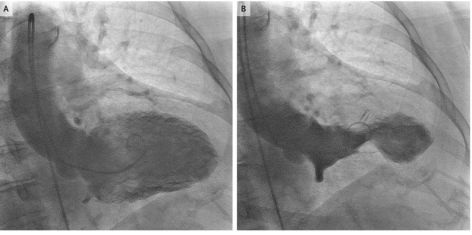
Picture1

Picture above and cool video from NEJM here.


Recurrent Pyogenic Cholangitis 9/3/2018

Paula presented a case of an elderly Mexican woman presenting with 2-4 weeks of non-specific complaints i.e. abdominal pain, nausea, anorexia, and yellow discoloration. Her labs were notable for obstructive pattern LFT abnormalities. US revealed cirrhosis, and CT AP revealed dilated stone-filled intrahepatic and extrahepatic biliary ducts. ERCP later revealed innumerable stones and copious sludge throughout the intrahepatic ducts, common hepatic ducts, and CBD. Her presentation was consistent with recurrent pyogenic cholangitis, also known as…

  • Hong Kong Disease
  • Oriental cholangitis
  • Oriental cholangiohepatitis
  • Oriental infestational cholangitis
  • Biliary obstruction syndrome of the Chinese
  • Cholangiohepatitis

I’m not kidding.

Epidemiology:

  • Found primarily in residents of East and SE Asia, or people who have resided there.
  • Associated with poorer socioeconomic backgrounds

Pathophysiology/Presentation

  • Characterized by recurrent cholangitis, biliary stasis, and innumerable intrabiliary stone formation ) calcium bilirubinate stones) throughout a fibrotic biliary ductal system.
    • Stone formation can occur within the intrahepatic bile ducts unlike the most common presentation of stone formation within the gallbladder.
  • Possibly associated with biliary parasitosis, namely liver flukes like Clonorchis sinensis, Fasciola spp. Ascaris lumbricoides (from prior studies revealing dead parasites within the stones).
  • Leads to recurrent infections due to persistent biliary stasis, stone formation, and bile duct structures.
  • Pts often present with cholangitis, non-spec abd pain, or pancreatitis. Often unrecognized at first, and recurrent attacks leads to progressive biliary and hepatic damage which may lead to abscesses or cirrhosis.

Diagnosis

  • Imaging correlating with clinical history, US first, CT, MRCP (can evaluate extent of biliary involvement), percutaneous transhepatic cholangioscopy
  • Invasive: ERCP
  • Abnormalities commonly found: intra + extrahepatic duct dilatation, periductal fibrosis, missing duct sign (complete obstruction)
  • All pts should have O&P checked

Management

  • Complicated, combination of management of infection and biliary drainage.
  • Severe cases: resection of affected bile duct segments followed by biliary-enteric anastomosis (i.e. hepaticojejunostomy, may require partial hepatectomy)
  • No optimal strategies have been established by large studies.

Big picture

  • Predominantly in Asians
  • Unclear pathophysiology but thought to be somewhat related to parasites
  • Lack of large studies on optimal management.
  • One Taiwanese study: 7% pts develop cirrhosis, 3% with cholangiocarcinoma

Mute and Unresponsive… 8/29/2018

Today Elise presented a case of a middle age woman, with a history of schizoaffective disorder and recent psych med changes, who came in unresponsive and mute. She was hypertensive and catatonic on exam but afebrile. Labs revealed moderately elevated CK. She responded well to IV Ativan. The final diagnosis was drug-induced catatonia!

Catatonia

  • Features:
    • Hypokinesis or akinesis
    • Excessive purposeless movements
    • Mutism
    • Decreased alertness/response to stimuli
    • Negativism (resistant to all instructions, commands)
    • Posturing
    • Fixed stare
    • Echolalia (repetition of another person’s words) or echopraxia (repetition of another’s actions)
    • Subtypes
      • Retarded Catatonia:
        • Mainly negativism, hypokinesis, mutism, staring.
        • +/- anorexia, incontinence, stupor
      • Excited catatonia:
        • Hyperkinesis, restlessness, impulsivity, aggression
      • Malignant catatonia
        • Life threatening: Fever, autonomic instability (labile BP, tachycardia, tachypnea, diaphoresis), delirium, rigidity.
        • Labs: Leukocytosis, elevated CK
        • Thought to be a spectrum of NMS
      • Management:
        • Withdrawal of offending medication if suspecting drug-related
        • Initial treatment: Benzos, if pt improves with the “benzo challenge,” then this supports the dx of catatonia.
        • Electro-convulsive therapy is an option.

NMS

  • Tetrad:
    • Encephalopathy
    • Muscular rigidity (lead pipe)
    • Hyperthermia
    • Autonomic instability
  • Associated with antipsychotics exposure, even some anti-emetics.
  • Can present days to weeks after exposure.
  • Management: DC offending agent, benzos, bromocriptine, supportive measures

NMS vs Catatonia

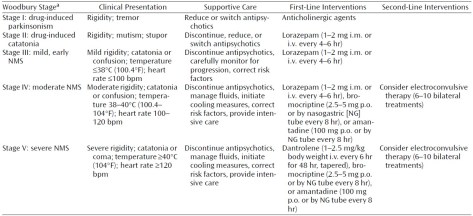
NMS can be a spectrum:

Woodbury

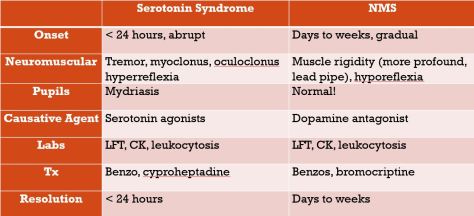
NMS can be confused with Serotonin Syndrome! Key to get a detailed medication history since SS is due to Serotonin, and NMS is due to Dopamine pathways! There are certain clues on the exam and presentation that can distinguish the two:

NMS SS


Thyroid storm! Or is it?… 8/28/18

Thanks Hong for presenting the case of a middle-aged woman with recent diagnosis of Grave’s disease off methimazole who presented with A fib with RVR and congestive heart failure, raising a debate on thyroid storm!


Clinical Pearls:

  • Thyroid storm is an extremely rare (1 in 500,000) but life-threatening diagnosis (up to 30% mortality) that should not be missed.
  • Degree of thyroid hormone elevation or TSH suppression is not a criteria for diagnosing thyroid storm! In fact, levels are typically similar to those of patients with uncomplicated thyrotoxicosis.
  • Common clinical feature is cardiovascular symptoms (heart failure, arrhythmia, tachycardia) but more specific finding is AMS.
  • Scoring criteria to screen for thyroid storm include Burch/Wartofsky and the Akamizu criteria, but they have not been validated.
  • Consult endocrine early if you suspect thyroid storm!

Thyroid storm: 

Risk factors:

  • Longstanding untreated hyperthyroidism
  • Precipitants:
    • Thyroid/non-thyroidal surgery
    • Trauma
    • Infection
    • Acute iodine load
    • Parturition
    • Irregular use or discontinuation of antithyroid treatment

Etiology: not clearly understood, but possibly related to the following

  • Rapid rate of increase in thyroid hormone levels?
  • Increased responsiveness to catecholamines?
  • Enhanced cellular responses to thyroid hormone?
  • The degree of thyroid hormone elevation or TSH suppression is not typically more profound than uncomplicated thyrotoxicosis

Clinical features:

  • CV (>60% of cases)
    • Tachycardia
    • CHF
    • Arrhythmias
  • Hyperpyrexia
  • AMS (considered by many to be essential to diagnosis)
    • Agitation, anxiety, delirium, psychosis, stupor, coma
  • Features associated with worse outcomes?
    • AMS
    • Older age >60
    • Mechanical ventilation
    • Not using antithyroid drugs or beta blockers

Diagnosis: 

  • Clinical! No universally accepted criteria or validated clinical tools.  Degree of hyperthyroidism is not a criterion for diagnosis.  Some to know of that might be helpful:
    • Burch and Wartofsky (sensitive, not specific)
      • > 45: highly suggestive of thyroid storm
      • 25 – 44: impending storm
      • <25: thyroid storm unlikely
    • Akamizu (Japanese) system developed in 2012 (less sensitive but more specific)

Treatment

  • ICU admission!
  • Regimen
    • Beta blockers ⇒ control symptoms from increased adrenergic tone
    • Thionamide ⇒ block new hormone synthesis. PTU is preferred because it blocks peripheral conversion of T4 to T3.
    • Iodine solution ⇒ block release of thyroid hormone (saturated solution of potassium iodide)
    • Iodinated radiocontrast agent (not available anymore in most places) ⇒  inhibit peripheral conversion of T4 to T3
    • Glucocorticoids ⇒ reduce T4 to T3 conversion, promote vasomotor stability, and treat any associated relative adrenal insufficiency
    • Bile acid sequestrants ⇒ decrease enterohepatic recycling of thyroid hormones (only in very severe cases)
  • Principles
    • Start with beta blockers + PTU, and stress dose steroids
    • 1 hour later: start SSKI q6h (after hormone synthesis has been halted with PTU, otherwise SSKI can make thyroid storm worse)

Suspiciously High Protein Gap… MM? 8/23/18

An elderly lady presented to the ED with what seems like orthostatic hypotension… Found to be anemic but otherwise no complaints. Her lab work incidentally revealed anemia, low anion gap, and grossly elevated protein gap (11.3), but otherwise nothing else! What’s going on?


Low Anion Gap:

  • Definition: Less than 3
  • Most common cause: Lab error!
  • Other causes: hypoalbuminemia, severe hyperchloremic metabolic acidosis, lithium intoxication, hyperklameia, hypercalcemia, hypermagnesemia…
  • Could also be a hint of presence of weird proteins!

Elevated Protein Gap:

  • Recall: Protein gap = Serum Protein – Serum Albumin, greater than 4 = elevated
  • Non-specific finding but can be caused by any processes that leads to an increase in non-albumin serum proteins, again could be a hint of presence of weird proteins??

Her peripheral blood smear revealed presence of Rouleaux, which is another hint of elevated levels of serum protein (but we already know that!). Hematology was consulted and the top differential at this point is some sort of gammopathy, with Waldenstrom’s Macroglobulinemia and Multiple Myeloma highest on the possibilities:

  MM Waldenstrom macroglobulinemia
Presentation Fatigue, anemia, Bsx, bone pain, rarely has hyperviscosity Fatigue, anemia, Bsx, neurologic sx (hyperviscosity, more common)
M-protein IgG, IgM is very very rare IgM
Bone-marrow >10% clonal plasma cells, CD56 positive Lymphoplasmacytic infiltration, CD 19, CD 20 positive. CD56 negative.

SPEP revealed monoclonal IgG spike, and bone marrow revealed > 60% plasmacytosis, hence pt has multiple myeloma!

Do not be tricked! If SPEP revealed polyclonal protein elevation, it could be due to a systemic inflammatory process or infection (Hep C, HIV for instance!)

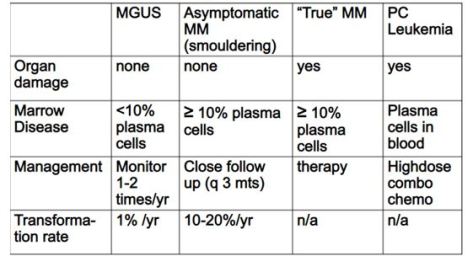
MM Spectrum


Multiple Myeloma

  • Diagnosis
    • SPEP/UPEP for immune proteins
    • Smar: > 50% Rouleaux formation, seen with elevated serum proteins
    • BM Bx: Looks at % of plasma cells in the marrow, also can do cytogenetics
    • Xrays: Lytic lesions (Bone Survey, not a bone scan)
    • Other: Cr, calcium, albumin, beta 2 microglobulin (levels help determine staging with prognostic differences)
    • > 60% plasma cells on BM has poor prognosis
    • UA picks up albumin, NOT light chains
    • Light chain: Normal kappa/Lambda FLC ratio is 0.26 – 1.65, MM would have one that’s grossly elevated
  • MM Presentation
    • Almost all pts will have M-protein spike
    • 73% with anemia, 66% with lytic bone lesions, 29% with renal insufficiency.
    • Fatigue and normocytic anemia are common findings, blood smear might reveal rouleaux.
    • Might cause pancytopenia
  • MM Types: based on the kind of abnrl protein
    • IgG: 55% of the time, followed by IgA (25%), least common is IgM (0.5%). 20% are light chains only, lacking expression of the immunoglobulin heavy chain.
    • Cytogenetics determine high risk vs standard risk myeloma
      • High risk = Del 17P, t(14; 16), t(14;20) on FISH
  • Management:
    • Smouldering: Watch
    • Active: treat
      • Chemo: 3 drug regimen preferred
        • VRd: Bortezomib, lenalidomide, dexamethasone
        • VCd/CyBorD: Bortezomib, cyclophosphamide, dexamethasone
        • VTd: Bortezomib, thalidomide, dex
      • Hematopoietic cell transplantation (HCT): High dose chemo followed by autologous HCT is standard of care if eligible.
      • US: case by case, but if pt meets one of the following, they are not eligible for transplant:
        • Age > 77
        • Cirrhosis
        • Poor performance status
        • NYHA 3-4

Encephalitis and CJD! – 8/22/18

Thanks to Joe for presenting the case of an elderly man presenting with subacute onset of AMS, vision changes, and ataxia, found to have creutzfeldt jakob disease (CJD).


Clinical Pearls

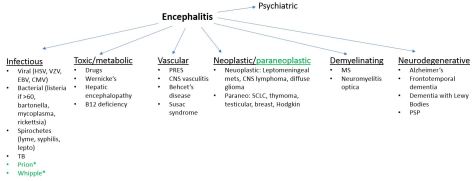
  • Rapidly progressive encephalitis should trigger prion disease, paraneoplastic encephalitis, or Whipple’s!
  • Most common malignancies associated with paraneoplastic encephalitis are SCLC, testicular tumors, thymomas, breast cancer, and hodgkin lymphoma
  • >90% of cases of CJD are sporadic
  • Definitive diagnosis of CJD is made by brain biopsy.  CSF testing of 14-3-3 protein marker and the RT-QuIC protein assay combined have sensitivity and specificity >90%.
  • If prion diseases are on your differential, be sure to let infection control know before doing an LP because strict precautions are required to prevent spread of infection!

Encephalitis:

Defined as AMS > 24 hours plus 2 of the following:

  1. Fever
  2. Focal neurologic deficit
  3. Seizure
  4. CSF pleocytosis
  5. Abnormal findings on EEG or neuroimaging

Differential

Capture

Prion diseases:

  • AKA transmissible spongiform encephalopathies
  • Rare, closely related, fatal, neurodegenerative conditions
  • Occur in humans and mammals
  • Result of accumulation of aggregated forms of the prion protein in the CNS
  • >90% are sporadic, the rest are infectious (kuru, variant CJD, and iatrogenic CJD)
    • Iatrogenic mostly resulting from receipt of growth hormone prepared from cadaveric pituitaries and contaminated cadaveric dura mater allografts
    • Sporadic is not transmissible by blood
  • Kuru was the first one recognized to be transmissible and linked to cannibalism among tribes in New Guinea

CJD: 

  • Most prominent clinical feature is disordered cognition
  • Typically, patients also have motor signs, such as ataxia or spasticity, vague sensory problems, or changes in visual perception
  • Myoclonus is common
  • Progressive neurologic decline resulting in death within 6-12 months
  • One in a million
  • Mean age of onset 57 – 62
  • More common in white people (may be ascertainment bias)

Diagnosis:

  • Elevated CSF levels of 14-3-3 are not very sensitive or specific.  Adding RT-QuIC protein assay to the test increases both sensitivity and specificity to >90%.
  • CDC requires the following criteria for diagnosis:
    • Progressive dementia AND
    • 2 of the following: myoclonus, visual or cerebellar disturbance, pyramidal/extrapyramidal dysfunction, akinetic mutism AND
    • Atypical EEG and/or positive 14-3-3 CSF assay  with clinical duration to death <2 years and or typical MRI abnormalities (see nice example here)

Prognosis:

  • Poor, majority die within 1 year
  • No treatment available