Tag Archives: Neurology

Cardiac arrest & anoxic brain injury

Today we discussed the case of a young man with Duchenne’s Muscular Dystrophy complicated by chronic respiratory failure and dilate cardiomyopathy who was found down at home in asystolic arrest.  Though ROSC was achieved en route to the hospital, patient suffered significant sequelae of anoxic brain injury.


Clinical Pearls

  • Most common causes of out-of-hospital cardiac arrests are
    • Acute MI
    • Cardiomyopathy
    • Primary arrhythmia
  • Most immediate threat to survival post cardiac arrest is cardiovascular collapse.
  • Most common cause of death in out-of-hospital cardiac arrests is neurologic injury.
  • Post cardiac arrest hemodynamic targets
    • SpO2 > 40%
    • PaCO2 > 40
    • MAP >65 (preferably 80-100 mmHg)
  • Read below for more info on the ongoing battle between therapeutic hypothermia (TH) and targeted temperature management (TTM) to reduce brain injury.

Post cardiac arrest management

Goals

  • Determining and treating cause of arrest
  • Minimizing brain injury
  • Managing cardiovascular dysfunction
  • Managing problems that arise from global ischemia and reperfusion injury

Most immediate threat to survival post ROSC is cardiovascular collapse.

  • Correct hypotension to maintain end-organ perfusion
  • Optimize oxygenation and ventilation
  • Correct electrolyte abnormalities

Determining cause and extent of injury:

  • Focused history
  • Exam:
    • Remember ABCs
    • Baseline neurologic exam
      • Make sure patient is off sedation or neuromuscular blocking agents
      • Brainstem reflexes:
        • Pupillary
        • Corneal
        • Oculocephalic
        • Gag
        • Cough
      • GCS ⇒ with special attention to motor score as it correlates with neurologic recovery
    • Work up
      • Causes
        • Most common are acute MI, cardiomyopathy, and primary arrhythmia ⇒ check ECG!
        • Labs
          • ABG
          • Basic electrolytes and liver function studies
          • CBC
          • Troponin q8-12 hours for 24 hours
          • Trend lactate
          • Toxicology studies
        • Management
          • Ventilator:
            • Target SpO2 >94% and PaCO2 > 40
              • Avoid hyperventilation because it leads to cerebral vasoconstriction and worsening cerebral perfusion
              • Avoid hyperoxia ⇒ a systematic review of 14 observational studies found that those with PaO2>300 mmHg had a higher in-patient mortality following cardiac arrest
          • Hemodynamics
            • Keep MAP >65 mmHg and preferably 80-100 mmHg to optimize cerebral perfusion
            • Prevent arrhythmia with meds only if patient has recurrent or ongoing unstable arrhythmia. No data on routine prophylactic use of these agents in other patients.
            • Coronary revascularization if indicated
          • Decrease brain injury
            • Targeted temperature management (TTM) and therapeutic hypothermia (TH)
              • Rationale
                • Neurologic injury is the most common cause of death in patients with out-of-hospital cardiac arrest
              • Indications
                • Anyone not following commands or showing purposeful movements following resuscitation from cardiac arrest
              • Contraindication
                • Active non-compressible bleeding
                • TH is associated with higher risk of bleeding in patients undergoing coronary cath or those who received thrombolytics
              • Timing
                • To be achieved as soon as possible and maintained for at least 48 hours
                  • Rate of good functional outcome is higher with 48 hours rather than 24
                • Avoid fever at all costs in the first 48 hours
              • Goal temperature
                • This is an area of much debate amongst neurologists and intensivists.  There are two main goal temperatures:
                  • 33ºC (TH)
                    • The studies in support of cooling to a temperature of 33 come from two landmark NEJM papers published back in 2002 (HACA and OHCA) which found that mild to moderate hypothermia improved neurologic outcomes post cardiac arrest.  The caveats were that all these patients had VF/VT arrest (not PEA/asystole), no baseline brainstem function was reported before randomization, and the sample sizes were small. Based on these findings, TH is recommended for anyone with the following:
                      • Deep coma (loss of motor response or brainstem reflexes)
                      • Malignant EEG patterns
                      • Early CT changes suggesting development of cerebral edema
                    • Adverse effects:
                      • Increased rates of infection
                      • Coagulopathy and bleeding
                      • Cold diuresis
                      • Bradycardia and QT prolongation induced cardiac arrhythmias
                  • 36ºC (TTM)
                    • The TTM trial published in 2012 is the largest study on the topic that randomized 939 patients with out-of-hospital cardiac arrests to 33 or 36 degrees temp regulation and found no difference in all cause mortality or neurologic recovery between the two groups.  They included all patients regardless of type of arrest (VF/VT/asystole/PEA).  In subgroup analyses, they found no difference in outcomes based on type of initial rhythm, shock on presentation, age, gender, or time from cardiac arrest to ROSC.
                • So what to do?
                  • General consensus seems to be that avoiding fever at all cost in the first 48 hours is the most important intervention.  Beyond that, keeping patients at 36 might be better as further cooling is associated with risks and no clear indication of benefit based on our best available evidence.
            • General critical care
              • Elevate HOB to 30 degrees
              • Stress ulcer ppx
              • DVT ppx
              • Early PT/OT
              • Seizures and myoclonic jerks
                • Common and a marker of more severe brain injury
                • Continuous EEG recommended if available
                • No benefit in prophylactic treatment

Anoxic brain injury

Nomenclature

  • Brain death: irreversible cessation of cerebral and brainstem function
  • Persistent vegetative state: subgroup that suffers from severe anoxic brain injury and progresses to a state of wakefulness without awareness
  • Minimally conscious state: can have some purposeful movements or interactions with the environment.

Clinical parameters associated with an unfavorable prognosis

Clinical parameters Unfavorable prognosis
Duration of anoxia >8-10 minutes
Duration of CPR >30 minutes
Pupillary light reaction Absent on day 3
Motor response to pain Absent on day 3
Brainstem reflexes Absent
Blood glucose on admission >300 mg/dL
Glascow coma score on day 3 <5
Table above adapted from UpToDate

Work up:

  • Somatosensory evoked potentials (SSEPs): absent response at 24-72 hours appears to be most useful in identifying those with poor prognosis
  • EEG: can be affected by sedative drugs, metabolic derangements, and sepsis so careful with interpreting its findings!
  • Lab test for neuron-specific enolase (NSE)
    • Markedly elevated levels are associated with poor outcomes but no clear cut-off established
  • Imaging:
    • CT/MRI: look for edema and inversion of gray-white densities associated with poor outcome.
Gradenigo Syndrome

Thanks to Amit for presenting the fascinating case of a middle-aged woman with history of DM2 who presented with subacute onset of unilateral periorbital pain, L CN 6 palsy, and L otorrhea, with MRI findings of petrous apicitis consistent with the super rare Gradenigo syndrome!


Clinical Pearls

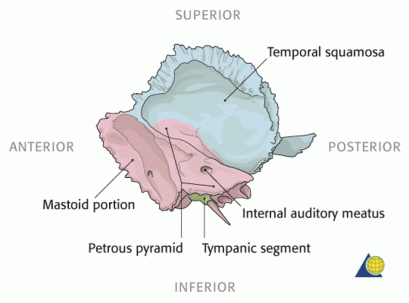
  • Gradenigo syndrome is a rare and life threatening complication of otitis media and involves inflammation of the medial aspect of the temporal bone, specifically the apex of the petrous bone (a pyramid shaped bone jutting medially from the temporal bone)
  • Gradenigo is clinically characterized by a triad of otorrhea, diplopia (due to CN6 palsy), and hemifacial pain (CN5 palsy).
  • This is a very rare complication since most cases of otitis media are treated with antibiotics early on.
  • Remember that a common cause of an isolated CN 6 palsy in a diabetic patient is diabetic neuropathy/ophthalmoplegia.  A patient who has more cranial nerves affected than CN6 alone, you should be concerned about cavernous sinus thrombosis.

Gradenigo syndrome:

  • First described in 1904 by Guiseppe Gradenigo.

    Petrous pyramid
    Source: AO Surgery Reference
  • A rare and potentially life threatening complication of otitis media involving the inflammation of the apex of petrous pyramid (medial aspect of temporal bone). Occurs any time between 1 week to 3 months after acute otitis media (AOM) and up to 3 years after chronic suppurative otitis media (CSOM).
    • Should suspect this syndrome any time there is CN 6 palsy in the setting of otitis media, whether acute or chronic
  • Clinically, Gradenigo syndrome is characterized by triad of ear discharge, diplopia, and hemifacial pain
    • Suppurative otitis media (ear discharge and pain)
    • Trigeminal neuralgia involvement causes pain in the distribution of the nerve manifested as hemicranial headache and hemi-facial pain
    • Abducens nerve involvement causes ipsilateral lateral rectus palsy and lateral gaze palsy
  • Infection spread from suppurative otitis media to the petrous apex may be via pneumatized air cell tracts, through vascular channels, or as a result of direct extension through fascial planes
  • Organisms are not well studied but the most common one appears to be pseudomonas.  Staph, strep, pneumococcus, and TB have also been reported.
  • If left untreated, it can result in serious complications such as meningitis, intra-cranial abscess, sinus thrombosis
  • Treatment
    • Broad spectrum antibiotics IV for up to 6 weeks (to treat a presumed temporal bone osteomyelitis)
    • Fluoroquinolone ear drops
    • Tight glucose control
  • Differential diagnoses to consider:
    • Cavernous sinus thrombosis
      • Headache
      • cavernous sinus thrombosis
        Source: UpToDate

        Papilledema

      • CN palsies (see picture of what runs through cavernous sinus)
    • Ophthalmoplegic migraine:
      • Rare condition, often manifests in children and young adults
      • Diagnosis of exclusion
      • Most commonly affects CN3 (but can go to CN4 and CN6 as well)
      • Can sometimes precede the headache
      • Review article here
    • Diabetic ophthalmoplegia
      • Common cause of isolated CN6 palsy
    • Neoplasms
      • Nasopharyngeal cancer
      • Plasmacytoma
      • Pituitary adenoma
      • CN6 neuroma
      • Skull base tumors
      • Sohenoid sinus tumors
      • Squamous cell
    • Stroke
    • Demyelinating diseases
    • Vasculitis
    • Idiopathic intracranial hypertension

Complications of acute otitis media

  • Intratemporal
    • Tympanic membrane rupture (leads to hearing loss and pain relief!)
    • Labrynthitis (nausea, vomiting, tinnitus, vertigo)
    • Mastoiditis
    • CN palsies (including Gradenigo syndrome)
  • Extratemporal
    • Epidural, subdural, and brain abscesses
    • Skull base osteo
    • Otitic hydrocephalus (without meningitis or brain abscess)
    • Otitic meningitis
    • Lateral sinus thrombosis

Stroke from CNS TB induced vasculitis!

Thanks to Katie for presenting the interesting case of a young man with history of disseminated TB with TB meningitis and hydrocephalus requiring VP shunts, admitted for acute LUE weakness, L homonymous hemianopsia, and memory impairment, found to have acute strokes in multiple vascular territories due to TB related CNS vasculitis!


Clinical Pearls

  • Remember that arterial dissection is the most common cause of stroke in a young patient.
  • CNS vasculitis can be primary or secondary to a systemic illness.  It typically presents with infarcts in multiple vascular territories.  Treatment involves immunosuppression with high dose steroids + cytoxan/rituxan.
  • CNS vasculitis is the most common cause of severe neurologic deficit in patients with TB meningitis.
  • Vasculitis in CNS TB is the result of a hypersensitivity reaction to proteins released from the bacteria.
  • TB meningitis requires an extended course of anti-TB treatment, generally up to 1 year or more.  Serial LPs are obtained to monitor adequate response to therapy.

Etiologies of stroke in a young adult

CNS TB:

Three main manifestations:

  1. TB meningitis (most common presentation in low incidence settings like the US)
  2. Intracranial tuberculoma
  3. Spinal tuberculous arachnoiditis

Spillage of tubercular protein into the subarachnoid space results in an intense hypersensitivity reaction and inflammation resulting in

  • Proliferative arachnoiditis (fibrous mass encasing cranial nerves and vessels adjacent to it)
  • Vasculitis with resultant aneurysm, thrombosis, and infarction
  • Communicating hydrocephalus 

TB Meningitis

  • 1% of all TB cases, 5% of all extrapulmonary TB cases
  • 15-40% mortality rate
  • Clinical manifestations
    • 3 stages:
      • Prodromal phase: malaise, headache, low grade fever, personality changes
      • Meningitic phase: meningismus, headache, vomiting, lethargy, confusion, CNS signs, some motor deficits
      • Paralytic phase: stupor, coma, seizures, hemiparesis (death within 5-8 weeks)
  • Diagnosis:
    • Characteristic CSF findings of low glucose, elevated protein, lymphocytic pleocytosis 
    • CSF AFB smear and culture: in general, a minimum of 3 serial LPs should be performed, as diagnostic yield increases f
    • Nucleic acid tests: Xpert MTB/RIF assay should be submitted in the setting of high clinical suspicion and negative AFB staining.
  • Treatment
    • Intensive phase (2 months): four drugs RIPE. Ethambutol has poor CNS penetration so some use fluoroquinolones instead.
    • Continuation phase (7-10 months)
    • Steroids
      • A review of 9 trials on 1337 patients found that use of steroids reduced death and disability by ~25%.
      • Benefit higher if started earlier in disease process.
      • Treat for 8 weeks, slow taper.
    • Stroke
      • A retrospective study in Stroke 2018 on patients with TB meningitis found that those >40, with concurrent HTN, dysplipidemia, and DM were more likely to have this complication. Some small case series showing benefit in reducing future strokes with the use of Aspirin.
      • No role for tPA.


Septic dural sinus thrombosis – 10/29/18

Thanks to Arathi for presenting the case of a middle-aged man with poorly controlled diabetes who presented with blurry vision and ear pain, found to have multiple cranial nerve palsies, diagnosed with skull base osteo, septic dural sinus thrombosis, and orbital cellulitis!


Clinical Pearls

  • Septic thrombophlebitis is venous thrombosis with inflammation in the setting of bacteremia and can impact any vein.  Most common cause of this condition in the hospitalized patient is indwelling lines and catheters.
    • Septic thrombophlebitis of the jugular vein is called Lemierre’s syndrome and is frequently preceded by pharyngitis.
  • Septic dural sinus thrombosis is extremely rare (only several hundred cases diagnosed in recent history).  The most common presenting symptom is headache.  There are three types:
    1. Cavernous sinus thrombosis
    2. Lateral (transverse) sinus thrombosis (rare)
    3. Superior sagittal sinus thrombosis (very rare)
  • Cavernous sinus thrombosis can present with CN III, IV, V1, V2, VI palsies.  Of these, CN VI is the first one to get affected.  So for patients presenting with lateral gaze palsy and headache, think cavernous sinus thrombosis!
  • The mainstay of treatment for septic dural sinus thrombosis is antibiotics.  Most common organism involved is staph aureus.
    • The role of anticoagulation is controversial.  The few retrospective studies done have shown a potential reduction in mortality/morbidity without a significant increase in risk of ICH.  Common practice currently is to start anticoagulation with heparin early on especially in patients with unilateral symptoms.

Septic dural sinus thrombosis

  • Uncommon disease with only several hundred cases reported in the antibiotic era. So you might only see one in your whole career!
  • Difficult to diagnose and often diagnosis and treatment are delayed.
  • Encompasses three basic syndromes: manifestations of each are unique
    1. Cavernous sinus thrombosis
    2. Lateral sinus thrombosis
    3. Superior sagittal sinus thrombosis
  • All three manifest as severe headaches which are often the presenting symptom.

Septic cavernous sinus thrombosis

  • Most common. Lots of trabeculae to trap bacteria.
  • Clinical manifestations
    • Headache and cranial nerve palsies should raise your suspicion!
    • Fever, periorbital edema. Pain is usually unilateral, retroorbital and frontal in nature with radiation to the occiput.
    • Diplopia
    • Altered mental status especially in older people
    • Less common: photophobia, tearing, and ptosis
  • Exam:
    • Fever
    • B/l ptosis, proptosis, chemosis, and ocular muscle paralysis but can be subtle
    • Fundoscopic exam with papilledema
    • Ophthalmoplegia
      • Lateral gaze palsy (isolated CN VI) is the first manifestation because of the location of the nerve in the cavernous sinus.
    • Loss of visual acuity from papilledema
    • Compression of optic nerve by mycotic aneurysm of the intercavernous segment of the internal carotid/ophthalmic artery can lead to blindness.
  • Labs:
    • CSF can show inflammatory cells in 75% of cases.
    • Micro
      • Staph aureus is the most common (70%) followed by strep and anaerobes.
    • Imaging:
      • CT venogram or MR venogram
    • Treatment
      • Antibiotics: IV and prolonged for at least 3 weeks b/c thrombus may prevent abx penetration
      • Anticoagulation: No prospective data. One retrospective study showed a significant reduction in mortality in patients with unilateral involvement who presented early and received heparin. A second showed no change in mortality but decreased morbidity.  No increased risk of ICH.  Based on these small studies, experts suggest heparin early on in patients with unilateral CST.  Duration of anticoagulation is at the discretion of the clinician (no data).
      • Surgery: Drainage of sinus infection if present, otherwise no benefit.
      • No role for steroids
  • Outcomes
    • Mortality is 30%
    • Infection can spread to meninges and the pituitary and morbidity can reach 50%.
    • 30% suffer serious sequelae:
      • Persistent oculomotor weakness
      • Blindness
      • Hemiparesis
      • Pituitary insufficiency

Septic lateral sinus thrombosis

  • Rare due to early treatment of otitis media. Generally results from untreated OM à mastoiditis à lateral sinus thrombosis.
  • Earache is generally the first symptom for several weeks

Septic superior sagittal sinus thrombosis

  • Extremely rare
  • Usually due to bacterial meningitis
  • Complete thrombosis is universally fatal.

Differential for cavernous sinus obstruction:

  • Infectious
    • fungal
    • TB
    • septic thrombosis
    • intra-orbital abscess
  • autoimmune/rheum
    • Tolosa-Hunt syndrome (granulomatous inflammation of the superior orbital vein and cavernous sinus)
    • Polyarteritis nodosa (Cogan syndrome)
    • sarcoid
    • IgG4 dz
    • GPA
  • malignant
    • Lymphoma
    • Nasopharyngeal tumor
  • Vascular
    • Thrombus

Skull base osteomyelitis:

  • Frequently seen in elderly patients with poorly controlled diabetes or immunocompromise
  • Most commonly a complication of malignant otitis externa.
  • Results in multiple cranial nerve palsies VII through XII due to involvement of the stylomastoid, jugular, and hypoglossal foramens.
  • Treatment requires antibiotics for at least 4-6 weeks.

Lymphocytic hypophysitis – 10/3/18

Thanks to Sahar for presenting the interesting case of a middle-aged woman with metastatic melanoma recently started on ipilimumab who presented with a headache and fatigue, found to have hypothyroidism and adrenal insufficiency with work up consistent with hypopituitarism related to an adverse effect of ipilimumab: lymphocytic hypophysitis!


Clinical Pearls

  • Remember that adrenal insufficiency and hypothyroidism are causes of elevated ADH levels.
  • Red flags for obtaining head imaging for headache include age >55, sudden onset, positional, onset after trauma or exercise, fever, focal neuro findings, and immunosuppression.
  • Pituitary adenomas can have three manifestations: mass effect, hormonal hypersecretion, and hypopituitarism.  When imaging shows a pituitary mass, your work up should address each of these categories.
  • The most sensitive test to assess hypothalamic-pituitary access function is LH/FSH!
  • Immunotherapies are commonly associated with a flare of autoimmune diseases.  A more rare side effect of CTLA-4 inhibitors (like ipilimumab) is lymphocytic hypophysitis (inflammation of the pituitary gland)
    • This condition commonly presents with headache out of proportion to neurologic findings and preferential decline in ACTH and TSH though other hormones can also be impacted.
  • For hypopituitarism, remember to always treat adrenal insufficiency first before replacing thyroid hormone.  Failure to do so can precipitate adrenal crisis!

Indications for imaging a patient with headache:

  • Age >55
  • Sudden onset
  • Worse with lying down or wakes patient from sleep
  • Rapid onset after trauma or exercise
  • Fever
  • Focal neurologic findings
  • New headache in immunosuppressed patient

Pituitary adenoma:

  • Evaluate for the following
    • Mass effect: visual field deficit, headache
    • Hormonal hypersecretion
      • Prolactin ⇒ galactorrhea, amenorrhea, infertility
      • GH ⇒ Acromegaly
      • TSH ⇒ hyperthyroidism
      • ACTH ⇒ Cushing disease
      • ADH ⇒ SIADH
    • Hyposecretion:

Capture

Hypophysitis:

  • Inflammation of the pituitary
  • Four categories based on histologic findings:
    • Lymphocytic
      • Most common form
      • Seen in late pregnancy and post-partum period
      • Also associated with ipilimumab as our patient here!
    • Granulomatous
      • Idiopathic or secondary to GPA, sarcoid, TB
    • Plasmacytic (IgG4-related)
    • Xanthomatous (most rare)
  • Clinical presentation
    • Headache out of proportion to exam findings
    • Preferential decrease in ACTH and TSH ⇒ adrenal insufficiency and hypothyroidism
  • Prognosis:
    • Pituitary size eventually normalizes but pituitary loss of function is often permanent.

Hyponatremia:

Lastly, refer to this algorithm from our recent morning report to help you think through hyponatremia.

Wound botulism – 9/26/18

Thanks to Alison for presenting the case of a middle aged man who presented with acute onset of ptosis, dysphagia, and dysarthria, with an evolving exam found to have botulism secondary to IV injection of black tar heroin.


Clinical Pearls

  • Botulism is extremely rare! Only 110 cases were reported last year in the US with 70-75% of them being related to infant botulism, 20-25% foodborne, and 5-10% wound botulism.  The latter category has been on the rise especially in California.
  • Most common form of botulism is infant botulism
  • Botulism presents with bulbar symptoms; progressive, descending paralysis; absent reflexes; and autonomic dysfunction
  • Management involves the following
    • Notify the Department of Public Health ASAP if botulism is on your ddx
    • Obtain wound/blood cultures (special tube to be sent to DPH)
    • Administer antitoxin EARLY (do NOT wait for culture confirmation)

Capture

For more information, check this prior post on our blog.

Ophthalmoplegic migraine – 9/25/18

Thanks to Joe fore presenting the case of a middle aged woman with a history of migraines who presented with acute onset of painless binocular diplopia, found to have an isolated CN3 palsy concerning for ophthalmoplegic migraine after an extensive work up.


Clinical Pearls:

  • Types of diplopia:
    • Binocular diplopia refers to diplopia that is only present when both eyes are open (goes away when one eye is closed) and results from ocular misalignment.
    • Monocular diplopia refers to diplopia that is present even when one eye is closed and is more consistent with a local eye disease (globe related processes involving the cornea or the lens).
  • Approach to diplopia is similar to any neurologic deficit in which you would localize the lesion!
    • Upper motor neuron (brain)
    • Peripheral nerve (cranial nerves)
    • Neuromuscular junction
    • Muscle (extra-ocular muscles)
    • Globe (local eye disease or refractive error)
  • CN3 palsy usually presents with the eye in the “down and out” position and can also impact the levator palpebrae muscle resulting in ptosis.  These result from ischemia at the center of the nerve (secondary to diabetes/HTN).
    • In a patient with CN3 and a dilated pupil, you must rule out a PCA aneurysm!  Impingement of the CN3 by an enlarging aneurysm cuts off the parasympathetic fibers running on the outside of the nerve, resulting in a dilated pupil.  This is the only aneurysm that gives a warning sign before rupture!

Commonly tested gaze palsies:

Capture

Ophthalmoplegic migraine:

  • Rare condition, often manifests in children and young adults
  • Diagnosis of exclusion
  • Most commonly affects CN3 (but can go to CN4 and CN6 as well)
  • Can sometimes precede the headache
  • Permanent nerve damage has been reported and some believe that it is a demyelinating neuropathy (for more info, refer to this review article)


Mute and Unresponsive… 8/29/2018

Today Elise presented a case of a middle age woman, with a history of schizoaffective disorder and recent psych med changes, who came in unresponsive and mute. She was hypertensive and catatonic on exam but afebrile. Labs revealed moderately elevated CK. She responded well to IV Ativan. The final diagnosis was drug-induced catatonia!

Catatonia

  • Features:
    • Hypokinesis or akinesis
    • Excessive purposeless movements
    • Mutism
    • Decreased alertness/response to stimuli
    • Negativism (resistant to all instructions, commands)
    • Posturing
    • Fixed stare
    • Echolalia (repetition of another person’s words) or echopraxia (repetition of another’s actions)
    • Subtypes
      • Retarded Catatonia:
        • Mainly negativism, hypokinesis, mutism, staring.
        • +/- anorexia, incontinence, stupor
      • Excited catatonia:
        • Hyperkinesis, restlessness, impulsivity, aggression
      • Malignant catatonia
        • Life threatening: Fever, autonomic instability (labile BP, tachycardia, tachypnea, diaphoresis), delirium, rigidity.
        • Labs: Leukocytosis, elevated CK
        • Thought to be a spectrum of NMS
      • Management:
        • Withdrawal of offending medication if suspecting drug-related
        • Initial treatment: Benzos, if pt improves with the “benzo challenge,” then this supports the dx of catatonia.
        • Electro-convulsive therapy is an option.

NMS

  • Tetrad:
    • Encephalopathy
    • Muscular rigidity (lead pipe)
    • Hyperthermia
    • Autonomic instability
  • Associated with antipsychotics exposure, even some anti-emetics.
  • Can present days to weeks after exposure.
  • Management: DC offending agent, benzos, bromocriptine, supportive measures

NMS vs Catatonia

NMS can be a spectrum:

Woodbury

NMS can be confused with Serotonin Syndrome! Key to get a detailed medication history since SS is due to Serotonin, and NMS is due to Dopamine pathways! There are certain clues on the exam and presentation that can distinguish the two:

NMS SS


Encephalitis and CJD! – 8/22/18

Thanks to Joe for presenting the case of an elderly man presenting with subacute onset of AMS, vision changes, and ataxia, found to have creutzfeldt jakob disease (CJD).


Clinical Pearls

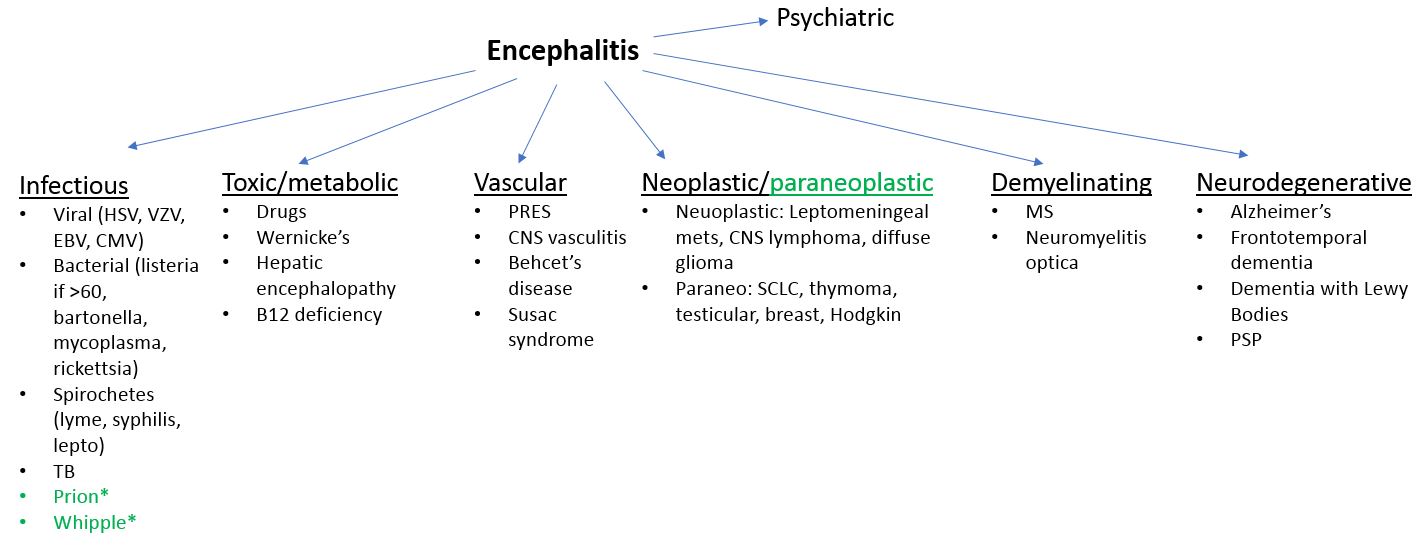
  • Rapidly progressive encephalitis should trigger prion disease, paraneoplastic encephalitis, or Whipple’s!
  • Most common malignancies associated with paraneoplastic encephalitis are SCLC, testicular tumors, thymomas, breast cancer, and hodgkin lymphoma
  • >90% of cases of CJD are sporadic
  • Definitive diagnosis of CJD is made by brain biopsy.  CSF testing of 14-3-3 protein marker and the RT-QuIC protein assay combined have sensitivity and specificity >90%.
  • If prion diseases are on your differential, be sure to let infection control know before doing an LP because strict precautions are required to prevent spread of infection!

Encephalitis:

Defined as AMS > 24 hours plus 2 of the following:

  1. Fever
  2. Focal neurologic deficit
  3. Seizure
  4. CSF pleocytosis
  5. Abnormal findings on EEG or neuroimaging

Differential

Capture

Prion diseases:

  • AKA transmissible spongiform encephalopathies
  • Rare, closely related, fatal, neurodegenerative conditions
  • Occur in humans and mammals
  • Result of accumulation of aggregated forms of the prion protein in the CNS
  • >90% are sporadic, the rest are infectious (kuru, variant CJD, and iatrogenic CJD)
    • Iatrogenic mostly resulting from receipt of growth hormone prepared from cadaveric pituitaries and contaminated cadaveric dura mater allografts
    • Sporadic is not transmissible by blood
  • Kuru was the first one recognized to be transmissible and linked to cannibalism among tribes in New Guinea

CJD: 

  • Most prominent clinical feature is disordered cognition
  • Typically, patients also have motor signs, such as ataxia or spasticity, vague sensory problems, or changes in visual perception
  • Myoclonus is common
  • Progressive neurologic decline resulting in death within 6-12 months
  • One in a million
  • Mean age of onset 57 – 62
  • More common in white people (may be ascertainment bias)

Diagnosis:

  • Elevated CSF levels of 14-3-3 are not very sensitive or specific.  Adding RT-QuIC protein assay to the test increases both sensitivity and specificity to >90%.
  • CDC requires the following criteria for diagnosis:
    • Progressive dementia AND
    • 2 of the following: myoclonus, visual or cerebellar disturbance, pyramidal/extrapyramidal dysfunction, akinetic mutism AND
    • Atypical EEG and/or positive 14-3-3 CSF assay  with clinical duration to death <2 years and or typical MRI abnormalities (see nice example here)

Prognosis:

  • Poor, majority die within 1 year
  • No treatment available

Paradoxical stroke in patient with ASD – 7/9/18

Today, Joe presented the case of a young woman presenting with acute onset of L sided weakness, found to have a paradoxical stroke due to ASD!


Clinical Pearls

  • Paradoxical stroke is a diagnosis of exclusion
  • Atrial septal defects (ASDs) have been associated with cryptogenic stroke (stroke of unknown etiology).  An embolic source is often not identified.
  • Ostium secundum is the most common type of ASD (>70% of cases)
  • Indications for ASD closure include the following
    • Symptomatic patient (DOE, platypnea-orthodeoxia)
    • R sided cardiac chamber enlargement
    • Left to right shunt >1.7:1
    • Before pacemaker or device placement
    • After a stroke
  • What about PFOs and cryptogenic stroke?
    • In the past, the recommendation was not to close them.  However, the 2017 CLOSE and REDUCE trials (as well as the 2013 RESPECT trial) showed that closure of PFO reduces the risk of a second stroke compared with medical therapy alone.  Thus, the latest ACC recommendation is to close PFOs after stroke!

Etiologies of stroke in a young adult:

  1. Hypercoagulable state
    • Inherited disorders
      • Protein C/S deficiency
      • Factor V Leiden
      • Prothrombin 20210 mutation
      • High homocysteine levels
      • Sickle Cell Disease
    • Acquired disorders
      • Pregnancy
      • OCPs
      • Estrogen hormone replacement therapy
      • Malignancy
      • APLS
      • DIC
  2. Vasculopathy
    • Noninflammatory
      • Dissection
      • Trauma
      • Connective Tissue Disease
      • Fibromuscular dysplasia
      • Migraine with aura
    • Inflammatory
      • Vasculitis
        • Large vessel: Takayasu, GCA
        • Small to medium: Kawasaki, PAN
      • Secondary vasculitis
        • Bacterial meningitis
        • HIV
        • Varicella
        • Syphilis
        • TB
        • Fungi (esp cocci)
    • Malformations
      • AVMs –> hemorrhagic
      • Aneurysms –> hemorrhagic
    • Venous
      • Cerebral venous sinus thrombosis
    • Other
      • Moyamoya
  3. Metabolic
    • Vessel injury
      • CADASIL (cerebral autosomal dominant arteriopathy with subcortical infarcts and leukoencephalopathy)
      • Fabry
      • Homocystinuria
    • Pure metabolic
      • MELAS (mitochondrial encephalomyopathy with lactic acidosis and stroke-like episodes)
      • Organic acid disorders
  4. Drugs
    • Cocaine
    • Meth
  5. Cardiac
    • Congenital
    • Rheumatic valve disease
    • Mitral Valve Prolapse
    • PFO
    • ASD
    • Endocarditis with septic emboli
    • Atrial myxomas
    • Fibroelastoma
    • Arrhythmias
    • Cardiac surgery

Atrial Septal Defects

  • Secundum is seen in 75% of cases
  • Exam findings:
    • Fixed split S2
    • Parasternal impulse
    • Mid-systolic mumur at LSB (can be mid-diastolic also)
    • EKG with RV strain and partial RBBB
  • Indications for closure:
    • After stroke
    • Symptomatic patient
      • DOE
      • Platypnea-orthodeoxia syndrome
    • R sided cardiac chamber enlargement
    • L to R shunt > 1.7:1 (based on TTE findings)
    • Before pacemaker/device placement